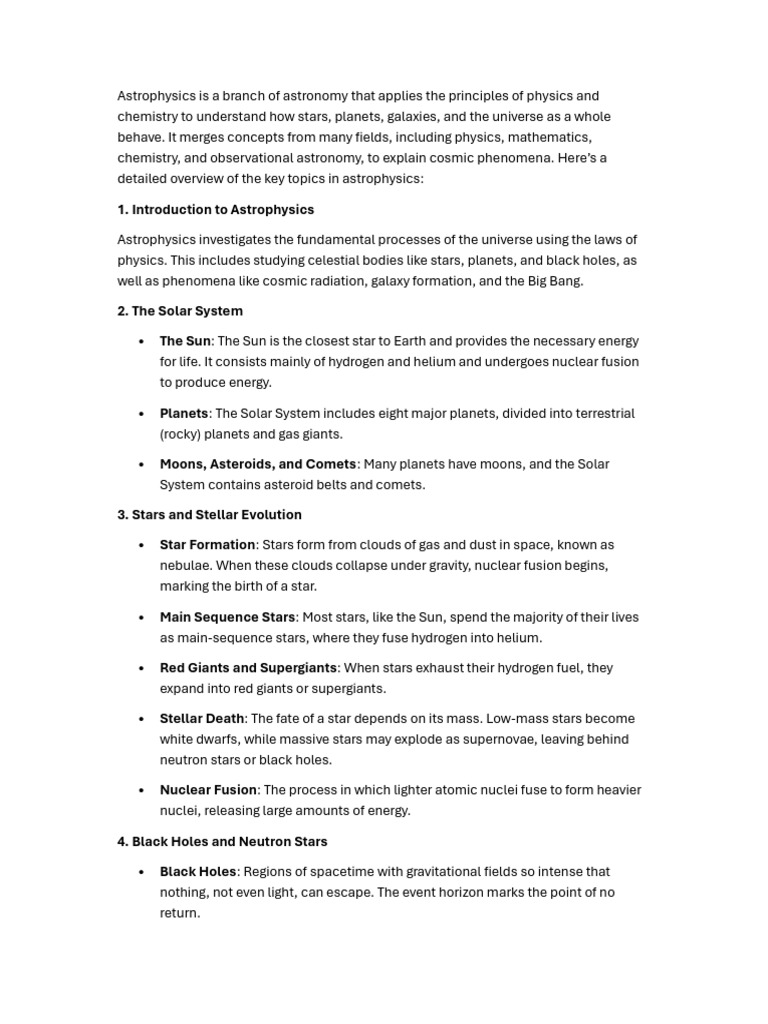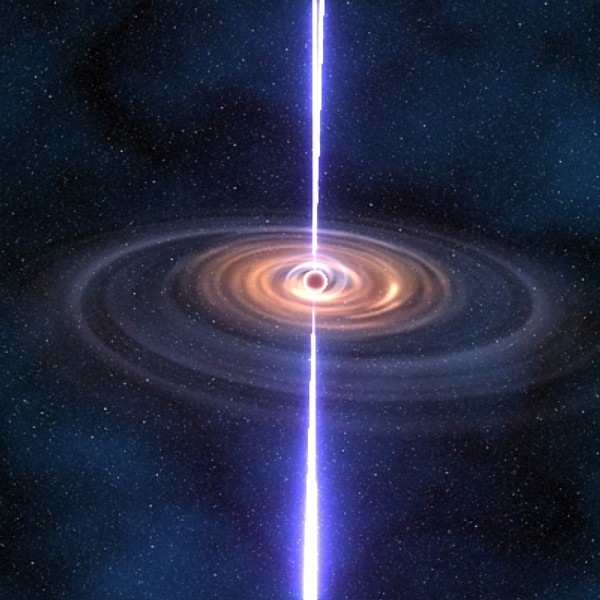
What If Dark Energy Fell Into a Black Hole?

Definition of Dark Energy and Black Holes Dark energy is a mysterious and pervasive force that fills the universe, driving its accelerated expansion. It stands as one of the most perplexing subjects in contemporary cosmology, defying conventional gravitational theories and prompting a reevaluation of fundamental physics. Black holes, in contrast, are regions of spacetime exhibiting […]

Read More →

What Causes Gravitational Waves in Space?

Definition of Gravitational Waves Gravitational waves are ripples in the fabric of spacetime caused by the acceleration of massive objects. These disturbances travel outward at the speed of light, carrying energy across the cosmos. Predicted by Albert Einstein’s General Theory of Relativity over a century ago, gravitational waves represent a dynamic aspect of the universe, […]

Read More →

Can You Study Astrophysics and AI Together?

Definition The combined study of astrophysics and artificial intelligence (AI) represents a cutting-edge interdisciplinary field that merges the exploration of cosmic phenomena with advanced computational techniques. Astrophysics is the branch of science focused on understanding the physical properties and behaviors of celestial bodies and the universe at large. Artificial intelligence, on the other hand, involves […]

Read More →

The Shape of Dark Matter Halos Explained Simply

Definition of Dark Matter Halos Dark matter halos are vast, invisible structures composed primarily of dark matter that envelop galaxies and galaxy clusters. These halos act as gravitational scaffolds, providing the essential framework that holds visible matter together and shapes the large-scale structure of the universe. Dark Matter: A form of matter that does not […]

Read More →

Scientists Are Closer Than Ever to Solving Black Holes

Definition of Black Holes Black holes are extraordinary cosmic entities characterized by gravitational fields so intense that nothing, not even light, can escape their grasp. These regions in space represent some of the most mysterious and captivating phenomena in astrophysics, often described as cosmic voids or singularities where conventional laws of physics break down. Event […]

Read More →

Galactic Nuclei Outshine Quasars

Definition of Galactic Nuclei and Quasars Galactic nuclei are the central regions of galaxies, often hosting some of the universe’s most intriguing and energetic phenomena. These cores can contain supermassive black holes and densely packed stars, making them focal points for astrophysical research. Quasars, short for “quasi-stellar objects,” are a specific type of active galactic […]

Read More →

Is the Sun a Dark Matter Trap?

Understanding the Sun’s Role in Cosmic Phenomena The Sun, far beyond being a mere glowing sphere in the sky, stands as a pivotal entity within the vast cosmic network of gravitational forces, light emission, and matter interactions. Its radiant presence prompts a fascinating question: could the Sun also function as a trap for dark matter? […]

Read More →

Discovering Darkness: The Ongoing Search for Dark Matter

Definition of Dark Matter Dark matter is a mysterious form of matter that is believed to make up about 27% of the universe’s total mass-energy content. Unlike ordinary matter, it does not emit, absorb, or reflect light, making it invisible to traditional astronomical instruments. Despite its elusive nature, dark matter exerts a significant gravitational influence […]

Read More →

A Galaxy Survey Fails to Add Up

Understanding Galaxy Surveys Galaxy surveys are comprehensive scientific endeavors designed to systematically catalog and analyze the vast array of galaxies scattered throughout the universe. These surveys aim to map the large-scale structure of the cosmos, revealing the distribution, composition, and dynamic behavior of galaxies. By collecting extensive observational data, researchers strive to deepen our understanding […]

Read More →