
Short Answer
Definition of the Bullet Cluster
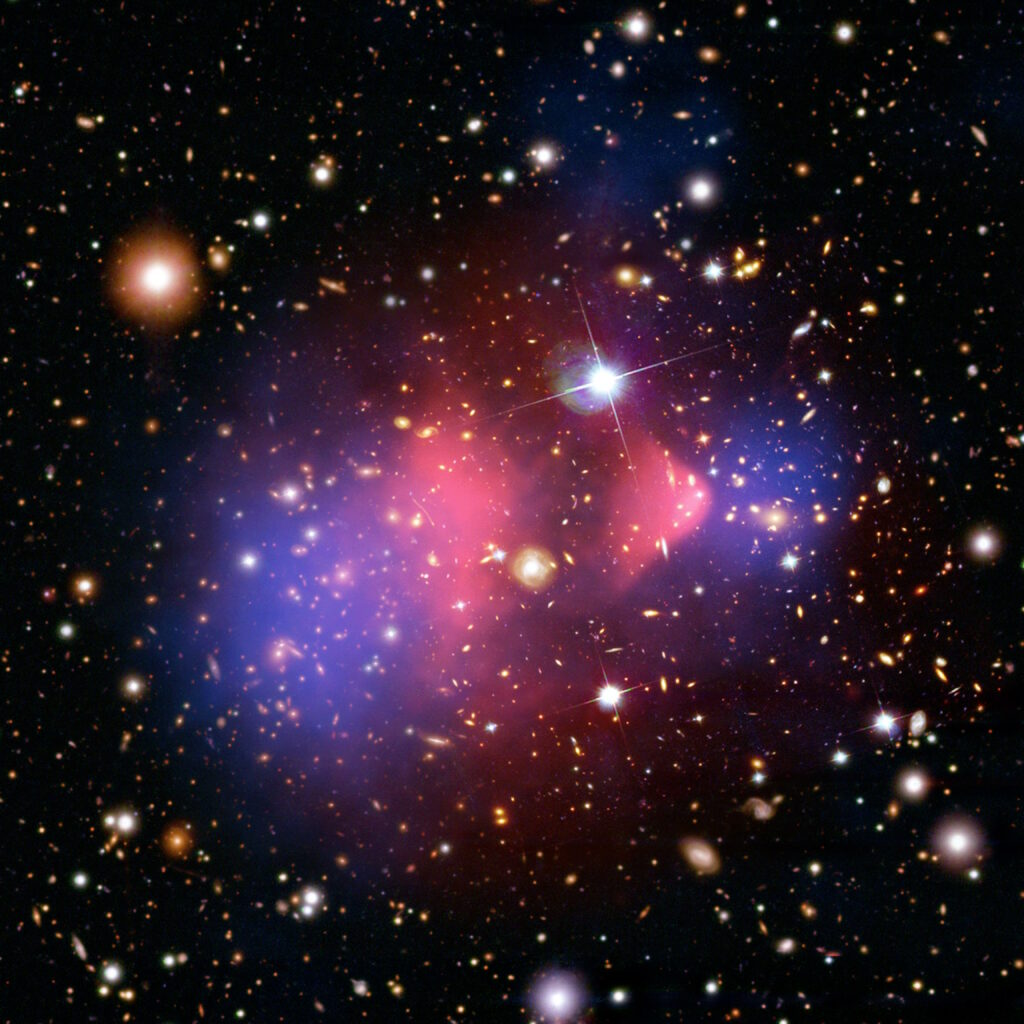
The Bullet Cluster is a remarkable astronomical phenomenon resulting from the high-speed collision of two galaxy clusters approximately three billion light-years from Earth. This event provides a unique cosmic laboratory where scientists can study the distribution of visible matter and the gravitational effects attributed to an unseen component known as dark matter. The cluster’s distinctive feature is the spatial separation between ordinary matter, primarily hot plasma emitting X-rays, and the total gravitational mass inferred from gravitational lensing, which appears to exceed what visible matter alone can account for.
Understanding the Bullet Cluster Collision
The Bullet Cluster represents the aftermath of a violent merger between two massive galaxy clusters. Unlike typical galactic interactions, this collision involves complex dynamics where the hot gas, constituting most of the baryonic matter, experiences significant friction and slows down. Meanwhile, the galaxies and the dominant gravitational mass continue moving ahead, creating a visible offset between the plasma and the gravitational potential. This separation is critical because it allows astronomers to distinguish between the effects of ordinary matter and those of an invisible mass component.
Gravitational Lensing and Mass Distribution
Gravitational lensing plays a pivotal role in analyzing the Bullet Cluster. This effect occurs when massive objects bend the trajectory of light from background sources, effectively acting as a cosmic magnifier. By mapping the lensing patterns, researchers have identified two distinct peaks of gravitational mass that do not coincide with the hot gas clouds but align with the locations of the galaxies. This observation strongly suggests the presence of dark matter halos that interact gravitationally but not electromagnetically, reinforcing the hypothesis of dark matter’s existence.
Alternative Theories and Scientific Debate
Despite the compelling evidence, the interpretation of the Bullet Cluster is not without controversy. Some scientists caution that the conclusions depend heavily on the models used to reconstruct the gravitational lensing data, which can be sensitive to underlying assumptions. Additionally, alternative gravity theories, such as Modified Newtonian Dynamics (MOND) and its relativistic extensions, attempt to explain the observed phenomena without invoking dark matter. Although these models face challenges in fully accounting for the Bullet Cluster’s features, ongoing refinements keep the debate open, suggesting that the cluster may challenge rather than conclusively confirm the nature of dark matter.
Scientific Insights from X-ray Observations
High-resolution X-ray imaging of the Bullet Cluster reveals detailed structures such as shock waves and bow shocks formed by the collision. These features indicate that the gas is compressed and heated to extreme temperatures, reaching hundreds of millions of degrees. Such observations provide critical data for simulations that model the behavior of matter under the combined influences of gravity, hydrodynamics, and dark matter interactions, enhancing our understanding of cluster dynamics and the properties of the dark sector.
Constraints on Dark Matter Properties
The Bullet Cluster also offers valuable constraints on the characteristics of dark matter particles. If dark matter consists of weakly interacting massive particles (WIMPs), the cluster’s high-velocity collision limits how strongly dark matter can interact with itself or ordinary matter. The fact that the dark matter halos do not decelerate significantly during the merger implies that dark matter must have extremely weak self-interactions. These findings influence both theoretical models and experimental searches aimed at identifying the fundamental nature of dark matter.
Why the Bullet Cluster is Crucial in Cosmology
The Bullet Cluster stands as a cornerstone in the empirical evidence supporting the existence of dark matter. It exemplifies the intricate interplay between observation and theory, showcasing how detailed data can challenge or reinforce prevailing scientific paradigms. While it strongly supports the dark matter hypothesis, the cluster also highlights the complexities and uncertainties inherent in cosmic phenomena, encouraging ongoing investigation and critical examination of alternative explanations.
Common Misconceptions About the Bullet Cluster
The Bullet Cluster definitively proves dark matter exists.
While it provides strong evidence, interpretations depend on models and assumptions, and alternative theories have not been entirely ruled out.
Modified gravity theories cannot explain the Bullet Cluster.
Although challenging, some modified gravity models continue to evolve and attempt to account for the observations, keeping the debate active.
Future Perspectives and Continuing Research
As astronomical techniques and computational models advance, the Bullet Cluster remains a focal point for exploring the universe’s dark components. It challenges researchers to refine their understanding of cosmic structure formation, the behavior of dark matter, and the fundamental laws governing gravity. The cluster’s study exemplifies the dynamic nature of scientific inquiry, where each discovery prompts new questions and deeper exploration into the universe’s hidden realms.
Summary
The Bullet Cluster is a spectacular cosmic event that offers profound insights into the distribution of visible and invisible matter in the universe. Through gravitational lensing and X-ray observations, it provides compelling evidence for dark matter while simultaneously inviting scrutiny and alternative interpretations. Its significance lies not only in supporting the dark matter paradigm but also in exemplifying the ongoing quest to unravel the universe’s most profound mysteries.
FAQ
What is the Bullet Cluster?
The Bullet Cluster is a galaxy cluster formed from the collision of two massive galaxy clusters, providing insights into dark matter.
How does the Bullet Cluster provide evidence for dark matter?
The spatial separation of visible matter and gravitational mass in the Bullet Cluster suggests the presence of dark matter.
Are there alternative theories to explain the Bullet Cluster's observations?
Yes, some alternative gravity theories, such as MOND, attempt to explain the phenomena without invoking dark matter.


Leave a Reply