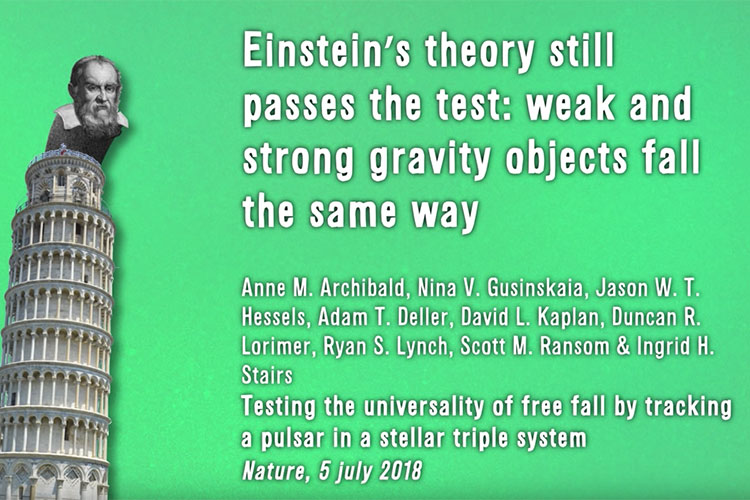
What Is the Speed of Gravity—and Does It Have Limits?

Definition of the Speed of Gravity The speed of gravity refers to the rate at which changes in a gravitational field propagate through the fabric of spacetime. When a massive object moves or a gravitational event occurs, the resulting disturbance does not affect distant objects instantaneously; instead, it travels outward as gravitational waves. These waves […]
Read More →

What Is the Value of Gravity on Mars?

Definition of Martian Gravity Gravity is the natural force by which a celestial body attracts objects toward its center. On Mars, this gravitational pull is significantly weaker than on Earth, measuring approximately 3.71 meters per second squared (m/s²), which is about 38% of Earth’s gravity. This difference profoundly influences the physical environment, biological processes, and […]

Read More →

Did Albert Einstein Really Say Gravity Isn’t a Force?

Understanding Gravity: A Fundamental Interaction Gravity is often envisioned as the invisible force that governs the motion of celestial bodies and everyday objects alike. It is responsible for the fall of an apple, the Earth’s orbit around the Sun, and the majestic spirals of galaxies scattered across the cosmos. Traditionally, gravity was described by Isaac […]

Read More →

Jupiter vs Venus: Which Has Stronger Gravity?

Definition of Planetary Gravity Planetary gravity refers to the force exerted by a planet due to its mass, attracting objects toward its center. This gravitational pull influences everything from the planet’s atmosphere and surface conditions to the orbits of moons and spacecraft trajectories. The strength of gravity on a planet depends primarily on its mass […]

Read More →

What If Earth Had the Gravity of a Neutron Star?

Understanding Neutron Star Gravity Neutron stars represent some of the densest objects in the universe, formed from the remnants of massive stars that have undergone supernova explosions. These stellar remnants pack immense mass into a sphere roughly 20 kilometers in diameter, resulting in gravitational fields that are extraordinarily intense-approximately 2×10¹¹ times stronger than Earth’s gravity. […]

Read More →

What Controls the Universe Might Not Be Gravity

Understanding Gravity and Its Role in the Universe Gravity has traditionally been regarded as the fundamental force orchestrating the cosmic ballet of planets, stars, and galaxies. It acts as the invisible conductor, shaping the trajectories and interactions of celestial bodies across the vast expanse of space. Rooted in the classical theories of Newton and later […]

Read More →

How Do Planets Stay Suspended in Space?

Understanding Planetary Suspension in Space The sight of planets seemingly floating effortlessly in the vast emptiness of space often evokes a deep sense of awe and curiosity. How do these enormous celestial bodies, some extending thousands of miles across, maintain their positions without drifting away or collapsing inward? The explanation transcends superficial observation, rooted in […]

Read More →