
Short Answer
Definition of Planetary Gravity
Planetary gravity refers to the force exerted by a planet due to its mass, attracting objects toward its center. This gravitational pull influences everything from the planet’s atmosphere and surface conditions to the orbits of moons and spacecraft trajectories. The strength of gravity on a planet depends primarily on its mass and radius, as described by Newton’s law of universal gravitation.
Fundamental Principles of Gravitational Force
Gravity is a universal force that acts between any two masses. The magnitude of this force is determined by the equation:
F = G * (m₁ * m₂) / r²

- F: Gravitational force between two objects
- G: Gravitational constant (6.674 × 10⁻¹¹ N·m²/kg²)
- m₁ and m₂: Masses of the two objects
- r: Distance between the centers of the two masses
For planets, surface gravity is often expressed as acceleration due to gravity (g), which depends on the planet’s mass (M) and radius (R):
g = G * M / R²
Comparative Overview: Jupiter vs. Venus
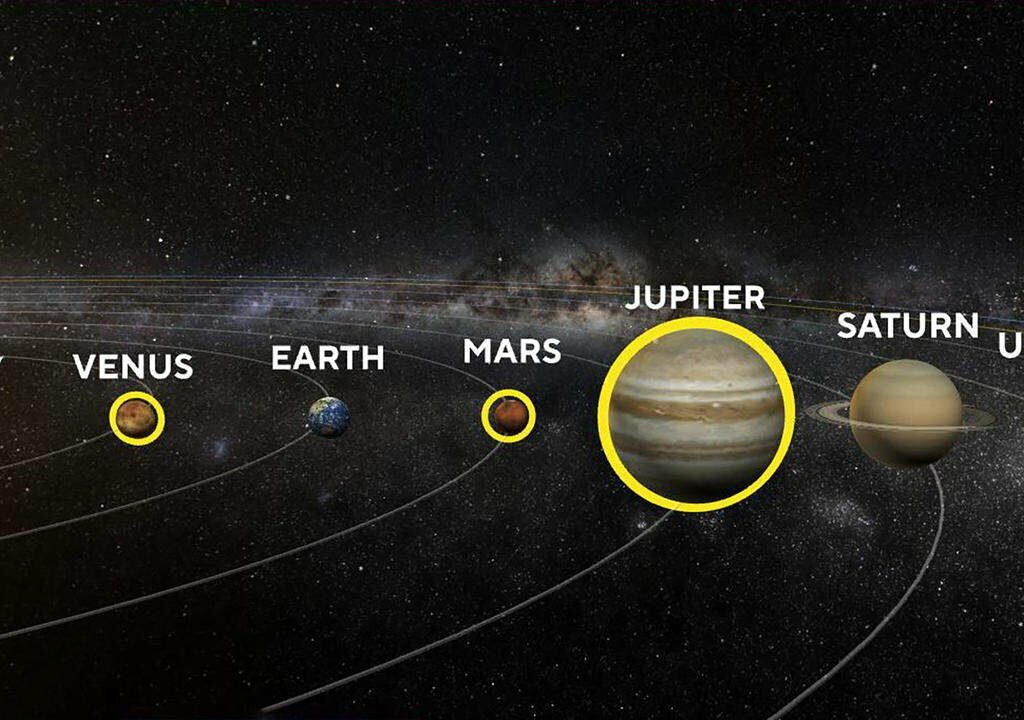
Jupiter and Venus represent two extremes in the solar system’s gravitational landscape. Jupiter, the largest planet, is a gas giant with a mass approximately 318 times that of Earth, resulting in a surface gravity near 24.79 m/s²-about 2.5 times Earth’s gravity. Venus, often dubbed Earth’s sister planet due to its similar size, has a mass roughly 81.5% that of Earth and a surface gravity of about 8.87 m/s², slightly less than Earth’s 9.81 m/s².
Mass and Radius Influence
The immense mass of Jupiter, combined with its large radius, creates a powerful gravitational field that governs its extensive system of moons and thick atmosphere. Venus, with a smaller mass and radius, exerts a weaker gravitational pull but still maintains a dense atmosphere due to its gravity and atmospheric composition.
Impact of Gravity on Planetary Atmospheres and Surface Conditions
Gravity plays a crucial role in retaining planetary atmospheres and shaping surface environments. Jupiter’s strong gravity holds a massive atmosphere primarily composed of hydrogen and helium, leading to extreme pressure gradients and dynamic weather phenomena such as the Great Red Spot-a storm larger than Earth. Conversely, Venus’s gravity supports a thick carbon dioxide atmosphere with surface pressures over 90 times that of Earth’s, contributing to its extreme surface temperatures and hostile conditions.
Gravitational Effects on Orbital Mechanics and Space Exploration
The gravitational differences between Jupiter and Venus significantly affect spacecraft mission planning. The escape velocity from Jupiter is approximately 59.5 km/s, demanding substantial energy for spacecraft to leave its gravitational influence. Venus’s escape velocity is much lower, around 10.36 km/s, making missions less fuel-intensive in comparison. These variations influence orbital insertion strategies, fuel requirements, and mission design.
Tidal Forces and Planetary Interactions
Jupiter’s gravity induces strong tidal forces on its moons, such as Io, causing intense volcanic activity due to tidal heating. Venus, lacking significant natural satellites, experiences different gravitational dynamics. Its slow retrograde rotation suggests a complex evolutionary history potentially shaped by past gravitational interactions with other celestial bodies.
Magnetospheric Consequences of Gravitational Variations
Gravity also affects the internal dynamics that generate planetary magnetic fields. Jupiter’s gravity supports conditions deep within its core that produce metallic hydrogen, fueling a powerful magnetic field and an extensive magnetosphere capable of shielding its moons from solar radiation. Venus, with weaker gravity and different internal structure, lacks a significant intrinsic magnetic field, illustrating the diverse outcomes of gravitational influence on planetary magnetism.
Role of Gravity in Solar System Architecture
Jupiter’s gravitational dominance has shaped the solar system’s structure by influencing asteroid belts, comet trajectories, and planetary migrations. Its massive gravitational well acts as a protective barrier for the inner planets by redirecting potential cosmic threats. Venus, situated closer to the Sun, experiences gravitational perturbations from solar forces that affect its orbit and axial tilt, contributing to its unique rotational characteristics.
Common Misconceptions About Planetary Gravity
Venus has the same gravity as Earth because of its similar size.
Although Venus is close in size to Earth, its surface gravity is slightly weaker due to differences in mass and density.
Jupiter’s gravity is so strong that it crushes everything on its surface.
Jupiter is a gas giant without a solid surface; its gravity influences its atmosphere and moons rather than crushing a solid ground.
Significance of Understanding Planetary Gravity
Grasping the nuances of gravitational forces on planets like Jupiter and Venus is vital for multiple scientific and practical reasons. It enhances our comprehension of planetary formation, atmospheric retention, and internal dynamics. Moreover, it informs the design of space missions, helping engineers calculate fuel needs and trajectory paths. Understanding gravity’s role also sheds light on the potential habitability of planets and the evolution of the solar system’s architecture.
Real-World Applications and Examples
Space missions such as NASA’s Juno probe to Jupiter must overcome the planet’s intense gravity to enter orbit and conduct studies. Similarly, missions to Venus, like the European Space Agency’s Venus Express, navigate its gravitational environment to analyze atmospheric conditions. These explorations rely heavily on precise knowledge of gravitational forces to ensure mission success and safety.

Leave a Reply