

Short Answer
Definition of Ancient Cosmic Radiation
Ancient cosmic radiation refers to the residual electromagnetic signals that permeate the universe, originating from its earliest epochs. These radiation remnants serve as vital clues, offering insights into the universe’s formation and evolution. Among these, the Cosmic Microwave Background Radiation (CMBR) stands out as the most significant, representing the afterglow of the Big Bang and providing a snapshot of the cosmos shortly after its inception.
Cosmic Microwave Background Radiation: A Window into the Early Universe
The Cosmic Microwave Background Radiation is a pervasive, faint glow detected throughout the universe, first discovered accidentally in 1965 by Arno Penzias and Robert Wilson. This radiation dates back to approximately 380,000 years after the Big Bang, a pivotal moment when the universe cooled enough for protons and electrons to combine into neutral hydrogen atoms. This process, known as recombination, allowed photons to travel freely, transforming the universe from an opaque plasma to a transparent expanse.
Significance of the CMBR
- Snapshot of Early Universe:
The CMBR captures the state of the cosmos at a critical juncture, revealing conditions that prevailed during the universe’s infancy. - Density Fluctuations:
Tiny variations in the CMBR’s temperature correspond to density irregularities that later evolved into galaxies and large-scale cosmic structures. - Cosmological Parameters:
Analysis of the CMBR anisotropies helps determine fundamental constants such as the Hubble constant, spatial curvature, and the influence of dark energy driving cosmic expansion.
Mechanisms Behind Ancient Radiation
The origin of ancient radiation lies in the early universe’s thermal history. Initially, the universe was a hot, dense plasma where photons were constantly scattered by free electrons. As the universe expanded and cooled, recombination occurred, allowing photons to decouple from matter and travel unimpeded. These photons have since stretched into the microwave region of the electromagnetic spectrum due to cosmic expansion, forming the CMBR we observe today.
Mathematical Framework and Cosmological Parameters
The study of ancient radiation involves precise mathematical modeling to interpret observational data. Key formulas include:
- Planck’s Law:
Describes the blackbody spectrum of the CMBR, confirming its thermal origin. - Friedmann Equations:
Govern the expansion dynamics of the universe, incorporating parameters such as matter density (Ωm), dark energy density (ΩΛ), and curvature (k). - Temperature Anisotropy Power Spectrum:
Quantifies the scale and amplitude of fluctuations in the CMBR, essential for understanding structure formation.
Illuminating the Cosmic Dawn: Formation of the First Stars and Galaxies
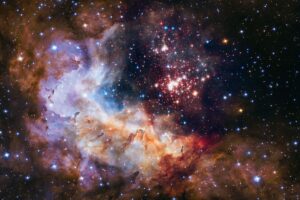
Following the era captured by the CMBR, the universe entered a phase known as the cosmic dawn, marked by the birth of the first stars and galaxies. These primordial objects emerged from the gravitational collapse of dark matter and baryonic gas, igniting nuclear fusion and emitting radiation that reionized the intergalactic medium. This epoch transformed the universe from darkness into a luminous landscape, setting the stage for subsequent cosmic evolution.
Interdisciplinary Insights
Understanding this transformative period requires integrating knowledge from astrophysics, gravitational theory, and cosmology. The interplay between radiation, matter, and dark matter during this time reveals the complex processes that shaped the large-scale structure of the universe.
Implications for Extraterrestrial Life and Cosmic Inquiry
The investigation of ancient radiation extends beyond cosmology, influencing our understanding of planetary formation and the potential for life elsewhere in the universe. By studying the conditions that fostered star and planet development, scientists gain clues about the likelihood of habitable environments and the emergence of extraterrestrial civilizations. This pursuit reflects humanity’s enduring quest to comprehend its place within the vast cosmic expanse.
Future of the Universe: Insights from Ancient Radiation
Current cosmological models, informed by ancient radiation studies, predict that the universe will continue expanding indefinitely. This expansion leads to scenarios such as the gradual cooling and fading of stars, culminating in a “cold death” where galaxies become isolated and star formation ceases. These projections provoke philosophical reflection on the transient nature of existence against the backdrop of an ever-evolving cosmos.
Challenges and Technological Advances in Cosmology
While ancient radiation offers profound insights, it also presents challenges requiring innovative approaches. The advancement of observational technology, exemplified by instruments like the James Webb Space Telescope, enhances our ability to probe deeper into cosmic history. These tools enable more detailed measurements of radiation and cosmic structures, pushing the boundaries of our understanding and necessitating continual refinement of theoretical models.
Why Studying Ancient Radiation Is Crucial
The exploration of ancient cosmic radiation is fundamental to unraveling the universe’s origins, structure, and ultimate fate. It bridges empirical science with philosophical inquiry, fostering a deeper connection between humanity and the cosmos. By decoding these primordial signals, we not only reconstruct the universe’s past but also enrich our understanding of existence itself, fueling an ongoing pursuit of knowledge and meaning.
Common Misconceptions About Ancient Radiation
The CMBR is uniform and featureless.
The CMBR contains subtle temperature fluctuations that reveal critical information about early universe density variations.
Ancient radiation only informs us about the distant past.
Studying ancient radiation also provides insights into current cosmic parameters and future evolution.
The universe’s expansion is slowing down.
Observations of the CMBR and distant supernovae indicate that the universe’s expansion is accelerating due to dark energy.
FAQ
What is Cosmic Microwave Background Radiation (CMBR)?
CMBR is the faint residual radiation from the Big Bang that fills the universe, providing a critical snapshot of its early state.
How does studying ancient radiation help us understand the universe?
It reveals the initial conditions and evolution of the cosmos, including matter distribution and cosmic expansion.
What is the cosmic dawn?
The cosmic dawn refers to the period when the first stars and galaxies formed, ending the universe's dark ages.
Who discovered the Cosmic Microwave Background Radiation?
Arno Penzias and Robert Wilson discovered the CMBR in 1965.
Why is the James Webb Space Telescope important for cosmology?
It provides detailed observations of distant cosmic phenomena, improving our understanding of the early universe.

Leave a Reply