
Short Answer
Definition of the Large Hadron Collider
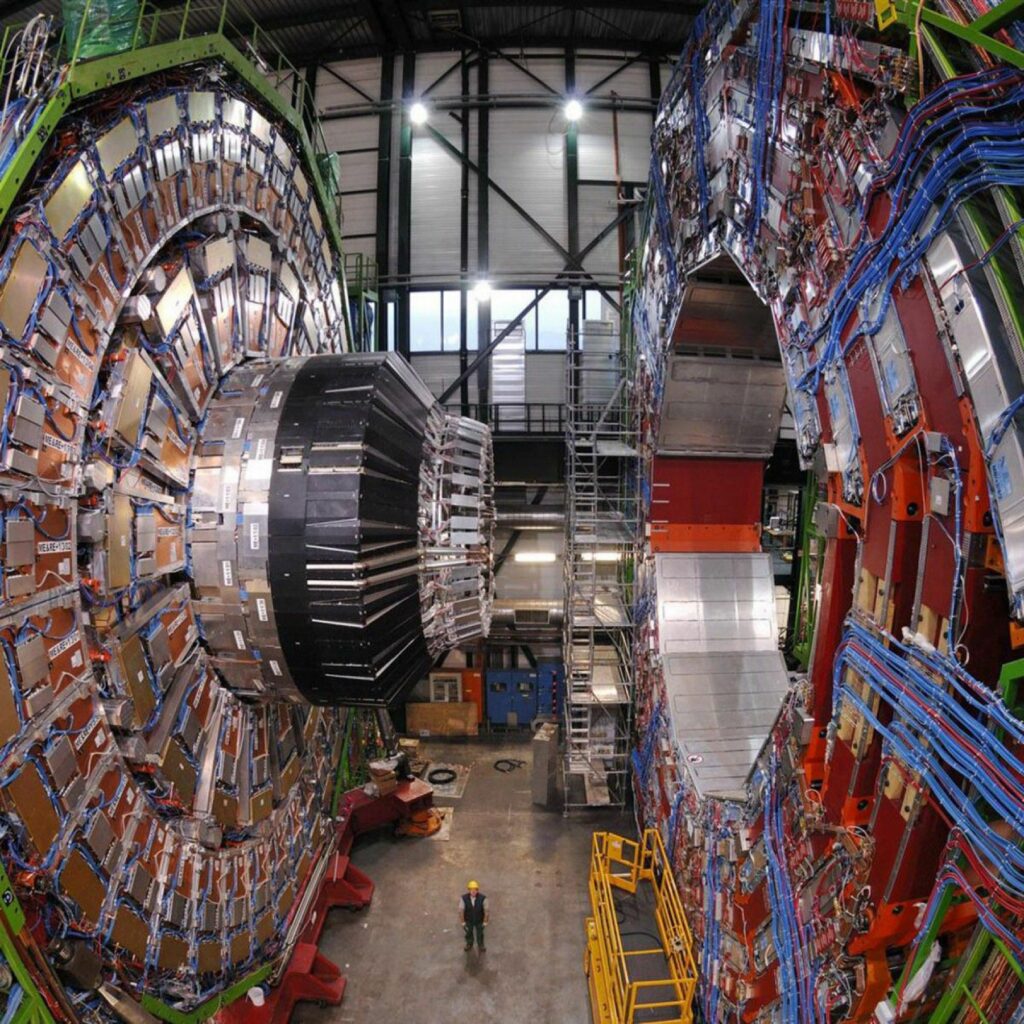
The Large Hadron Collider (LHC) is the world’s most powerful particle accelerator, designed to explore the fundamental components of matter and the forces governing the universe. Situated in a 27-kilometer circular tunnel beneath the border of France and Switzerland, the LHC propels particles to velocities near the speed of light, enabling collisions at unprecedented energy levels. These high-energy impacts allow scientists to investigate the subatomic world and uncover the underlying principles of physical reality.
Purpose and Scientific Ambitions
While the LHC is widely recognized for its role in discovering the Higgs boson in 2012-a particle that imparts mass to other particles and completes the Standard Model of particle physics-its mission extends far beyond this achievement. The collider serves as a gateway to new physics, challenging and expanding the current theoretical framework. It seeks to answer profound questions about the universe’s composition, the nature of matter and antimatter, and the existence of phenomena that lie beyond the Standard Model.
How the LHC Operates
The LHC accelerates protons and other particles along its circular track, bringing them to nearly light speed before orchestrating collisions at specific points. These collisions generate energy levels millions of times greater than those produced by cosmic rays naturally striking Earth’s atmosphere. By breaking particles into their most elementary constituents, the LHC momentarily exposes the fundamental building blocks of matter and the forces acting upon them. Sophisticated detectors capture the resulting particle debris, allowing physicists to analyze the fleeting traces of these high-energy events.
Exploring Dark Matter
One of the LHC’s most intriguing quests involves the search for dark matter, a mysterious form of matter that neither emits nor absorbs light but exerts gravitational effects on galaxies and cosmic structures. Accounting for roughly 27% of the universe’s total mass-energy content, dark matter remains undetected by conventional means. The LHC attempts to produce or identify dark matter particles by examining collisions for missing energy signatures-indications that invisible particles have escaped detection, hinting at a hidden sector of the universe.
Supersymmetry and Its Implications
Supersymmetry (SUSY) is a theoretical framework proposing that every known particle has a heavier “superpartner.” This concept could resolve several outstanding puzzles in physics, such as the relative lightness of the Higgs boson and the unification of fundamental forces at high energies. The LHC’s experiments probe for evidence of these supersymmetric particles, which, if discovered, would revolutionize our understanding of particle physics and provide candidates for dark matter.
Investigating Extra Dimensions
The LHC also explores the possibility of spatial dimensions beyond the familiar three. Inspired by string theory, the idea of extra dimensions suggests that our observable universe might be a three-dimensional slice of a higher-dimensional space. Particle collisions at the LHC could reveal subtle effects caused by particles like gravitons temporarily moving into these hidden dimensions, potentially altering collision outcomes. Confirming extra dimensions would profoundly change our grasp of spacetime and open new avenues for technological innovation.
Addressing the Matter-Antimatter Asymmetry
A fundamental cosmological mystery is why the universe contains more matter than antimatter, a disparity that allows galaxies, stars, and life to exist. The LHC investigates this imbalance by studying subtle differences in the behavior of particles and antiparticles during collisions. Understanding these asymmetries could shed light on the conditions that shaped the early universe and made it hospitable to complexity and consciousness.
Probing New Energy Frontiers
By pushing collisions to ever-higher energies, the LHC ventures into uncharted physical regimes. Each increase in energy provides an opportunity to observe phenomena that may deviate from established theories, potentially revealing a more fundamental framework that unites quantum mechanics with gravity-a long-sought “theory of everything.” This exploration at the frontier of energy scales is akin to charting unknown territory in the landscape of physics.
Philosophical and Conceptual Significance
The LHC’s investigations extend beyond empirical science, touching on deep philosophical questions about the nature of reality and human knowledge. It challenges our understanding of determinism versus quantum probability, the origin of fundamental constants, and whether the laws of physics emerge from deeper, undiscovered principles. In this way, the collider acts as a tool for probing not only particles but the very conceptual framework that underpins existence.
Why the Large Hadron Collider Matters
The LHC is far more than a machine smashing particles; it is a bold scientific expedition into the unknown. Its discoveries have the potential to redefine physics, influence philosophical thought, and inspire technological breakthroughs. By revealing the universe’s hidden symphony-where every particle and interaction carries clues about the origins and fate of everything-the LHC embodies the spirit of inquiry at the edge of human understanding.
Summary
- Definition:
The LHC is the world’s largest and most powerful particle accelerator, designed to explore fundamental physics. - Operation:
It accelerates particles to near-light speeds and collides them to study subatomic phenomena. - Key Goals:
Discover new particles, investigate dark matter, test supersymmetry, explore extra dimensions, and understand matter-antimatter asymmetry. - Scientific Impact:
The LHC challenges existing theories and seeks a unified understanding of the universe. - Philosophical Importance:
It raises questions about the nature of reality and the limits of human knowledge.
FAQ
What is the LHC?
The LHC is the largest and most powerful particle accelerator in the world, designed to explore fundamental physics.
What does the LHC search for?
It searches for new particles, dark matter, and tests theories like supersymmetry.



Leave a Reply