
Short Answer
Definition of Gravity
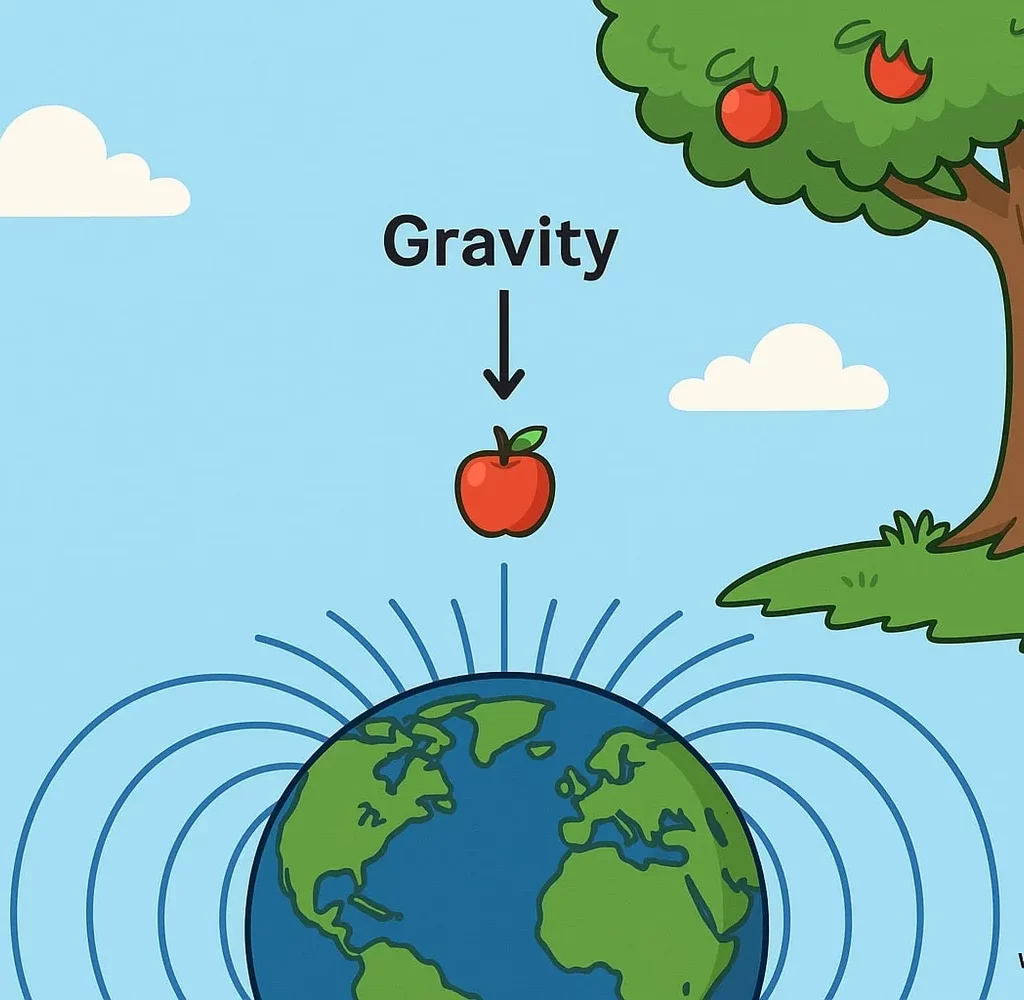
Gravity is a fundamental force of nature that exerts an attractive influence between all objects with mass. It is the invisible phenomenon responsible for anchoring us to the Earth and governing the motion of celestial bodies throughout the universe. This force ensures that objects, regardless of their size-from tiny stones to towering mountains-remain firmly connected to our planet and to each other.
- Universal Attraction:
Every mass pulls on every other mass, creating a mutual force of attraction. - Omnipresence:
Gravity operates everywhere, from the smallest particles to the largest cosmic structures.
Historical Background and Fundamental Principles
The concept of gravity has evolved over centuries, with its foundational principle first articulated by Sir Isaac Newton in the 17th century. Newton’s law of universal gravitation states that the gravitational force between two objects is directly proportional to the product of their masses and inversely proportional to the square of the distance separating them. This means that larger masses exert stronger pulls, while increasing distance weakens the force.
Mathematically, Newton’s law can be expressed as:
Mathematical Explanation of Gravity
The gravitational force (F) between two masses is given by the formula:
F = G × (m₁ × m₂) / r²
- F: Gravitational force between the two objects
- G: Gravitational constant (6.674 × 10⁻¹¹ N·m²/kg²)
- m₁, m₂: Masses of the two objects
- r: Distance between the centers of the two masses
Gravity as a Cosmic Architect
Beyond its role on Earth, gravity acts as the fundamental force shaping the universe. It governs the orbits of planets around stars, the formation and stability of galaxies, and the large-scale structure of the cosmos. The gravitational field of Earth extends well beyond its atmosphere, capturing satellites and influencing ocean tides. This force provides a consistent directional pull, allowing us to experience a sense of “down” and enabling everyday activities such as walking and pouring liquids.
Einstein’s Revolution: Gravity and Spacetime
In the early 20th century, Albert Einstein transformed our understanding of gravity through his theory of General Relativity. Instead of viewing gravity as a simple force, Einstein described it as the curvature of spacetime caused by mass and energy. Imagine spacetime as a stretched rubber sheet; a massive object like a planet creates a depression, causing nearby objects to move along curved paths toward it. This geometric interpretation explains gravitational phenomena more accurately, especially in extreme conditions such as near black holes or at cosmic scales.
Gravity’s Influence on Earth and Life
Gravity profoundly affects both the physical environment and biological systems on Earth. It shapes atmospheric pressure patterns, influencing weather and climate. In living organisms, gravity impacts cellular functions and human physiology. For example, astronauts in microgravity environments experience muscle weakening and bone density loss, highlighting gravity’s essential role in maintaining bodily health.
Applications and Technological Significance
Understanding gravity is crucial for modern technology and space exploration. It guides the trajectories of spacecraft, enables the operation of GPS satellites, and assists in managing orbital debris. Recent advancements in detecting gravitational waves have opened new frontiers in astrophysics, allowing scientists to observe cosmic events like black hole mergers and neutron star collisions, thereby deepening our knowledge of the universe.
Educational Tools and Public Engagement
Gravity captivates learners and enthusiasts through interactive educational resources. Visual simulations demonstrate how objects fall, how planets orbit stars, and how gravity interacts with other fundamental forces. Quizzes and trivia enhance engagement and retention, revealing intriguing facts such as variations in Earth’s gravitational strength due to altitude and density differences.
Common Misconceptions About Gravity
Heavier objects fall faster than lighter ones.
In the absence of air resistance, all objects fall at the same rate regardless of mass.
Gravity is only significant on Earth.
Gravity is a universal force acting throughout the cosmos, influencing all matter.
Frequently Asked Questions
- Why do objects of different masses fall at the same speed?
Because gravitational acceleration is constant near Earth’s surface, and air resistance affects fall rates, not mass. - How does gravity affect time?
According to General Relativity, gravity can slow down time near massive objects, a phenomenon known as gravitational time dilation. - What happens in the absence of gravity?
In microgravity environments, such as space, objects experience weightlessness, affecting physical processes and human health.
Importance of Gravity in Science and Daily Life
Gravity is indispensable for sustaining life on Earth and for the coherence of the universe. It prevents us from drifting into space, maintains the stability of planetary orbits, and influences natural phenomena from tides to weather. Its study bridges physics, astronomy, biology, and technology, making it a cornerstone of scientific inquiry and practical application.
Conclusion
Far beyond being a mere force that keeps us grounded, gravity is a fundamental interaction that orchestrates the structure, behavior, and evolution of the universe. Its persistent influence provides stability and order to an ever-changing cosmos. By exploring gravity’s principles, effects, and applications, we gain a deeper appreciation for the profound simplicity and vast complexity of the force that literally holds everything together.
FAQ
What is gravity?
Gravity is a fundamental force that attracts two bodies with mass towards each other.
How does gravity affect time?
Gravity can slow down time near massive objects, a phenomenon known as gravitational time dilation.
Leave a Reply