
Short Answer
Definition of Dark Matter
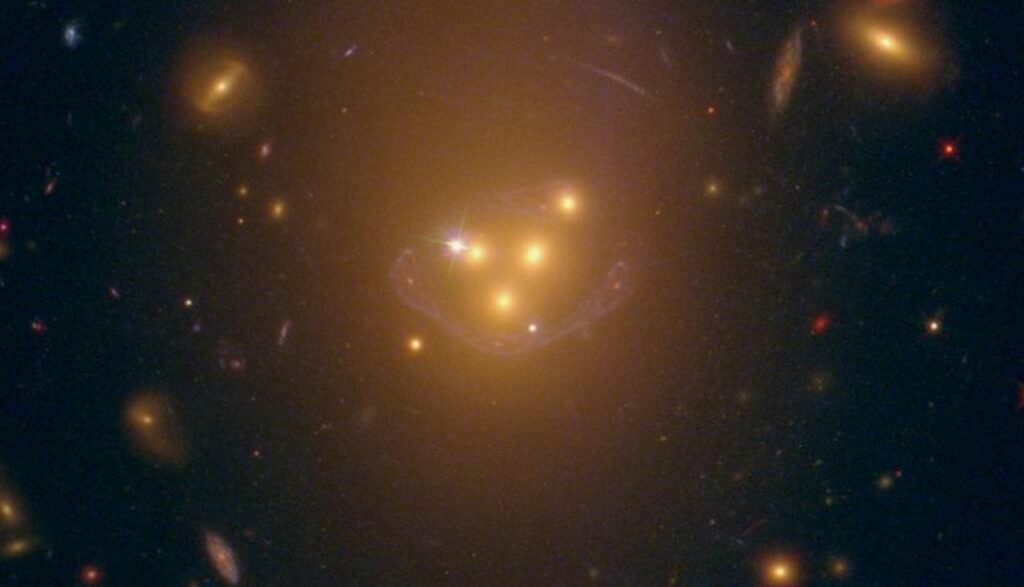
Dark matter is a mysterious and invisible form of matter that plays a crucial role in the structure and dynamics of the universe. It does not emit, absorb, or reflect light, making it undetectable by conventional electromagnetic observations. Despite its invisibility, dark matter exerts gravitational effects that influence the motion of galaxies and galaxy clusters, suggesting it constitutes a significant portion of the universe’s total mass.
- Invisible Nature:
Dark matter cannot be seen directly because it does not interact with electromagnetic radiation. - Gravitational Influence:
Its presence is inferred from gravitational effects on visible matter, radiation, and the large-scale structure of the cosmos. - Cosmic Abundance:
Estimates indicate dark matter makes up about 27% of the universe’s total mass-energy content, far exceeding ordinary matter.
Observational Evidence and Galactic Dynamics
The concept of dark matter emerged from observations that galaxies and clusters rotate and move in ways inconsistent with the gravitational pull of visible matter alone. Stars in galaxies orbit at speeds that should cause them to fly apart if only the observable mass were present. This discrepancy implies the existence of an unseen mass component providing the necessary gravitational binding.
These gravitational anomalies are central to our understanding of cosmic evolution and the formation of large-scale structures, as dark matter acts as a scaffolding around which galaxies coalesce and evolve.

Particle Candidates and Theoretical Models
Scientists have proposed various hypothetical particles as constituents of dark matter, each with unique properties that evade direct detection:
- Weakly Interacting Massive Particles (WIMPs):
Hypothetical particles that interact via gravity and the weak nuclear force but not electromagnetically, making them difficult to detect. - Axions:
Ultra-light particles proposed to solve certain problems in quantum chromodynamics, potentially contributing to dark matter. - Sterile Neutrinos:
Hypothetical neutrinos that do not interact via the weak force, only through gravity, making them elusive candidates.
Despite extensive experimental efforts using particle detectors and colliders, definitive evidence for these particles remains elusive, complicating the dark matter puzzle.
Alternative Theories: Modifications to Gravity
Some researchers challenge the necessity of dark matter by proposing modifications to the laws of gravity, especially at galactic and cosmological scales. One prominent example is Modified Newtonian Dynamics (MOND), which suggests that Newton’s laws may not hold universally and that gravitational forces behave differently under extremely low accelerations.
These alternative frameworks attempt to explain observed gravitational anomalies without invoking unseen matter, though they remain controversial and have yet to achieve widespread acceptance.
Emerging Perspectives: Beyond the Traditional Dark Matter Paradigm
Recent theoretical developments propose that dark matter might not be entirely non-interactive or “dark” in the strictest sense. Some hypotheses suggest it could exhibit subtle electromagnetic or self-interactions that have so far escaped detection. These interactions might produce faint signals or effects detectable with advanced instruments or novel observational techniques.
Such possibilities open new avenues for research, encouraging scientists to re-examine existing data from cosmic microwave background measurements, gravitational lensing, and galaxy cluster collisions for overlooked clues.
Significance of Dark Matter in Cosmology and Physics
Understanding dark matter is vital for comprehending the universe’s composition and the mechanisms driving the formation and evolution of cosmic structures. It constitutes a major component of the universe’s mass-energy budget, influencing everything from galaxy rotation curves to the cosmic web’s large-scale architecture.
Moreover, uncovering the true nature of dark matter could reveal new physics beyond the Standard Model, potentially uncovering hidden symmetries or forces analogous to the historical discoveries of electromagnetism and nuclear interactions.
Technological Advances and Interdisciplinary Research
Modern astronomy and physics benefit from cutting-edge technologies such as gravitational wave observatories, high-energy particle accelerators, and ultra-sensitive telescopes capable of probing deeper into space and time. These tools, combined with sophisticated computational simulations, enhance our ability to test dark matter theories and explore alternative explanations.
The quest to understand dark matter fosters collaboration across multiple scientific disciplines, including particle physics, cosmology, astrophysics, and information theory. This interdisciplinary approach is essential for developing innovative experimental designs and analytical methods to unravel the dark matter enigma.
Common Misconceptions About Dark Matter
Dark matter is simply “dark” because it absorbs light.
Dark matter does not interact with light at all; it neither emits nor absorbs electromagnetic radiation, making it invisible.
Dark matter has been directly detected.
To date, dark matter has only been inferred through gravitational effects; no direct detection of dark matter particles has been confirmed.
Modified gravity theories have been disproven.
While controversial and not universally accepted, alternative gravity models remain active areas of research and have not been conclusively ruled out.
Philosophical and Human Dimensions
The mystery of dark matter transcends scientific inquiry, touching on profound philosophical questions about the limits of human knowledge and our place in the cosmos. It embodies humanity’s enduring curiosity and humility in the face of the unknown, inspiring ongoing exploration and intellectual growth.
Conclusion: The Evolving Understanding of Dark Matter
Dark matter remains one of the most compelling and dynamic subjects in modern astrophysics. Its evolving conceptualization-from an entirely invisible substance to a potentially more complex entity with subtle interactions-illustrates the fluid nature of scientific knowledge. As research progresses, the enigma of dark matter continues to challenge and expand our understanding of the universe, promising transformative discoveries that may redefine fundamental physics and cosmology.



Leave a Reply