
Short Answer
Definition of Supermassive Black Holes and Dark Matter
Supermassive black holes are among the most mysterious and awe-inspiring objects in the universe, typically found at the centers of galaxies. These colossal entities possess masses ranging from millions to billions of times that of the Sun, making them fundamental components in galactic evolution. Dark matter, on the other hand, is an invisible, non-luminous form of matter that constitutes approximately five times more mass than ordinary baryonic matter in the cosmos. Despite its dominance, dark matter’s exact nature remains one of the greatest unsolved puzzles in modern astrophysics.
- Supermassive Black Holes:
Extremely massive black holes located at galactic centers, influencing galaxy formation and dynamics. - Dark Matter:
A form of matter that does not emit, absorb, or reflect light, detectable only through its gravitational effects.
Formation Challenges of Supermassive Black Holes
The rapid emergence of supermassive black holes in the early universe, within a few hundred million years after the Big Bang, presents a significant challenge to traditional astrophysical models. Conventional theories suggest that black holes grow through the gradual accretion of ordinary matter or through mergers with other black holes. However, these processes alone struggle to explain the swift formation of such massive objects within the limited cosmological timeframe available.
Dark Matter’s Role in Black Hole Genesis
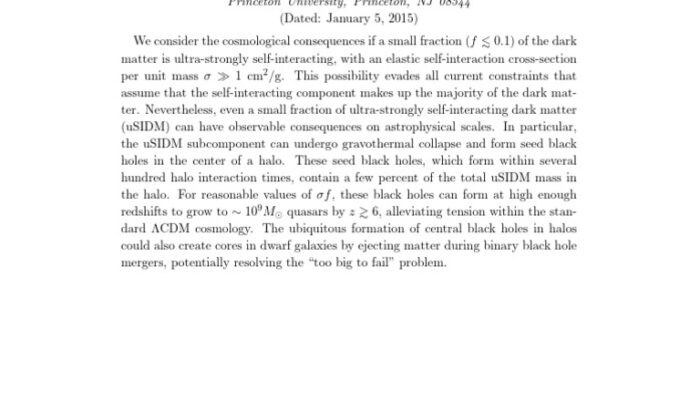
Recent theoretical developments propose that dark matter might play a crucial role in the birth and evolution of supermassive black holes. Specifically, if dark matter particles exhibit ultra-strong self-interactions, they could facilitate the rapid collapse of dark matter halos into dense cores. These compact dark matter structures might then serve as direct progenitors of black holes, bypassing the slower processes involving baryonic matter accretion.

Ultra-Strong Self-Interacting Dark Matter
Unlike the traditional cold dark matter model, which treats dark matter as collisionless and weakly interacting, new hypotheses suggest that dark matter particles could interact through forces much stronger than previously assumed. These interactions might allow dark matter to form bound states analogous to atoms or molecules, leading to highly compact and gravitating objects that could seed or constitute supermassive black holes.
Implications for Galactic Structure and Black Hole Properties
The presence of self-interacting dark matter could also address several discrepancies observed in galactic dynamics. For example, the cusp-core problem-where observed dark matter density profiles in galaxies differ from predictions-and the diversity of rotation curves in dwarf galaxies might be explained by these strong self-interactions. Furthermore, if dark matter influences black hole interiors, it could alter the classical picture of singularities and event horizons, potentially giving rise to novel quantum properties and affecting phenomena such as gravitational waves and black hole thermodynamics.
Observational and Experimental Prospects
Testing the hypothesis that supermassive black holes are linked to dark matter is challenging but feasible with advancing technology. Potential observational signatures include unusual stellar motions near galactic centers, anomalies in gravitational lensing patterns, and distinctive features in gravitational wave signals from black hole mergers. Future space- and ground-based observatories may detect these subtle effects. Additionally, laboratory experiments aimed at uncovering dark matter particle properties could provide indirect evidence supporting or refuting models of ultra-strong self-interacting dark matter.
Why Understanding This Connection Matters
Exploring the relationship between supermassive black holes and dark matter offers a unified framework that connects dark matter physics, galaxy formation, and black hole astrophysics. This integrated perspective not only helps resolve outstanding observational puzzles but also reshapes our understanding of the universe’s fundamental structure. By investigating these cosmic giants as potential manifestations of dark matter, scientists can deepen insights into the unseen forces shaping the cosmos and challenge long-held assumptions in astrophysics.
Common Misconceptions
Supermassive black holes form solely through the accretion of ordinary matter.
While accretion plays a role, the rapid formation of supermassive black holes suggests additional mechanisms, such as dark matter dynamics, may be involved.
Dark matter is completely non-interacting.
Emerging theories propose that dark matter may have strong self-interactions, influencing structure formation and black hole genesis.
Summary
Supermassive black holes and dark matter represent two of the most profound enigmas in astrophysics. The possibility that these massive black holes are partially or wholly composed of ultra-strongly self-interacting dark matter offers a compelling avenue to explain their rapid formation and unique properties. This hypothesis bridges gaps between cosmology, particle physics, and gravitational studies, promising to enhance our comprehension of the universe’s hidden architecture. Continued theoretical and observational efforts are essential to unravel the true nature of these cosmic phenomena and their interconnection.

Leave a Reply