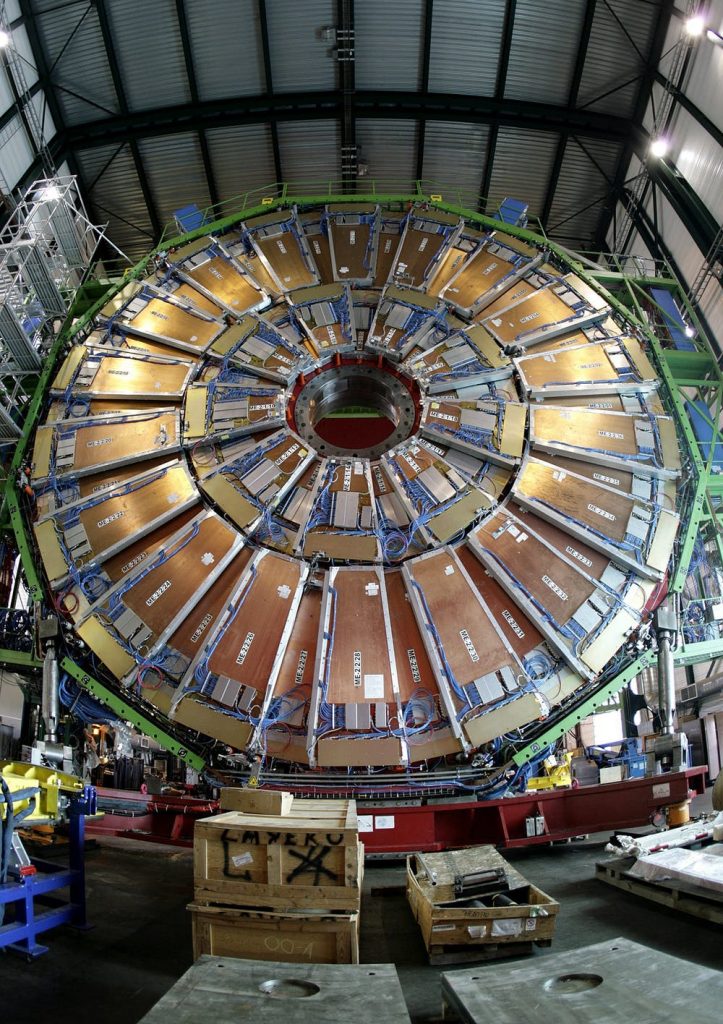
What kind of weird stuff is happening at CERN?

Overview of CERN and Its Scientific Significance The European Organization for Nuclear Research, commonly known as CERN, stands as a monumental hub for particle physics research. Situated on the border between France and Switzerland, this expansive facility is renowned worldwide for housing the Large Hadron Collider (LHC), the most powerful particle accelerator ever constructed. Beyond […]

Read More →

Why is CERN underground?

Definition of CERN and the Large Hadron Collider CERN, known as the European Organization for Nuclear Research, represents one of the most ambitious scientific ventures of our time. It focuses on investigating the fundamental particles and the forces that govern their interactions. At the heart of CERN lies the Large Hadron Collider (LHC), an extensive […]

Read More →

CERN vs Conspiracies: The Science Behind the Safety

Overview of CERN and Its Scientific Mission The European Organization for Nuclear Research, widely recognized as CERN, is a leading institution in the field of particle physics. It houses the Large Hadron Collider (LHC), the most extensive and powerful particle accelerator ever constructed. This cutting-edge facility has been instrumental in advancing our understanding of the […]

Read More →

When did the construction of CERN start?

Definition and Origins of CERN The European Organization for Nuclear Research, widely known as CERN, stands as a monumental institution dedicated to exploring the fundamental particles and forces that constitute the universe. Its inception is deeply rooted in the post-World War II era, reflecting a collective ambition to advance scientific knowledge through international cooperation. Rather […]

Read More →

Which types of engineering do we find at CERN?

Overview of Engineering Disciplines at CERN CERN, the European Organization for Nuclear Research, stands at the cutting edge of physics, conducting experiments that reshape our comprehension of the universe. The groundbreaking scientific achievements at CERN are made possible through the collaboration of multiple engineering fields. This article explores the various engineering specialties involved at CERN […]

Read More →

CERN Confirms Direct CP Violation: Matter’s Mirror Shattered

Definition of CP Violation CP violation, or Charge-Parity violation, describes a fundamental asymmetry in the laws of physics where the behavior of particles changes when they are replaced by their corresponding antiparticles and their spatial coordinates are inverted. This phenomenon is crucial for explaining why the universe contains more matter than antimatter, a question that […]

Read More →

Quark-Gluon First! CERN’s Latest Claim Rewrites the Early Universe

Definition of Quark-Gluon Plasma Quark-gluon plasma (QGP) is an extraordinary state of matter believed to have existed just microseconds after the Big Bang. Unlike ordinary matter composed of protons and neutrons, QGP consists of free quarks and gluons-fundamental particles that are usually confined within hadrons. This plasma forms under extreme temperatures and densities, where quarks […]

Read More →

What is the LHC?

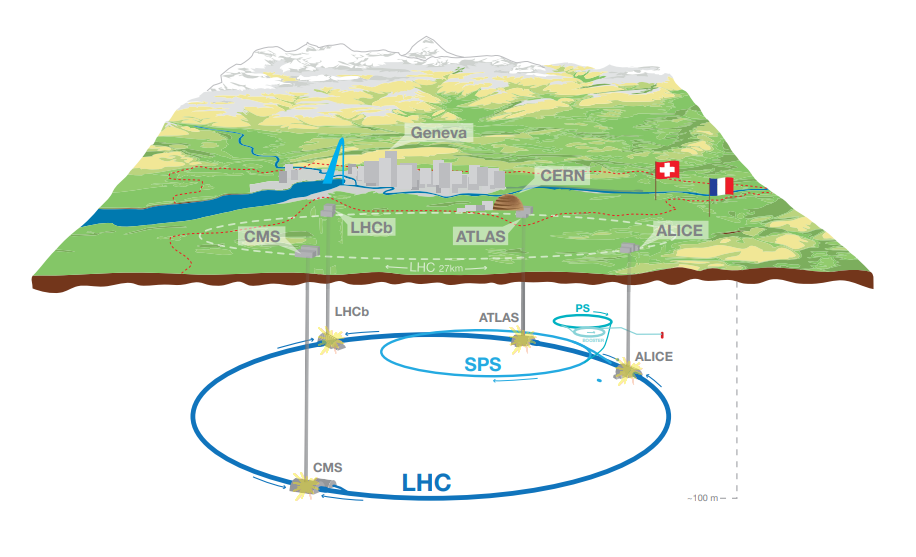
Overview of the Large Hadron Collider The Large Hadron Collider (LHC) stands as a pinnacle achievement in modern particle physics, functioning as the world’s largest and most powerful particle accelerator. Situated underground along the Franco-Swiss border near Geneva, this immense scientific instrument stretches approximately 27 kilometers in circumference. It embodies a monumental collaborative effort involving […]

Read More →

CERN Traps Antihydrogen: Holding Ghost Matter in Place

Understanding Antimatter Antimatter is a fascinating concept in physics, referring to particles that mirror ordinary matter but carry opposite electrical charges. Each particle of matter has a corresponding antiparticle; for instance, the proton, which has a positive charge, is paired with the antiproton, bearing a negative charge. The simplest antimatter atom is antihydrogen, composed of […]

Read More →

Why was CERN built?

Definition and Purpose of CERN The European Organization for Nuclear Research, widely known as CERN, is a premier scientific institution dedicated to exploring the fundamental components of the universe. Founded in 1954, CERN was established with the ambitious goal of advancing our understanding of particle physics and the forces that shape reality. It serves as […]

Read More →