
Short Answer
Definition of CP Violation
CP violation, or Charge-Parity violation, describes a fundamental asymmetry in the laws of physics where the behavior of particles changes when they are replaced by their corresponding antiparticles and their spatial coordinates are inverted. This phenomenon is crucial for explaining why the universe contains more matter than antimatter, a question that has intrigued physicists for decades. Initially theorized through the Kobayashi-Maskawa mechanism in the 1970s, CP violation has been primarily observed in mesons until recent discoveries extended its presence to baryons.
- Charge (C) transformation:
Replacing particles with their antiparticles. - Parity (P) transformation:
Inverting spatial coordinates (mirror reflection). - CP violation:
When the combined C and P transformations do not leave physical laws invariant.
Historical Background and Theoretical Foundations
The concept of CP violation emerged from efforts to understand subtle imbalances in particle interactions. In 1964, the discovery of CP violation in neutral kaon decays challenged the assumption that physical laws were symmetric under charge and parity transformations. Later, in 1973, Makoto Kobayashi and Toshihide Maskawa proposed a theoretical framework requiring three generations of quarks to accommodate CP violation within the Standard Model. This theory, initially met with skepticism, gained experimental support over subsequent decades, primarily through studies of mesons such as kaons and B mesons.
Baryons and Their Role in CP Violation Studies
Baryons, particles composed of three quarks, including protons and neutrons, differ fundamentally from mesons, which consist of a quark-antiquark pair. The recent observation of direct CP violation in baryons like the Λb and Ξb represents a pivotal advancement, expanding the scope of CP violation beyond mesons. This discovery was achieved through meticulous experiments conducted by the LHCb collaboration at CERN, confirming theoretical predictions and bridging gaps between theory and experimental data.
Experimental Techniques at CERN’s LHCb
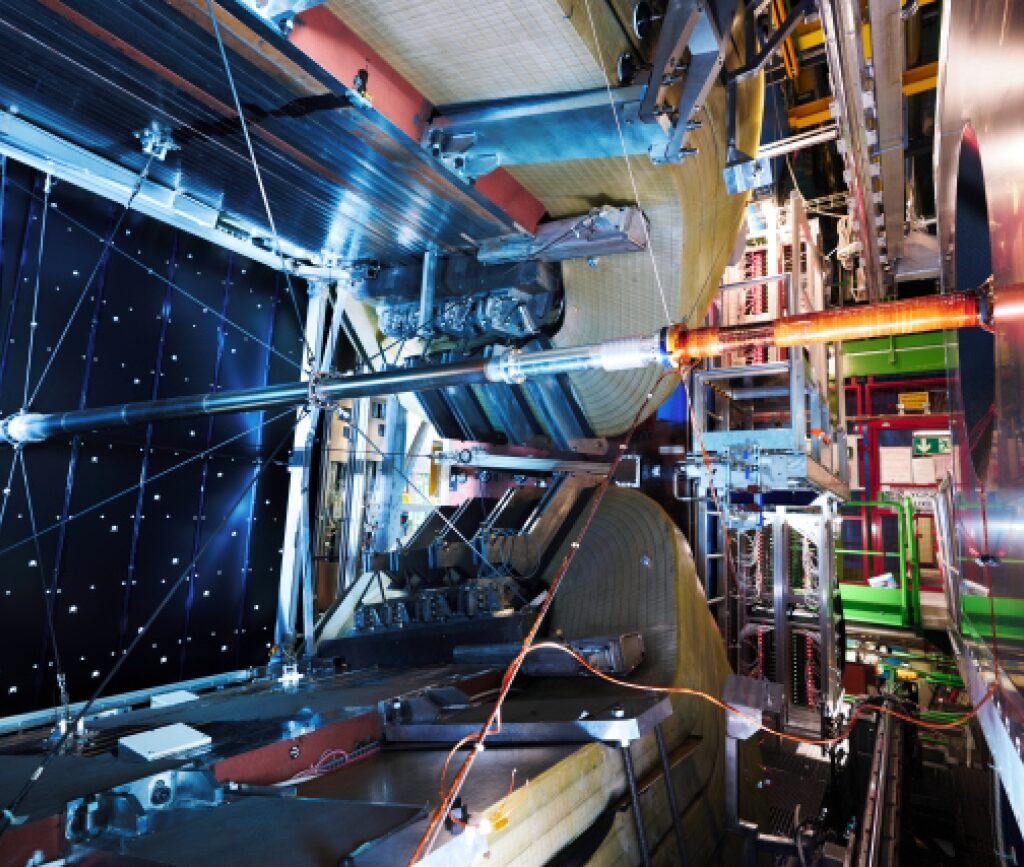
The LHCb experiment utilizes high-energy proton-proton collisions to generate a variety of particles, including baryons, in a controlled environment. Sophisticated detection systems-comprising tracking detectors, calorimeters, and particle identification modules-enable precise measurement of particle decay processes. Researchers focus on specific decay channels of baryons, analyzing the frequency and characteristics of these decays to detect any asymmetries indicative of CP violation. Statistical methods are applied to discern deviations from expected symmetrical decay rates, providing evidence for direct CP violation.
Key Findings: Evidence of Direct CP Violation in Baryons
Analyses of decay patterns revealed measurable asymmetries in baryon decays, particularly in the Ξb baryon. These asymmetries manifest as preferential decay pathways, signaling that the fundamental interactions governing these particles are not perfectly symmetrical. This observation marks the first confirmed instance of direct CP violation in baryons, a phenomenon previously documented only in meson systems, thereby opening new avenues for understanding matter-antimatter asymmetry.
Theoretical Significance and Implications
The detection of direct CP violation in baryons carries profound theoretical consequences. It reinforces the Standard Model’s predictions while simultaneously hinting at physics beyond its current framework. This discovery may provide critical insights into the longstanding cosmological puzzle of why matter dominates over antimatter in the universe. It also motivates exploration into advanced theories such as supersymmetry and grand unified theories, which could accommodate additional sources of CP violation and deepen our grasp of fundamental forces.
Future Research and Experimental Prospects
Building on this breakthrough, future research aims to enhance the precision of CP violation measurements in baryons. Planned upgrades to the Large Hadron Collider, including the LHC Upgrade II, will increase collision energies and detector sensitivities, enabling more detailed studies of baryonic decays. Expanding the range of baryons examined may uncover further instances of CP violation, thereby refining our understanding of the symmetry properties of nature and potentially revealing new physics.
Why CP Violation Matters
Understanding CP violation is essential for explaining the fundamental asymmetry between matter and antimatter, which underpins the very existence of the observable universe. This phenomenon influences particle physics, cosmology, and the evolution of the cosmos. Insights gained from studying CP violation inform the development of theoretical models and experimental techniques, driving progress in high-energy physics and contributing to our broader comprehension of the universe’s origins and structure.
Common Misconceptions About CP Violation
CP violation means that physical laws are completely different for matter and antimatter.
CP violation indicates subtle asymmetries, not a complete breakdown of physical laws; most interactions remain symmetric.
CP violation has only been observed in mesons.
Recent experiments have confirmed direct CP violation in baryons, expanding the phenomenon’s known domain.
CP violation alone explains the matter-antimatter imbalance in the universe.
While CP violation is a necessary ingredient, it is not sufficient by itself; other mechanisms likely contribute to the observed asymmetry.
FAQ
What is direct CP violation?
Direct CP violation is a phenomenon where particles and their corresponding antiparticles decay at different rates, indicating a fundamental asymmetry in the laws of physics.
Why does CP violation matter in physics?
CP violation is crucial for understanding why the observable universe consists primarily of matter rather than equal parts matter and antimatter.
How did CERN confirm direct CP violation in baryons?
CERN's LHCb experiment meticulously measured decay patterns of baryons and observed asymmetries indicative of direct CP violation.
What implications does this discovery have for the Standard Model?
It confirms predictions within the Standard Model but also suggests the potential for new physics beyond current theories.
What are the next steps in research after this discovery?
Future research includes more sensitive experiments at the LHC and studying other baryonic decay channels to deepen understanding of CP violation.






Leave a Reply