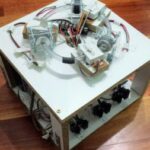
How to make a mini particle accelerator at home?

Definition of a Particle Accelerator A particle accelerator is a sophisticated device designed to propel charged particles, such as electrons or protons, to extremely high speeds. These accelerators enable scientists to investigate the fundamental building blocks of matter and the underlying principles of the universe by facilitating high-energy particle collisions. Charged particles: Particles with an […]

Read More →

Could an electric car be used for a road trip across the US?

Definition of Electric Road Trips An electric road trip refers to a long-distance journey undertaken using an electric vehicle (EV), typically spanning extensive terrains such as cross-country travel. This mode of travel emphasizes sustainability by utilizing battery-powered cars instead of traditional fossil fuel vehicles, thereby reducing carbon emissions and promoting eco-friendly transportation. Challenges and Considerations […]

Read More →

Should I become a physicist or a doctor?

Understanding the Career Paths: Physicist vs. Physician Choosing between a profession as a physicist or a physician presents a stimulating intellectual challenge. Both careers offer distinct rewards, obstacles, and the chance to make significant contributions-whether to humanity’s health or to our comprehension of the universe. To make an informed decision, it is crucial to explore […]

Read More →

800G Optical Transceivers: The Jobs Powering Tomorrow’s Internet

Definition of 800G Optical Transceivers 800G optical transceivers represent a cutting-edge advancement in telecommunications hardware designed to transmit data at speeds of 800 gigabits per second. These devices are integral components in modern optical networks, enabling ultra-high bandwidth communication essential for handling the exponential growth in data traffic driven by digital services and applications. Optical […]

Read More →

Why is quantum computing considered to be the fastest?

Understanding Quantum Computing Quantum computing signifies a revolutionary advancement in computational technology, promising remarkable improvements in efficiency and speed for solving complex problems. Unlike classical computers that rely on bits-binary units of information represented as either 0 or 1-quantum computers utilize quantum bits, or qubits. These qubits harness the unique principles of quantum mechanics, such […]

Read More →

What are the unsolved problems in quantum computing?

Understanding Quantum Computing Quantum computing represents a groundbreaking fusion of theoretical physics, computer science, and engineering disciplines. It promises to transform how information is processed by harnessing the principles of quantum mechanics. Despite its revolutionary potential, numerous fundamental obstacles remain unresolved, posing significant challenges to both our theoretical understanding and practical implementation of quantum technologies. […]

Read More →

Nathan Bullock: Where Quantum Dreams Meet Engineering Reality

Definition The intersection of quantum mechanics and engineering represents a groundbreaking fusion of abstract scientific theory with practical technological innovation. This convergence has sparked transformative advancements, challenging traditional frameworks and opening new horizons for human progress. Central to this dynamic field is Nathan Bullock, whose inventive work exemplifies the harmonious blend of theoretical insight and […]

Read More →

How to determine the uncertainty of a measuring instrument?

Definition of Measurement Uncertainty Measurement uncertainty represents the degree of doubt associated with the result of a measurement. It defines a range within which the true value of the measured quantity is expected to lie, offering a quantitative indication of the measurement’s reliability. This concept is fundamental in scientific experiments and engineering applications, where precise […]

Read More →

From Bits to Qubits: Computer Logic Reimagined on a Quantum Canvas

Understanding Quantum Computing Quantum computing represents a groundbreaking shift in the way information is processed, moving beyond the traditional binary framework of classical computing. This new paradigm leverages the principles of quantum mechanics to redefine computational logic, promising capabilities far beyond those of conventional systems. Definition and Fundamental Concepts At the heart of classical computing […]

Read More →