
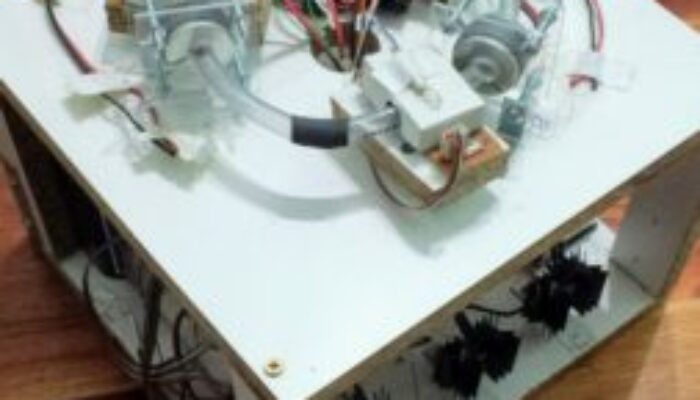
Short Answer
Definition of a Particle Accelerator
A particle accelerator is a sophisticated device designed to propel charged particles, such as electrons or protons, to extremely high speeds. These accelerators enable scientists to investigate the fundamental building blocks of matter and the underlying principles of the universe by facilitating high-energy particle collisions.
- Charged particles:
Particles with an electric charge, typically electrons or protons, which can be influenced by electromagnetic fields. - Acceleration:
The process of increasing the kinetic energy of particles using electric fields. - High-energy collisions:
Interactions between accelerated particles that can produce new particles and reveal subatomic phenomena.
Fundamental Principles Behind Particle Acceleration
At the core of particle acceleration lies the application of electric fields to impart energy to charged particles. When these particles are accelerated to speeds approaching that of light, they gain significant kinetic energy, enabling them to collide with other particles at high energies. These collisions are crucial for exploring the subatomic world and understanding particle interactions.
Essential Components of a Basic Particle Accelerator
While constructing a full-scale particle accelerator at home is impractical, a simplified model-often resembling a cathode ray tube (CRT)-can be assembled using key components:
- Electron gun:
This component emits electrons through thermionic emission, where a heated cathode releases electrons that are then attracted by a metal anode to initiate acceleration. - High-voltage power supply:
A source capable of generating kilovolt-level voltages is necessary to accelerate electrons. Proper insulation and current regulation are critical for safety. - Vacuum chamber:
To prevent electrons from colliding with air molecules, a vacuum environment is required. This chamber, made from glass or metal, maintains low pressure for unobstructed particle movement. - Deflection plates:
These plates apply an electric field to steer the electron beam by altering its trajectory through voltage adjustments. - Detection system:
Devices such as fluorescent screens or detectors observe the interactions when electrons strike a target, providing visual or measurable feedback.
Step-by-Step Assembly Process
The construction of a mini particle accelerator begins with assembling the vacuum chamber, ensuring airtight seals to maintain the necessary low-pressure environment. The electron gun is then positioned inside the chamber and connected to the high-voltage power supply with secure, insulated wiring to prevent electrical hazards.
Next, a vacuum pump is employed to evacuate air from the chamber, creating the vacuum essential for efficient electron acceleration. Monitoring the internal pressure is vital, as residual gases can impede particle movement and reduce performance.
Once the vacuum is established, the electron gun is activated by applying voltage, causing electron emission. Adjusting the current controls the electron flow, balancing between sufficient particle production and system stability.
Finally, the deflection plates are energized to manipulate the electron beam’s path, directing it toward a target where interactions can be observed and studied.
Scientific and Educational Applications
Operating a home-built particle accelerator allows for exploration of phenomena such as cathode ray fluorescence, where accelerated electrons collide with materials, causing them to emit light. These experiments offer hands-on insights into electron dynamics and atomic interactions, making complex physics concepts more accessible.
Safety Considerations and Required Knowledge
Engaging in particle accelerator construction demands a solid grasp of electromagnetism and particle physics principles. Safety is paramount, especially when handling high voltages and potential radiation. Proper insulation, current limiting, and adherence to safety protocols are essential to prevent accidents and ensure a secure experimental environment.
Broader Significance of Amateur Particle Accelerators
Building a mini particle accelerator at home symbolizes the democratization of scientific inquiry, bridging the gap between professional research and personal experimentation. This pursuit nurtures curiosity, empowers enthusiasts to engage deeply with physics, and exemplifies the enduring human drive to unravel the mysteries of the universe.
Summary: The Educational Value of Home Particle Accelerators
Constructing a simplified particle accelerator offers a unique blend of theoretical knowledge and practical skills. Despite inherent challenges, the educational benefits are substantial, providing a tangible connection to the fundamental forces and particles that compose our universe. This endeavor not only enriches understanding but also inspires continued exploration in the field of physics.
FAQ
What is the purpose of a mini particle accelerator?
To provide an educational tool demonstrating the principles of particle acceleration and electron behavior in a controlled environment.
How does a mini particle accelerator work?
It accelerates electrons using high-voltage electric fields inside a vacuum chamber, directing them via deflection plates towards a target for observation.
What safety measures should be taken?
Use proper insulation, limit current flow, maintain a secure vacuum, and avoid exposure to high voltages and potential radiation.






Leave a Reply