

Short Answer
Understanding Quantum Computing
Quantum computing represents a groundbreaking shift in the way information is processed, moving beyond the traditional binary framework of classical computing. This new paradigm leverages the principles of quantum mechanics to redefine computational logic, promising capabilities far beyond those of conventional systems.
Definition and Fundamental Concepts
At the heart of classical computing lies the bit, a basic unit of data that exists in one of two states: 0 or 1. These bits form the foundation of logic gates and digital circuits, enabling the processing of information in a binary format. However, quantum computing introduces the qubit, a quantum analogue to the classical bit, which can exist in multiple states simultaneously due to the phenomenon known as superposition.
- Classical Bit:
A binary unit of information restricted to either 0 or 1. - Qubit:
A quantum unit capable of representing 0, 1, or both states at once through superposition. - Superposition:
The ability of a qubit to be in multiple states simultaneously, enabling parallel computation. - Entanglement:
A quantum property where qubits become interconnected such that the state of one instantly influences the state of another, regardless of distance.
How Quantum Computing Operates
Quantum computers harness superposition and entanglement to perform complex calculations more efficiently than classical computers. While classical bits process information sequentially, qubits can evaluate multiple possibilities at once, exponentially increasing computational power. Entanglement further enhances this by linking qubits in ways that allow for coordinated operations across the system.
Mathematical Framework and Quantum Logic
The mathematical foundation of quantum computing is rooted in linear algebra and quantum mechanics. Qubit states are represented as vectors in a complex Hilbert space, often expressed as:
|ψ⟩ = α|0⟩ + β|1⟩
- |ψ⟩: The state vector of the qubit.
- α, β: Complex probability amplitudes where |α|² + |β|² = 1.
- |0⟩, |1⟩: Basis states corresponding to classical bit values.
Quantum gates manipulate these states through unitary transformations, enabling the construction of quantum algorithms that exploit superposition and entanglement.
Practical Applications and Examples
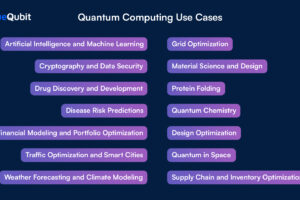
Quantum computing holds promise across various domains by solving problems that are intractable for classical computers:
- Cryptography:
Algorithms like Shor’s algorithm can factor large numbers efficiently, threatening current encryption methods. - Chemistry and Materials Science:
Quantum simulations can model molecular interactions with high precision, accelerating drug discovery and materials design. - Optimization and Machine Learning:
Quantum algorithms can tackle complex optimization problems and enhance machine learning models through entangled qubit networks.
Challenges in Quantum Computing Implementation
Despite its theoretical potential, quantum computing faces significant practical obstacles:
- Quantum Decoherence:
The fragile nature of qubit states makes them susceptible to environmental interference, causing loss of coherence and computational errors. - Error Correction:
Developing fault-tolerant quantum systems requires sophisticated error correction techniques to maintain qubit stability. - Hardware Development:
Building reliable qubit architectures-such as superconducting circuits, trapped ions, or topological qubits-remains a complex engineering challenge.
Adapting Algorithms for Quantum Computing
Classical algorithms are generally incompatible with quantum systems due to the fundamentally different nature of quantum information processing. Consequently, new quantum-specific algorithms must be designed to fully exploit superposition and entanglement. This necessitates collaboration between physicists and computer scientists to develop a novel computational language and methodologies tailored to quantum mechanics.
Societal and Ethical Considerations
The advent of quantum computing raises important ethical and societal questions, particularly regarding data security and privacy. The ability of quantum computers to break existing cryptographic protocols could compromise sensitive information, prompting urgent research into quantum-resistant encryption methods. Additionally, the equitable distribution of quantum technology and education is essential to ensure broad participation and benefit from this transformative field.
Educational Imperatives and Future Outlook
To cultivate a workforce capable of advancing quantum computing, interdisciplinary education encompassing physics, computer science, and mathematics is vital. Encouraging diverse perspectives and fostering collaboration will be key to overcoming the complexities of quantum technology. As we approach a future shaped by quantum logic, the integration of classical and quantum paradigms will redefine computation, presenting both unprecedented opportunities and challenges.
Conclusion: Embracing the Quantum Revolution
The transition from classical bits to quantum qubits signifies more than a technological upgrade; it represents a fundamental reimagining of computation. While the path forward is fraught with technical and conceptual hurdles, the potential rewards in computational power and scientific discovery are immense. Preparing for this quantum era requires innovation, cooperation, and a commitment to addressing the ethical and practical implications of this transformative technology.
FAQ
What is a qubit?
A qubit is the fundamental unit of quantum information, capable of existing in multiple states simultaneously through superposition, unlike classical bits that are either 0 or 1.
How does quantum computing differ from classical computing?
Quantum computing leverages principles such as superposition and entanglement, allowing it to perform certain calculations exponentially faster than classical computers.
What are the main challenges in building quantum computers?
Challenges include maintaining qubit stability due to quantum decoherence, developing fault-tolerant architectures, and creating effective error correction methods.
What are the practical applications of quantum computing?
Applications include cryptography, drug discovery, materials science, optimization problems, and advancing artificial intelligence.
How does quantum computing impact data security?
Quantum computers could break current cryptographic protocols, necessitating the development of quantum-resistant algorithms to protect data privacy.


Leave a Reply