
Short Answer
Definition of Dark Matter and Dark Energy
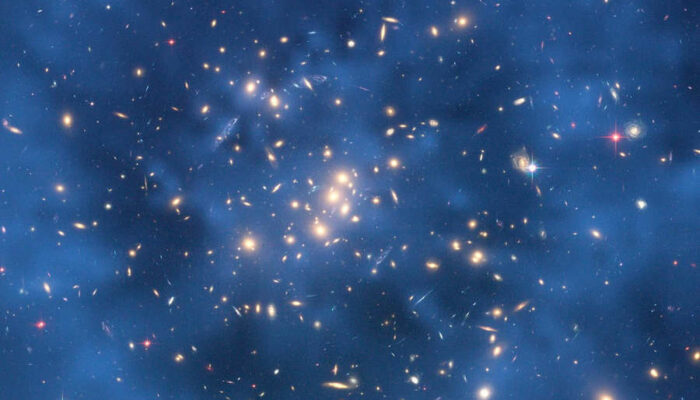
Dark matter and dark energy are two enigmatic components that together constitute about 95% of the universe’s total content. Despite their invisibility and elusive nature, they play crucial roles in shaping the cosmos. Dark matter is an unseen form of matter that exerts gravitational attraction, helping to hold galaxies together. In contrast, dark energy is a mysterious force responsible for the accelerated expansion of the universe, effectively pushing spacetime apart.
- Dark Matter:
A non-luminous substance inferred from gravitational effects on visible matter, radiation, and the large-scale structure of the universe. - Dark Energy:
A repulsive force or energy permeating space, causing the expansion of the universe to accelerate over time.
Historical Context and Discovery
The concept of dark matter arose when astronomers noticed that galaxies rotate at speeds that cannot be explained solely by the gravitational pull of visible matter. This discrepancy suggested the presence of an invisible mass exerting additional gravity. Dark energy was identified later through observations of distant supernovae, which revealed that the universe’s expansion is not slowing down as previously thought but accelerating. These discoveries challenged existing cosmological models and introduced profound questions about the universe’s composition and fate.
Distinct Roles and Characteristics
Dark matter and dark energy differ fundamentally in their gravitational effects and spatial behavior:
- Gravitational Influence:
Dark matter attracts and clusters around galaxies, forming halos that influence galactic dynamics. - Cosmic Expansion:
Dark energy acts as a repulsive force on cosmological scales, driving the accelerated expansion of spacetime. - Distribution:
Dark matter is concentrated in dense regions, while dark energy is diffuse and nearly uniform throughout the universe. - Temporal Dominance:
Dark matter has influenced structure formation since the early universe, whereas dark energy became dominant only in the recent cosmological past.
Theoretical Perspectives on Unification
While traditionally treated as separate phenomena, some theoretical models propose that dark matter and dark energy might be different manifestations of a single underlying entity. These hypotheses challenge the conventional dichotomy by suggesting a unified dark sector with adaptive properties depending on environmental conditions.
Unified Dark Fluid Models
These models describe a single cosmic fluid that behaves like dark matter in dense regions such as galactic halos but exhibits dark energy-like repulsive effects on larger, intergalactic scales. This fluid’s equation of state changes dynamically, allowing it to mimic both gravitational attraction and cosmic acceleration.
Scalar Field Theories
Scalar fields permeating the universe are proposed as candidates for unification. In quintessence models, a slowly evolving scalar field accounts for dark energy, while other theories suggest scalar fields that interact with matter and spacetime curvature to replicate dark matter effects in certain regimes. Such fields could provide a common framework linking the two phenomena.
Modified Gravity Approaches
Alternatives to Einstein’s general relativity propose that gravity itself behaves differently on large scales, potentially explaining both dark matter and dark energy effects without invoking separate substances. These theories suggest that the observed phenomena might arise from geometric or field-theoretic properties of spacetime.
Challenges to Unification
Despite the appeal of a unified explanation, significant obstacles remain:
- Observational Evidence:
Data from cosmic microwave background radiation, gravitational lensing, and galaxy cluster dynamics generally support models treating dark matter and dark energy as distinct entities with unique properties. - Behavioral Differences:
Dark matter clusters gravitationally, whereas dark energy remains diffuse and uniform, making it difficult to reconcile their effects within a single framework. - Scale and Interaction:
The two phenomena operate on vastly different spatial and temporal scales, with dark matter influencing galactic dynamics and dark energy dominating cosmic expansion at the largest scales. - Experimental Detection:
Direct detection of dark matter particles has so far been unsuccessful, raising questions about its assumed properties and opening the door for alternative explanations.
Mathematical Frameworks and Formulations
The study of dark matter and dark energy involves complex mathematical models that describe their influence on the universe’s evolution.
- Dark Matter:
Often modeled as cold, collisionless particles contributing to the total matter density parameter Ωm in the Friedmann equations governing cosmic expansion. - Dark Energy:
Frequently represented by the cosmological constant Λ or a dynamic scalar field with an equation of state parameter w = p/ρ, where p is pressure and ρ is energy density. For a cosmological constant, w = -1.
Real-World Observations and Experimental Efforts
Ongoing and future observational projects aim to deepen our understanding of dark matter and dark energy:
- Vera C. Rubin Observatory (LSST):
Will provide detailed maps of the universe’s structure, helping to trace dark matter distribution and the effects of dark energy on cosmic expansion. - Euclid Space Telescope:
Designed to study dark energy by measuring the geometry of the universe and the growth of cosmic structures. - Nancy Grace Roman Space Telescope:
Will investigate dark energy and dark matter through wide-field infrared surveys and gravitational lensing measurements. - Particle Physics Experiments:
Efforts to detect dark matter particles directly or indirectly continue, with implications for understanding its nature and potential links to dark energy.
Common Misconceptions
Dark matter and dark energy are the same because both are invisible.
Although both are unseen, they have fundamentally different effects-dark matter attracts gravitationally, while dark energy causes cosmic acceleration.
Dark energy is just empty space.
Dark energy may be related to vacuum energy but could also be a dynamic field with complex properties, not simply empty space.
Dark matter has been directly detected.
Despite extensive searches, no direct detection of dark matter particles has been confirmed to date.
Significance in Cosmology and Physics
Understanding dark matter and dark energy is vital for comprehending the universe’s structure, evolution, and ultimate fate. These components influence galaxy formation, cosmic expansion, and the large-scale geometry of spacetime. Unraveling their mysteries could revolutionize physics by revealing new fundamental forces or particles and refining our grasp of gravity and quantum fields. Moreover, the quest to understand these phenomena drives technological advancements and inspires profound philosophical reflections on the nature of reality.
FAQ
What is dark matter?
Dark matter is an unseen form of matter that exerts gravitational attraction, helping to hold galaxies together.
What is dark energy?
Dark energy is a mysterious force responsible for the accelerated expansion of the universe.
Are dark matter and dark energy the same thing?
No, they are fundamentally different; dark matter attracts gravitationally, while dark energy causes cosmic acceleration.


Leave a Reply