
Short Answer
Definition of Dark Photons
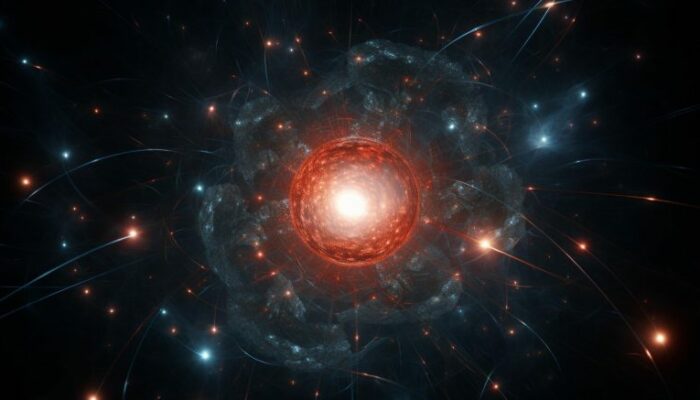
Dark photons are hypothetical particles proposed as counterparts to the well-known photon, the quantum of electromagnetic radiation responsible for light. Unlike ordinary photons, dark photons are theorized to belong to a hidden or “dark” sector of the universe, interacting weakly with both dark matter and, to a lesser extent, normal matter. They are considered potential mediators of forces within this invisible realm, which remains undetectable by conventional electromagnetic means.
- Photon:
The fundamental particle that carries electromagnetic force and enables light to travel through space. - Dark Photon:
A proposed particle similar to the photon but associated with a hidden sector, possibly interacting with dark matter. - Dark Sector:
A hypothesized parallel realm of particles and forces that do not interact strongly with ordinary matter or light.
Background: The Mystery of Dark Matter
Dark matter constitutes about 27% of the universe’s total mass-energy content and acts as the gravitational framework around which galaxies form and evolve. Despite its significant presence, dark matter has eluded direct detection because it does not emit, absorb, or reflect light, making it invisible to electromagnetic observations. This invisibility has driven scientists to explore new theoretical frameworks and particles, such as dark photons, that might bridge the gap between observable matter and the unseen dark matter.
Mechanism: How Dark Photons Operate
Dark photons are thought to interact with ordinary photons through a process called kinetic mixing. This subtle interaction allows energy or information to be exchanged between the visible universe and the dark sector. The kinetic mixing effect is extremely weak, akin to a faint background hum beneath a dominant melody, making detection challenging but not impossible. Through this mechanism, dark photons could produce faint electromagnetic signals or decay products that might be observed with highly sensitive instruments.
Mathematical Framework: Kinetic Mixing and Interaction
The interaction between dark photons and ordinary photons can be described by the kinetic mixing term in the Lagrangian of particle physics:
𝓛 ⊃ – (ε/2) Fμν F’μν
- Fμν: Electromagnetic field strength tensor for ordinary photons.
- F’μν: Field strength tensor for dark photons.
- ε (epsilon): The kinetic mixing parameter, a small dimensionless constant quantifying the strength of interaction between photons and dark photons.
This term allows dark photons to couple weakly to the electromagnetic current, enabling potential observable effects despite their hidden nature.
Experimental Searches and Techniques
Physicists employ a variety of experimental strategies to detect dark photons, leveraging both high-energy particle collisions and precision measurements:
- Collider Experiments:
Facilities like the Large Hadron Collider (LHC) analyze collision data for unusual events that could indicate dark photon production or decay. - Fixed-Target Experiments:
Intense electron beams directed at targets are used to search for subtle deviations in particle behavior caused by dark photons. - Precision Measurements:
Atomic and molecular experiments with ultra-high sensitivity look for tiny electromagnetic anomalies that might signal dark photon interactions. - Astrophysical and Cosmological Observations:
Surveys of cosmic microwave background radiation and galactic structures provide indirect evidence by examining the influence of dark photons on the evolution of the universe.
Significance in Physics and Cosmology
The discovery of dark photons would revolutionize our understanding of the universe by unveiling a hidden layer of particles and forces that coexist alongside the familiar ones. This could shed light on the nature of dark matter, revealing how it interacts and influences cosmic structures beyond gravity alone. Furthermore, uncovering dark photons might inspire new quantum technologies and deepen the theoretical framework of particle physics, potentially leading to breakthroughs in both fundamental science and applied technology.
Common Misconceptions About Dark Photons
Dark photons are just regular photons with a different name.
While similar in concept, dark photons belong to a separate hidden sector and interact very weakly with ordinary photons, making them fundamentally distinct.
Dark photons have already been detected.
To date, dark photons remain hypothetical, with ongoing experiments searching for evidence but no confirmed detection yet.
Dark photons explain all dark matter phenomena.
Dark photons are one possible component or mediator within the dark sector, but dark matter may involve multiple particles and forces beyond just dark photons.
Why the Study of Dark Photons Is Crucial
Investigating dark photons is essential because it addresses one of the most profound mysteries in modern physics: the composition and behavior of dark matter. Understanding dark photons could unlock new physics beyond the Standard Model, offering insights into the universe’s hidden architecture. This research not only advances fundamental knowledge but also exemplifies the synergy between theoretical innovation and experimental ingenuity, driving progress in particle physics, cosmology, and potentially future technologies.
Conclusion: The Ongoing Quest for Cosmic Illumination
The pursuit of dark photons embodies humanity’s enduring desire to illuminate the unknown and comprehend the universe’s deepest secrets. Whether these elusive particles will ultimately be discovered remains uncertain, but their study continues to inspire scientific creativity and exploration. As researchers refine their methods and expand their reach, dark photons stand as a beacon of possibility-an invitation to uncover the shadowy dimensions that shape the cosmos and enrich our understanding of reality.
FAQ
What are dark photons?
Hypothetical particles similar to photons, theorized to interact weakly with dark matter.
How do dark photons interact with ordinary matter?
Through a process known as kinetic mixing, allowing subtle interactions.
Have dark photons been detected?
No, dark photons remain hypothetical, with ongoing searches for evidence.


Leave a Reply