The UCSC won’t offer me admission to the CS department?

Overview of UCSC Computer Science Admissions The University of California, Santa Cruz (UCSC) holds a distinguished position in the field of computer science education. Its competitive admissions process reflects the high caliber of applicants drawn to this vibrant academic community. Receiving a rejection from UCSC’s Computer Science (CS) department can be a challenging experience, but […]


Read More →

What will replace silicon computer chips?

Overview of Silicon Chip Limitations Silicon has been the foundational material for computer chips due to its semiconductor properties, abundance, and ease of manufacturing. However, as transistor dimensions approach atomic scales, silicon faces significant physical and technical constraints. These include increased power consumption, difficulties in heat management, and quantum tunneling effects that disrupt transistor behavior. […]

Read More →

What is PhD level physics like?

Understanding a PhD in Physics Pursuing a Doctor of Philosophy (PhD) in Physics represents an intricate and demanding academic journey, marked by both intellectual challenges and profound discoveries. This advanced degree goes beyond imparting specialized knowledge; it transforms the way candidates think about the fundamental principles of the physical universe. Unlike undergraduate studies that emphasize […]

Read More →

What is the forbidden transition in quantum mechanics?

Definition of Forbidden Transitions in Quantum Mechanics In the field of quantum mechanics, forbidden transitions refer to changes between quantum energy states that are highly improbable or disallowed according to specific selection rules. These rules arise from fundamental physical laws and symmetries governing quantum systems. Forbidden transitions contrast with allowed transitions, which comply with these […]

Read More →

What is the difference between spin and isospin?

Definition of Spin and Isospin Spin and isospin are fundamental concepts in particle physics that describe intrinsic angular momentum properties of particles, yet they originate from different theoretical backgrounds and serve distinct physical roles. Both are quantized quantum numbers, but while spin is an inherent characteristic of individual particles, isospin is a symmetry-related quantum number […]

Read More →

Is it possible to create a gamma radiation in lab?

Definition of Gamma Radiation Gamma radiation is a highly energetic form of electromagnetic radiation that originates from atomic nuclei. Unlike alpha and beta particles, gamma rays are massless and electrically neutral photons. They possess extremely short wavelengths, typically ranging from 0.01 to 10 nanometers, placing them at the extreme high-energy end of the electromagnetic spectrum, […]

Read More →

Cosmology Gets Precise: Mapping the Universe in Ultra HD

Definition of Ultra-High-Definition Imaging in Cosmology Ultra-high-definition (UHD) imaging refers to visual data captured at resolutions of no less than 3840 x 2160 pixels, offering an extraordinary level of detail far surpassing conventional imaging techniques. In the context of cosmology, UHD imaging enables scientists to observe celestial objects and phenomena with remarkable clarity, facilitating deeper […]

Read More →

Is quantum field theory useful for engineering?

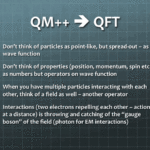
Understanding Quantum Field Theory Quantum Field Theory (QFT) stands as a cornerstone of contemporary theoretical physics, offering a comprehensive framework to describe the behavior and interactions of subatomic particles. It merges the principles of quantum mechanics with special relativity, enabling a unified mathematical depiction of fundamental forces such as electromagnetic, weak, and strong interactions. While […]

Read More →