
Short Answer
Understanding Quantum Field Theory
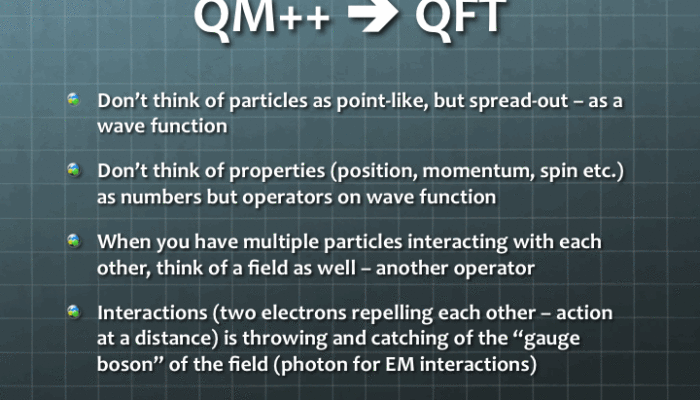
Quantum Field Theory (QFT) stands as a cornerstone of contemporary theoretical physics, offering a comprehensive framework to describe the behavior and interactions of subatomic particles. It merges the principles of quantum mechanics with special relativity, enabling a unified mathematical depiction of fundamental forces such as electromagnetic, weak, and strong interactions. While QFT is often perceived as highly abstract and mathematically intensive, its foundational concepts have begun to permeate various engineering fields, fostering innovative approaches to complex technological challenges.
Core Principles and Mechanisms of QFT
At its essence, QFT treats particles as excitations of underlying quantum fields that permeate space-time. These fields interact according to quantized rules, allowing the prediction of particle creation, annihilation, and scattering processes. The theory’s mathematical structure employs operators acting on quantum states, encapsulating phenomena like superposition and entanglement. This framework not only explains particle physics but also provides insights into condensed matter systems and electromagnetic interactions at the quantum scale.
Applications of Quantum Field Theory in Engineering
Advanced Material Engineering
One of the most significant engineering applications of QFT lies in the design and understanding of novel materials, particularly superconductors. The Bardeen-Cooper-Schrieffer (BCS) theory, which explains superconductivity, is deeply rooted in quantum field theoretical concepts. Superconductors exhibit remarkable properties such as zero electrical resistance and the Meissner effect-the expulsion of magnetic fields. By applying QFT principles, engineers can manipulate material properties at the quantum level, optimizing performance for electronics, power transmission, and magnetic sensing technologies.
Optoelectronics and Photonic Devices
Optoelectronics, the field concerned with devices that convert electrical signals into light and vice versa, benefits extensively from QFT insights. Photons, the quantum particles of light, are described as excitations of the electromagnetic field within QFT. This understanding enables engineers to refine the design of lasers, LEDs, and photonic circuits, enhancing efficiency and enabling ultra-fast data transmission and advanced imaging systems. The quantum nature of light-matter interaction is crucial for pushing the boundaries of communication technology.
Quantum Computing Engineering
Quantum computing represents a transformative frontier where QFT’s principles are directly harnessed. Quantum bits (qubits) exploit superposition and entanglement-phenomena explicable through QFT-to perform computations far beyond classical capabilities. Engineering quantum processors involves integrating quantum mechanical concepts with classical engineering techniques to maintain coherence and mitigate decoherence. This interdisciplinary challenge demands a deep understanding of QFT to realize scalable, practical quantum computing devices.
Nanotechnology and Quantum-Scale Engineering
As device dimensions shrink to the nanoscale, classical physics fails to accurately describe material behavior. Here, QFT provides essential tools to analyze electron and phonon interactions, tunneling effects, and quantization phenomena. These quantum effects are pivotal in developing next-generation semiconductors, energy harvesting systems, sensors, and catalysts. Engineers leverage QFT to innovate at scales where quantum phenomena dominate, enabling breakthroughs in nanodevice performance and functionality.
Challenges in Integrating QFT with Engineering Practice
Despite its potential, the adoption of QFT in mainstream engineering faces several hurdles. The complexity and abstract nature of quantum mechanics and QFT’s mathematical formalism can be daunting for engineers accustomed to classical paradigms. This often results in a divide between theoretical physics advancements and their practical engineering applications. Additionally, scaling quantum-based solutions from laboratory settings to commercially viable products remains a significant challenge, necessitating collaborative efforts across physics, engineering, materials science, and computer science disciplines.
Educational and Collaborative Imperatives
To bridge the gap between QFT theory and engineering practice, educational reforms are essential. Engineering curricula must evolve to incorporate quantum physics fundamentals, equipping future engineers with the knowledge to navigate and innovate within this complex domain. Furthermore, fostering interdisciplinary collaboration is critical to translate QFT insights into tangible technologies, driving progress in fields such as quantum computing, advanced materials, and nanotechnology.
Significance of Quantum Field Theory in Modern Engineering
The integration of QFT into engineering heralds a paradigm shift with far-reaching implications. From enabling the creation of superconducting materials and enhancing optoelectronic devices to pioneering quantum computing and nanoscale technologies, QFT provides a theoretical foundation for next-generation innovations. Embracing this interdisciplinary approach promises to unlock unprecedented capabilities, shaping the future landscape of technology and engineering.
Frequently Asked Questions
Is Quantum Field Theory directly applicable in conventional engineering fields?
While QFT is fundamentally theoretical and mathematically complex, its direct use in traditional engineering is limited. However, it underpins advanced sectors like materials science, quantum computing, and nanotechnology, where its principles are increasingly influential.
How does QFT contribute to the development of superconductors?
QFT forms the theoretical basis for understanding electron pairing mechanisms in superconductors, as described by the BCS theory. This knowledge enables engineers to design materials exhibiting zero electrical resistance and magnetic field expulsion.
Why is interdisciplinary collaboration crucial for applying QFT in engineering?
The sophisticated mathematics and concepts of QFT require joint efforts among physicists, engineers, and material scientists to effectively convert theoretical models into practical engineering solutions.
What role does QFT play in the engineering of quantum computers?
QFT explains key quantum phenomena such as superposition and entanglement, which quantum computers exploit for high-speed processing. It guides the design of quantum chips and strategies to maintain quantum coherence.
What challenges exist in incorporating QFT into engineering education?
Traditional engineering programs focus on classical physics and empirical methods, so integrating QFT demands curriculum updates to provide engineers with the quantum knowledge necessary for future technological advancements.




Leave a Reply