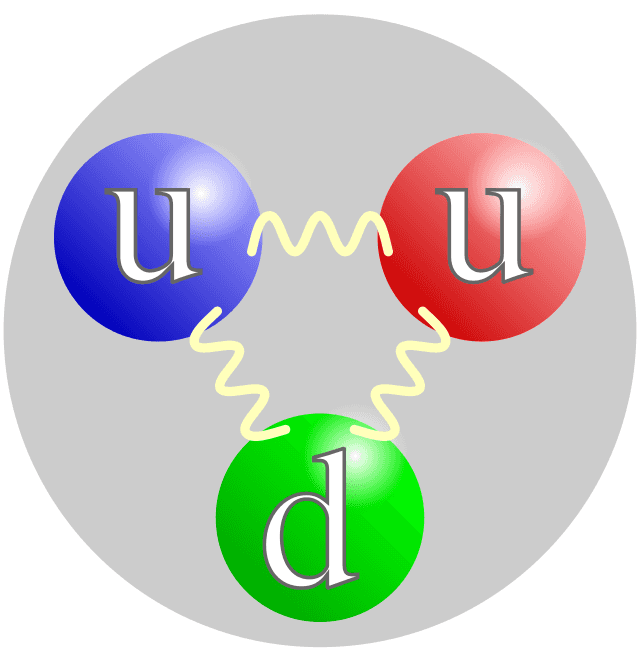
What is a quark

Definition of Quarks Quarks are fundamental particles that serve as the essential building blocks of matter. They are elementary constituents that combine to form protons, neutrons, and other hadrons, playing a pivotal role in the composition of the universe. As one of the core elements in particle physics, quarks provide critical insight into the structure […]

Read More →

What’s the geometry of an elementary particle?

Definition of Elementary Particle Geometry The geometry of elementary particles encompasses the mathematical and physical frameworks used to describe their spatial and intrinsic characteristics. This concept extends beyond viewing particles as mere point-like entities, incorporating advanced theoretical models that attribute geometric and topological properties to these fundamental constituents of matter. Point Particles: Traditionally, elementary particles […]

Read More →

How to learn about particle physics?

Definition of Particle Physics Particle physics is the scientific discipline focused on investigating the most basic building blocks of matter and radiation. It seeks to understand the fundamental particles that constitute the universe and the forces that govern their interactions. This field not only deepens our comprehension of the physical world but also challenges conventional […]

Read More →

What laws apply to quarks?

Definition of Quarks Quarks are elementary particles that serve as the fundamental components of protons and neutrons, which in turn constitute the nuclei of atoms. Understanding quarks is essential for grasping the principles of particle physics, as they reveal the underlying structure of matter and the universe at its most basic scale. The Standard Model […]

Read More →

What is the origin of virtual particles in quantum physics?

Definition of Virtual Particles Virtual particles are transient, short-lived entities that emerge within the framework of quantum physics. Unlike real particles, which can be directly observed and measured, virtual particles exist fleetingly during interactions between quantum fields. They are fundamental to understanding the non-classical behavior of the quantum world and play a crucial role in […]

Read More →

Can the Higgs boson be used as a weapon?

Definition of the Higgs Boson The Higgs boson is a fundamental particle linked to the Higgs field, a scalar field that exists throughout the universe. This field is essential for giving mass to elementary particles through a process known as the Higgs mechanism. Discovered in 2012 at CERN’s Large Hadron Collider (LHC), the Higgs boson […]

Read More →

Chilly Answer to the Neutrino Mass Mystery?

Understanding Neutrino Mass Neutrino mass represents a fundamental puzzle in particle physics, challenging long-held assumptions about the nature of these elusive particles. Neutrinos, often referred to as “ghost particles,” are elementary particles that interact extremely weakly with matter, making them difficult to detect. Despite their abundance throughout the universe, their mass remains incredibly small compared […]

Read More →

What is the significance of high energy physics?

Definition of High Energy Physics High energy physics (HEP), commonly known as particle physics, is a specialized field of physics dedicated to investigating the most elementary constituents of matter and the fundamental forces that dictate their behavior. This discipline extends beyond theoretical curiosity, playing a crucial role in expanding our comprehension of the universe’s underlying […]

Read More →