
Short Answer
Definition of the Higgs Boson
The Higgs boson is a fundamental particle in particle physics, initially hypothesized as part of a theoretical framework and later confirmed through experimental discovery. It is intrinsically linked to the Higgs field, a pervasive quantum field that imparts mass to other elementary particles. Without the Higgs boson and its associated field, particles such as electrons and quarks would remain massless, fundamentally altering the structure of matter and the universe.
- Higgs Field:
A quantum field that exists throughout the universe, responsible for giving mass to particles through their interaction with it. - Mass Generation:
Particles gain mass proportional to the strength of their interaction with the Higgs field.
Historical Background and Theoretical Foundations
The concept of the Higgs boson emerged in the 1960s when physicists Peter Higgs, François Englert, and Robert Brout independently proposed mechanisms involving spontaneous symmetry breaking. Their work explained how particles could acquire mass without violating the gauge symmetry of the electroweak interaction, which unifies electromagnetism and the weak nuclear force. This breakthrough provided a crucial piece in the Standard Model of particle physics, offering a deeper understanding of fundamental forces and particles.
Role Within the Standard Model
Within the Standard Model, the Higgs boson represents the quantum excitation of the Higgs field. It plays a central role in explaining why certain particles have mass while others do not. The electroweak symmetry breaking facilitated by the Higgs mechanism allows particles to obtain mass, enabling the formation of atoms and matter as observed in the universe.
Experimental Discovery and Significance
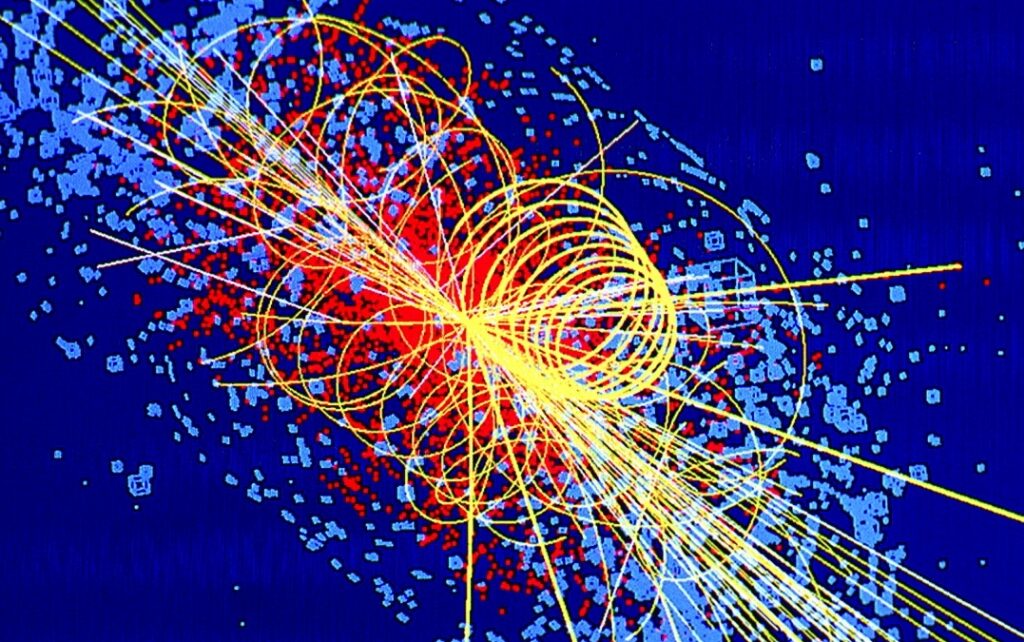
After decades of theoretical development, the Higgs boson was experimentally observed on July 4, 2012, by scientists at CERN using the Large Hadron Collider (LHC). This discovery was a landmark achievement, confirming the existence of the Higgs boson and validating the Standard Model’s predictions. The detection involved identifying the particle’s fleeting presence through its decay products, a challenging task given its extremely short lifetime.
- Detection Method:
The Higgs boson was identified by analyzing the particles it decays into, such as photons, W and Z bosons, and fermions. - Lifetime:
The particle exists for approximately 10-22 seconds before decaying.
Mechanism of Mass Generation
The Higgs mechanism explains how particles acquire mass through their interaction with the Higgs field. Particles that couple strongly to the field gain more mass, while those with weaker interactions remain lighter or massless. This process preserves the gauge symmetries of the electroweak force, ensuring consistency within the Standard Model.
Mathematical Framework
The mass generation via the Higgs mechanism can be described mathematically through spontaneous symmetry breaking in the electroweak Lagrangian. The Higgs field acquires a nonzero vacuum expectation value (VEV), denoted as v, which leads to mass terms for gauge bosons and fermions:
- Mass of W and Z Bosons:
mW = ½ gv, mZ = ½ √(g² + g’²) v, where g and g’ are coupling constants. - Fermion Masses:
Generated through Yukawa couplings yf with the Higgs field: mf = yf v / √2.
Current Research and Open Questions
Despite the discovery, many aspects of the Higgs boson and field remain enigmatic. Physicists continue to investigate the precise nature of the Higgs mass, measured at about 125 giga-electronvolts (GeV), and explore theories beyond the Standard Model, such as supersymmetry and extra dimensions, which might explain the origin of this mass. Additionally, the relationship between the Higgs field and dark matter is an active area of research, as understanding these connections could illuminate the composition of the universe.
Cosmological Implications
The Higgs boson also raises profound questions about the universe’s fundamental symmetries and matter-antimatter asymmetry. The dynamics of the Higgs field may be linked to why the universe contains more matter than antimatter and whether hidden symmetries exist at deeper levels. These inquiries are crucial for comprehending cosmic evolution and the underlying principles governing the cosmos.
Challenges in Detection and Study
Studying the Higgs boson is inherently difficult due to its extremely short lifespan and the complexity of its decay signatures. Advanced particle accelerators and detectors, such as those at the LHC, are essential for capturing and analyzing the fleeting evidence of its existence. Researchers must sift through vast amounts of collision data to isolate events consistent with Higgs boson production and decay.
Why the Higgs Boson Is Important
The Higgs boson is a cornerstone of modern physics, providing critical insight into the origin of mass and the structure of matter. Its discovery not only confirmed a key prediction of the Standard Model but also opened new pathways for exploring physics beyond current theories. Understanding the Higgs boson deepens our grasp of the universe’s fundamental workings and may eventually lead to breakthroughs in unifying forces and explaining dark matter.
Common Misconceptions About the Higgs Boson
The Higgs boson is the particle that gives mass to everything.
The Higgs boson is a manifestation of the Higgs field, which imparts mass to certain fundamental particles, but not all mass in the universe arises from this mechanism (e.g., most of the mass of protons and neutrons comes from strong force interactions).
The Higgs boson is a stable particle.
The Higgs boson is highly unstable, existing for an extremely brief time before decaying into other particles.
Future Prospects
Ongoing and future experiments aim to probe the Higgs boson’s properties with greater precision, searching for deviations from Standard Model predictions that could hint at new physics. These studies may reveal unknown interactions, help identify dark matter candidates, and contribute to a more unified understanding of fundamental forces, potentially revolutionizing particle physics and cosmology.
FAQ
What is the Higgs boson?
The Higgs boson is an elementary particle linked to the Higgs field, which endows other particles with mass.
Why is the Higgs boson important in physics?
Its discovery confirmed the Higgs mechanism within the Standard Model, explaining why particles have mass.
How was the Higgs boson discovered?
It was detected through high-energy collisions at the Large Hadron Collider at CERN in 2012.
What are the future research directions related to the Higgs boson?
Scientists aim to explore its properties in more detail, search for connections to dark matter, and investigate physics beyond the Standard Model.






Leave a Reply