
Short Answer
Definition of the Higgs Boson and Its Role in Particle Physics
The Higgs boson, frequently dubbed the “God Particle,” is a fundamental element in particle physics that connects the abstract concept of the Higgs field with tangible subatomic particles. It plays a crucial role in explaining how particles acquire mass, a property essential for the structure and behavior of matter in the universe.
The Higgs Field: An Omnipresent Quantum Medium
Central to understanding the Higgs boson is the Higgs field, a quantum field believed to permeate all of space. This field can be envisioned as an invisible, all-encompassing energy ocean through which particles move. The interaction between particles and this field determines their mass, influencing their physical properties and interactions.
- Mass Acquisition:
Particles gain mass by interacting with the Higgs field; the strength of this interaction varies among different particles. - Massless Particles:
Some particles, like photons, do not interact with the Higgs field and thus remain massless, allowing them to travel at the speed of light.
Mechanism of Mass Generation
The process by which particles obtain mass through the Higgs field can be likened to moving through a viscous medium. As particles traverse this field, they experience resistance that manifests as inertia or mass. This resistance differs among particles, resulting in a spectrum of masses.
- Light Particles:
Photons pass through the Higgs field without resistance, remaining massless. - Heavy Particles:
Particles such as W and Z bosons interact strongly with the field, acquiring significant mass that affects fundamental forces.
Discovery and Significance of the Higgs Boson
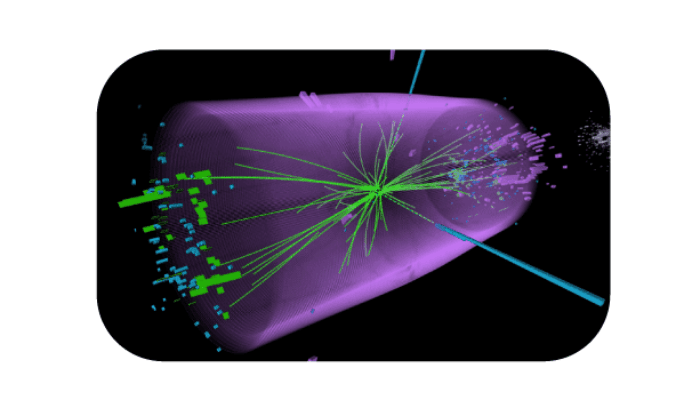
In 2012, scientists at CERN’s Large Hadron Collider (LHC) confirmed the existence of the Higgs boson, a particle that represents a quantized excitation of the Higgs field. This discovery validated the Higgs mechanism, a theoretical model proposed in the 1960s by Peter Higgs and others, explaining how particles gain mass.
- Quantized Excitation:
The Higgs boson is analogous to a ripple in the Higgs field, signaling its presence. - Experimental Confirmation:
Detecting the Higgs boson provided empirical support for the Standard Model of particle physics.
The Standard Model and the Importance of the Higgs Mechanism
The Standard Model outlines the fundamental particles and their interactions, with the Higgs mechanism serving as a pivotal component that enables particles to have mass. Without this mechanism, all particles would be massless, preventing the formation of atoms, molecules, and ultimately, the complex structures that constitute the universe.
- Massless Universe:
Absence of the Higgs field would mean no mass, leading to a universe devoid of matter as we know it. - Particle Diversity:
The Higgs mechanism explains the wide range of particle masses observed in nature.
Symmetry Breaking and the Higgs Field
The Higgs field is intimately connected to the concept of symmetry and its spontaneous breaking in particle physics. Initially, the universe existed in a highly symmetrical state. As it cooled after the Big Bang, the Higgs field acquired a non-zero value, breaking this symmetry and allowing certain particles to gain mass while others remained unaffected.
- Spontaneous Symmetry Breaking:
The transition of the Higgs field to a non-zero state disrupted the original symmetry of the universe. - Selective Mass Acquisition:
This process enabled some particles to become massive, while particles like photons stayed massless.
Interplay Between the Higgs Field and Gravity
While gravity is described by general relativity on cosmic scales, the Higgs field governs mass at the quantum level. The relationship between these two frameworks raises profound questions about how mass generated by the Higgs field influences gravitational interactions, hinting at deeper connections between quantum mechanics and gravity.
Broader Implications and Future Research
The Higgs boson’s discovery opens avenues for exploring phenomena beyond the Standard Model. Its role in particle mass affects nuclear stability and stellar processes. Additionally, researchers speculate about potential links between the Higgs boson and dark matter, a mysterious form of matter that constitutes a large portion of the universe’s mass but remains poorly understood.
- Nuclear Stability:
Particle masses influenced by the Higgs field affect the forces that hold atomic nuclei together. - Dark Matter Connections:
Understanding the Higgs boson may shed light on the nature of dark matter and the universe’s evolution.
Summary: The Higgs Boson as a Gateway to Understanding the Universe
The relationship between the Higgs boson and subatomic particles is fundamental to the fabric of the universe, encompassing mass generation, symmetry breaking, and the fundamental forces. As scientific knowledge advances, the Higgs boson remains a key to unraveling the mysteries of existence, highlighting the profound interplay between theoretical physics and the observable cosmos.
FAQ
What is the Higgs boson?
The Higgs boson is an elementary particle associated with the Higgs field, responsible for giving mass to other subatomic particles through their interaction with this field.
How does the Higgs field give particles mass?
Particles acquire mass by interacting with the Higgs field, which permeates the universe; the strength of this interaction determines the mass of the particle.
Why is the Higgs boson called the 'God Particle'?
The nickname 'God Particle' highlights the Higgs boson's fundamental role in explaining why particles have mass, a crucial aspect of the universe's structure.
What was the significance of the Higgs boson discovery at CERN?
The discovery confirmed the existence of the Higgs field and validated the Standard Model's mechanism for particle mass generation.
Does the Higgs boson relate to dark matter?
While speculative, some theories suggest connections between the Higgs boson and dark matter, potentially shedding light on the universe's missing mass.






Leave a Reply