
Short Answer
Definition and Origin of the Wilson Loop
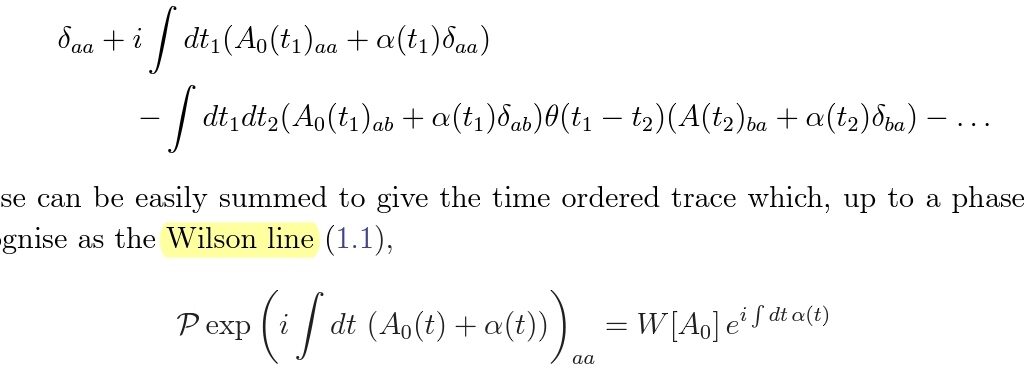
The Wilson loop is a fundamental gauge-invariant quantity in theoretical physics, originally introduced by Kenneth Wilson in the early 1970s. It is defined as the path-ordered exponential of the gauge field integrated along a closed loop in spacetime. This mathematical construct captures essential information about gauge fields and their interactions, particularly in non-perturbative regimes of quantum field theory.
- Gauge Invariance:
The Wilson loop remains unchanged under gauge transformations, making it a robust observable in gauge theories. - Path Integral Formulation:
It involves integrating the gauge connection along a closed contour, encoding the holonomy of the gauge field. - Historical Context:
Initially developed to study the strong interaction in quantum chromodynamics (QCD), it provided a novel approach to understanding quark confinement.
Mathematical Framework and Physical Interpretation
Mathematically, the Wilson loop is expressed as:
W(C) = Tr P exp(i ∮C Aμ(x) dxμ)
where:
- C: A closed loop in spacetime.
- Aμ(x): The gauge field (connection) at point x.
- P: Path-ordering operator ensuring the correct sequence of integration.
- Tr: Trace over the gauge group representation.
This formulation encodes the phase acquired by a charged particle moving along the loop C in the presence of a gauge field. Physically, the Wilson loop can reveal confinement phenomena through its area law behavior, where the expectation value decreases exponentially with the area enclosed by the loop, indicating the binding of quarks.
Historical Significance in Particle Physics
Within high-energy physics, the Wilson loop has been instrumental in advancing the understanding of the strong nuclear force. It enabled non-perturbative analyses in lattice gauge theories, where spacetime is discretized into a lattice, allowing numerical simulations of quantum chromodynamics. The Wilson loop’s expectation values correspond to the potential energy between quark-antiquark pairs, providing insights into confinement and the behavior of hadrons.
Applications in Condensed Matter Physics
Beyond particle physics, the Wilson loop has found impactful applications in condensed matter systems, particularly in the study of topological phases of matter. It serves as a diagnostic tool for identifying topological invariants that characterize exotic states such as topological insulators and quantum Hall systems.
- Topological Insulators:
The Wilson loop helps classify insulating phases by revealing the presence of protected edge states linked to bulk topological properties. - Quantum Hall Effect:
It aids in understanding the quantization of Hall conductance and the emergence of fractional statistics in two-dimensional electron gases. - Symmetry and Topology Interplay:
The Wilson loop framework elucidates how symmetries influence topological order and phase transitions in complex materials.
Role in Quantum Gravity and Spacetime Structure
In the quest to unify quantum mechanics with general relativity, the Wilson loop has emerged as a pivotal concept in quantum gravity research. Particularly in loop quantum gravity, it provides a mechanism to quantize geometric quantities such as areas and volumes by associating them with discrete loops in spacetime.
- Gravitational Wilson Loop:
Extends the concept to gravitational fields, capturing the quantum entanglement of spacetime geometry. - Discrete Spacetime:
The Wilson loop formalism supports the idea that spacetime is composed of fundamental discrete units at the Planck scale. - Bridging Paradigms:
It connects classical geometric notions with quantum field theoretic descriptions, deepening our understanding of the universe’s fabric.
Wilson Loop in Topological Quantum Field Theory (TQFT)
Within topological quantum field theory, the Wilson loop functions as a crucial element for constructing topological invariants associated with knots and links embedded in manifolds. These invariants are sensitive to the global properties of the space rather than local geometric details.
- Knot and Link Invariants:
Wilson loops correspond to observables that classify knots, providing a bridge between physics and classical knot theory. - Quantum States and Anomalies:
They help characterize quantum states that depend solely on topological features, relevant for understanding anomalies in gauge theories. - Quantum Computing Implications:
The topological invariants derived from Wilson loops inform the design of fault-tolerant quantum gates and algorithms.
Interdisciplinary Impact and Future Directions
The versatility of the Wilson loop extends its influence into emerging fields such as cosmology and quantum information science. In cosmology, generalized Wilson loops may provide insights into the quantum nature of the early universe and the interplay between quantum fields and gravitational dynamics.
In quantum information theory, the Wilson loop framework offers a novel perspective on quantum entanglement networks, potentially guiding the development of advanced quantum communication and computation technologies.
Common Misconceptions About the Wilson Loop
The Wilson loop is only relevant in particle physics.
While originating in particle physics, its applications now span condensed matter, quantum gravity, and quantum information science.
The Wilson loop is purely a mathematical abstraction without physical consequences.
It encodes measurable physical phenomena such as quark confinement, topological phases, and quantum geometric properties.
Significance of the Wilson Loop in Modern Physics
The Wilson loop stands as a cornerstone in contemporary physics, bridging diverse disciplines through its ability to capture gauge-invariant and topological information. Its role in elucidating confinement in QCD, characterizing topological matter, quantizing spacetime geometry, and informing quantum computation underscores its profound impact. As research continues to uncover new applications, the Wilson loop remains a vital tool for advancing our fundamental understanding of nature and developing innovative technologies.
FAQ
What is the Wilson loop?
The Wilson loop is a mathematical construct in quantum field theory representing a gauge-invariant quantity defined as a path integral over a closed loop, used to study gauge fields and confinement.
Why is the Wilson loop important in particle physics?
It allows for non-perturbative analysis of the strong force binding quarks, particularly in quantum chromodynamics.
How does the Wilson loop apply to condensed matter physics?
It helps identify topological invariants in materials like topological insulators and quantum Hall systems, shedding light on exotic phases of matter.
What is the role of the Wilson loop in quantum gravity?
It quantifies discrete spacetime structures and entanglement in loop quantum gravity, bridging quantum mechanics and general relativity.
Can the Wilson loop be used in quantum computing?
Yes, through its connection with topological quantum field theory, it aids in understanding quantum entanglement and fault-tolerant quantum gates.



Leave a Reply