

Short Answer
Definition of Dark Energy
Dark energy is a mysterious form of energy that permeates all of space and is believed to be responsible for the accelerated expansion of the universe. It constitutes roughly 68% of the total energy content of the cosmos, making it the dominant component in the large-scale dynamics of the universe. Unlike ordinary matter and dark matter, dark energy exerts a repulsive effect that counterbalances the attractive force of gravity on cosmic scales.
- Nature:
A repulsive energy that drives the universe’s expansion to speed up rather than slow down. - Prevalence:
Constitutes the majority of the universe’s total energy density. - Effect:
Opposes gravitational attraction, causing galaxies to move away from each other at an increasing rate.
Mechanisms Behind Dark Energy
The fundamental mechanism of dark energy involves its role as a form of energy with negative pressure, which leads to a repulsive gravitational effect. This contrasts with the attractive gravity produced by matter and dark matter. The most widely accepted explanation is the cosmological constant, introduced by Albert Einstein, which treats dark energy as a constant, uniform energy density filling space homogeneously. Alternative models propose that dark energy may vary over time, potentially altering its influence on cosmic expansion.
The Cosmological Constant
This model assumes dark energy is a fixed energy density inherent to space itself, unchanging over time and space. Its uniformity implies a steady, persistent influence that gently accelerates the expansion of the universe.
Dynamical Dark Energy Models
These theories suggest that dark energy’s density might evolve, possibly governed by scalar fields that change over cosmic epochs. Such variability could mean dark energy’s strength fluctuates, sometimes exerting a more pronounced effect on the universe’s expansion rate.
Mathematical Framework and Formulas
The influence of dark energy is often incorporated into Einstein’s field equations of General Relativity through the cosmological constant (Λ). The Friedmann equation, which describes the expansion of the universe, includes Λ as follows:
H² = (8πG/3)ρ – (k/a²) + (Λ/3)
- H: Hubble parameter (expansion rate of the universe)
- G: Gravitational constant
- ρ: Energy density of matter and radiation
- k: Curvature parameter of space
- a: Scale factor of the universe
- Λ: Cosmological constant representing dark energy density
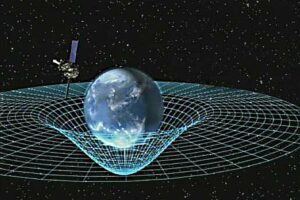
The term Λ/3 acts as a repulsive force, accelerating the expansion of the universe.
Observational Evidence Supporting Dark Energy
Empirical data from various astronomical observations underpin the existence and effects of dark energy:
- Type Ia Supernovae:
Measurements of distant supernovae reveal that the universe’s expansion is accelerating, a phenomenon attributed to dark energy. - Gravitational Lensing:
The bending of light from distant galaxies provides insights into the distribution of matter and the influence of dark energy on spacetime curvature. - Cosmic Microwave Background (CMB):
Fluctuations in the CMB radiation support models that include dark energy as a dominant component affecting the universe’s geometry and expansion history.
Interpreting the Strength of Dark Energy
Determining whether dark energy is “weak” or “strong” depends on the context in which its effects are considered. Locally, dark energy’s influence is negligible compared to gravitational forces from massive objects like stars and galaxies. However, on cosmic scales, its cumulative effect is profound, driving the accelerated expansion of the entire universe.
This duality presents a paradox:
- Local Weakness:
Dark energy’s repulsive force is extremely subtle and overshadowed by gravity in small-scale systems. - Cosmic Strength:
Over vast distances and volumes, dark energy dominates the dynamics of the universe, shaping its ultimate fate.
Philosophical and Practical Considerations
While dark energy is a fundamental aspect of the cosmos, it remains intangible and currently beyond direct manipulation or harnessing by humans. This raises philosophical questions about the nature of “strength” in physical phenomena. Can an entity be considered strong if it cannot be interacted with or controlled? Dark energy challenges traditional notions of force and agency, existing as a pervasive yet elusive influence.
Implications for the Universe’s Future
The properties of dark energy are crucial in predicting the long-term evolution of the cosmos. If dark energy remains constant, the universe will continue expanding indefinitely, potentially leading to a “Big Freeze” where galaxies drift apart and star formation ceases. Alternatively, if dark energy’s density increases, it could culminate in a “Big Rip,” tearing apart galaxies, stars, and eventually atomic structures.
Common Misconceptions About Dark Energy
Dark energy is a form of dark matter.
Dark energy and dark matter are distinct; dark matter exerts gravitational attraction, while dark energy causes repulsion.
Dark energy is a strong force like electromagnetism.
Dark energy’s effect is subtle locally but dominates on cosmic scales, differing fundamentally from known forces.
Dark energy can be harnessed or controlled.
Currently, dark energy is a cosmological property, not a manipulable substance.
Significance of Understanding Dark Energy
Comprehending dark energy is vital for advancing cosmology and physics. It shapes our understanding of the universe’s structure, evolution, and ultimate destiny. Insights into dark energy could unlock new physics beyond the Standard Model, potentially revolutionizing technology and our grasp of fundamental forces.
FAQ
What is dark energy?
Dark energy is a mysterious form of energy that permeates all space and drives the accelerated expansion of the universe.
Is dark energy weak or strong?
Dark energy can be seen as weak locally but strong in its effect on the universe's expansion.
What theories explain dark energy?
The cosmological constant and dynamical dark energy models are key theories explaining dark energy.
How is dark energy observed?
Through supernova measurements, gravitational lensing, and cosmic expansion studies.
Can we harness dark energy?
Currently, dark energy cannot be harnessed or manipulated.
Leave a Reply