
Short Answer
Definition of Humanity’s Next Space Mission
The future of human space exploration poses a profound question: what should be the next grand venture beyond Earth? This inquiry encompasses not only the choice of destination but also the ambitions, challenges, and values that will shape our journey into the cosmos. The next mission must transcend incremental progress and embody a bold leap into new frontiers, reflecting humanity’s insatiable curiosity and technological evolution.
Potential Destinations and Their Significance
Exploring Icy Moons: Europa’s Hidden Ocean
Europa, one of Jupiter’s intriguing moons, captivates scientists due to its subsurface ocean concealed beneath a thick icy crust. This ocean is hypothesized to possess the essential conditions for life, making Europa a prime candidate for astrobiological studies. Investigating this moon could unlock secrets about the origins of life and the potential for extraterrestrial ecosystems.
- Challenges:
Penetrating miles of ice requires advanced drilling technology, while radiation belts around Jupiter pose significant hazards. Robotic explorers must be designed to operate autonomously in extreme cold and radiation. - Technological Needs:
Innovations in cryogenic robotics, autonomous navigation, and sensitive life-detection instruments are critical to mission success.
Mars: The Prospect of Human Colonization
Mars remains a focal point for human exploration due to its relative proximity and Earth-like features. It offers the tantalizing possibility of establishing a sustainable human presence beyond our planet.
- Environmental Hurdles:
The thin atmosphere, intense radiation, and barren landscape present formidable obstacles to human survival. - Ethical Considerations:
The debate over terraforming Mars raises questions about humanity’s right to alter extraterrestrial environments versus preserving their natural state. - Technological Innovations:
Developing closed-loop life support, in-situ resource utilization (ISRU) for air, water, and fuel, and habitat construction are essential for long-term habitation.
Asteroids and Comets: Gateways to Space Industry
Small celestial bodies such as asteroids and comets offer unique opportunities for resource extraction and as potential bases for space operations.
- Resource Potential:
Rich in metals and volatile compounds, these bodies could supply materials critical for space manufacturing and fuel production. - Operational Challenges:
Their low gravity simplifies landing but erratic orbits demand precise navigation and autonomous docking technologies. - Economic Impact:
Establishing mining stations could catalyze a sustainable space economy, reducing dependence on Earth-based resources.
Interstellar Exploration: Beyond the Solar System
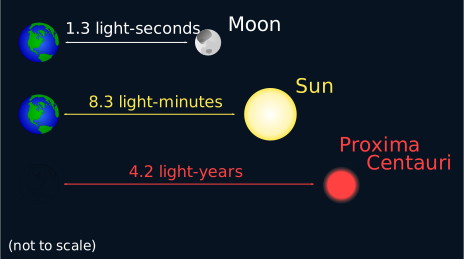
Venturing to star systems beyond our own, such as Alpha Centauri, represents the ultimate frontier in space exploration, though current technology limits make this a long-term aspiration.
- Propulsion Technologies:
Emerging concepts like ion drives, nuclear propulsion, and light sails offer potential pathways to interstellar travel. - Philosophical Implications:
Such missions challenge our understanding of time, legacy, and humanity’s place in the universe, potentially initiating a cosmic diaspora. - Generational Endeavors:
Interstellar voyages may span centuries, requiring multi-generational planning and commitment.
Technological and Human Challenges
Engineering Innovations
Successful missions demand breakthroughs in robotics, autonomous systems, propulsion, and habitat design. For example, drilling through Europa’s ice or sustaining life on Mars requires cutting-edge materials and systems capable of operating in hostile environments.
Human Factors and Psychological Resilience
Long-duration space missions impose significant psychological and physiological stresses. Addressing these requires:
- Artificial Gravity:
To mitigate muscle atrophy and bone loss. - Life Support Systems:
Closed-loop ecosystems that recycle air, water, and waste. - Mental Health Solutions:
Virtual reality and social support systems to combat isolation and maintain morale.
Environmental and Ethical Considerations
Planetary Protection and Space Debris
As humanity expands into space, preserving the integrity of celestial bodies and minimizing orbital debris are critical. This involves:
- Contamination Prevention:
Strict protocols to avoid biological contamination of other worlds and Earth. - Debris Management:
Designing spacecraft with end-of-life disposal plans and materials that reduce debris generation.
International Collaboration and Governance
Space exploration transcends national borders, requiring cooperative frameworks for resource sharing, technology exchange, and conflict resolution. Effective governance can transform space into a domain of peaceful collaboration, fostering global unity.
Scientific Discovery and Serendipity
Space missions often yield unexpected findings that revolutionize our understanding of the universe. Designing flexible, modular missions capable of adapting to new discoveries maximizes the potential for groundbreaking science, from uncovering novel minerals to detecting organic compounds.
Why the Next Space Mission Matters
The forthcoming space endeavor is not merely a technical challenge but a defining moment for humanity’s identity and aspirations. It embodies our quest for knowledge, survival beyond Earth, and the desire to unite across cultures and nations. By balancing ambition with responsibility, innovation with ethics, and exploration with preservation, the next mission will chart a new chapter in our cosmic journey, inspiring generations to come.
FAQ
What is the significance of exploring Europa?
Europa's subsurface ocean may hold the conditions for life, making it a prime candidate for astrobiological studies.
Why is Mars considered for colonization?
Mars offers Earth-like features and the potential for establishing a sustainable human presence.
What are the challenges of interstellar exploration?
Interstellar travel presents challenges in propulsion technologies and requires multi-generational planning.



Leave a Reply