
Short Answer
Definition of Subatomic Particles
Subatomic particles are the most basic units that constitute matter, forming the essential foundation of the physical universe. These particles, though often discussed in abstract terms, are the fundamental components that determine the properties and behavior of all known matter. Understanding what subatomic particles consist of requires an exploration into the field of particle physics, which investigates both the elementary particles themselves and the forces that govern their interactions.
Fundamental Framework: The Standard Model
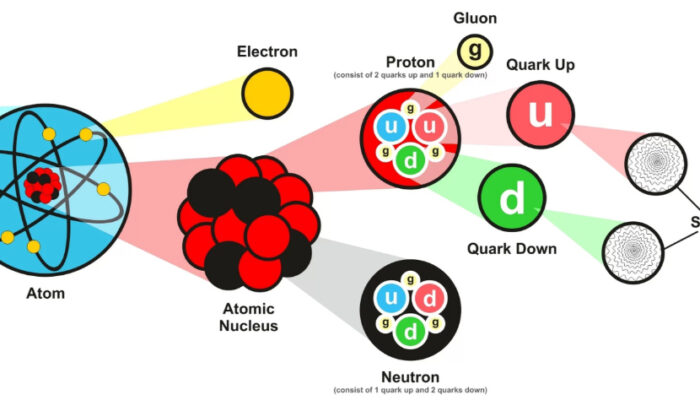
The Standard Model serves as the cornerstone theoretical framework in particle physics, describing three of the four fundamental forces-electromagnetic, weak, and strong nuclear forces-and cataloging the elementary particles involved. Within this model, two primary categories of particles emerge: quarks and leptons. Quarks combine to form protons and neutrons, which make up atomic nuclei, while leptons, such as electrons, orbit these nuclei, creating the structure of atoms.
Quarks: The Building Blocks of Baryons
Quarks are elementary particles that come in six varieties, known as flavors: up, down, charm, strange, top, and bottom. Each quark carries a fractional electric charge of either +2/3 or -1/3. A unique property of quarks is that they are never found in isolation due to a phenomenon called color confinement, which is a consequence of the strong nuclear force. This force is mediated by gluons, particles that act both as force carriers and as integral components of the strong interaction field. The interplay between quarks and gluons forms a complex network of interactions that bind quarks tightly within protons and neutrons.
Leptons: Fundamental Particles Beyond the Strong Force
Leptons constitute another essential group of elementary particles, consisting of six types: the electron, muon, tau, and their corresponding neutrinos. Unlike quarks, leptons do not participate in the strong nuclear force but are influenced by the weak nuclear force, which governs processes such as radioactive decay. Electrons, the most familiar leptons, carry a full negative electric charge and play a critical role in chemical bonding and electrical phenomena, thereby shaping matter on a macroscopic scale.
The Origin of Mass: The Higgs Mechanism
Mass is a fundamental yet enigmatic attribute of subatomic particles, primarily explained by the Higgs mechanism. According to this theory, particles gain mass through their interaction with the Higgs field, an omnipresent field permeating all space. The discovery of the Higgs boson, the particle associated with this field, has significantly advanced our understanding of how mass arises and its implications for the structure of the universe. This relationship between mass, particle interactions, and the resulting structures invites deeper contemplation about the nature of existence.
Force Carriers and Particle Interactions
Beyond quarks and leptons, the forces that govern particle interactions are mediated by gauge bosons. Gluons facilitate the strong force, photons are responsible for electromagnetic interactions, and W and Z bosons mediate the weak nuclear force. These force carriers are essential for maintaining the symmetries and laws that regulate particle behavior, highlighting the interconnectedness of the universe at a fundamental level.
Quantum Field Theory: A Holistic Perspective
Quantum field theory (QFT) provides a comprehensive framework that unifies quantum mechanics with special relativity. In QFT, particles are understood not as isolated entities but as excitations or fluctuations within underlying fields. This perspective challenges classical views of particles, suggesting instead a dynamic, wave-like interaction across multidimensional fields. Such a viewpoint enriches our understanding of matter’s fundamental structure and the nature of particle interactions.
Real-World Applications and Technological Impact
The study of subatomic particles has catalyzed numerous technological advancements, including the development of quantum computing and novel materials with exceptional properties. These innovations demonstrate how abstract theoretical concepts translate into practical technologies, opening new frontiers in science and engineering and underscoring the profound impact of particle physics on modern life.
Unresolved Questions and Cosmic Mysteries
Exploring subatomic particles also raises profound questions about the universe’s fundamental nature. For example, the observed dominance of matter over antimatter in the cosmos remains an unsolved puzzle, challenging physicists to uncover the mechanisms behind this asymmetry. Such inquiries continue to drive research, pushing the boundaries of our knowledge about the laws that govern reality.
Why Understanding Subatomic Particles Is Crucial
Grasping the composition and behavior of subatomic particles is vital for advancing science and technology. It provides insight into the universe’s fundamental architecture, informs the development of cutting-edge technologies, and deepens our philosophical understanding of existence. This knowledge bridges the microscopic world of particles with the vast cosmic structures, offering a comprehensive view of reality’s intricate design.
Summary
The investigation into what subatomic particles are made of reveals a complex network of particles and forces that shape the universe. Each discovery in this domain peels back layers of complexity, enhancing our comprehension of matter’s fundamental nature. As research progresses, it not only uncovers the building blocks of the physical world but also invites reflection on humanity’s place within the grand cosmic tapestry.
FAQ
What are subatomic particles made of?
They are composed of elementary particles such as quarks and leptons, which interact via fundamental forces governed by the Standard Model.
Why can't quarks be found independently?
Due to color confinement, quarks are permanently confined within composite particles like protons and neutrons and cannot exist in isolation.
What is the Higgs boson?
The Higgs boson is a fundamental particle associated with the Higgs field, responsible for giving mass to other subatomic particles.
How do leptons differ from quarks?
Leptons do not experience the strong nuclear force, unlike quarks, and include particles such as electrons and neutrinos.
What are gauge bosons?
Gauge bosons are force carrier particles that mediate fundamental interactions between elementary particles.





Leave a Reply