

Short Answer
Definition of DNA and Its Role in Biological Information
Deoxyribonucleic acid (DNA) is the fundamental macromolecule that stores genetic instructions essential for the development, functioning, and reproduction of all living organisms. It acts as the molecular blueprint that encodes hereditary information, enabling the transmission of traits from one generation to the next. The study of DNA encompasses various scientific disciplines including molecular biology, genetics, and bioinformatics, which together reveal how DNA’s structure and sequence govern its biological functions.
Structural Composition of DNA
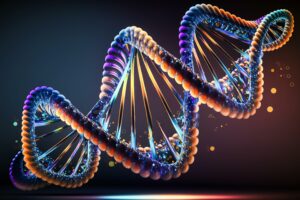
DNA is distinguished by its iconic double helix structure, first described by James Watson and Francis Crick in 1953. This structure consists of two antiparallel strands composed of repeating nucleotide units twisted around each other. Each nucleotide is made up of three parts:
- Phosphate group:
Forms the backbone of the DNA strand by linking sugars of adjacent nucleotides. - Deoxyribose sugar:
A five-carbon sugar molecule that connects the phosphate group to the nitrogenous base. - Nitrogenous base:
One of four types-adenine (A), thymine (T), cytosine (C), or guanine (G)-which pair specifically (A with T, C with G) through hydrogen bonds to stabilize the helix.
The complementary base pairing is critical for DNA replication and accurate genetic information transfer during cell division.
Encoding Genetic Information: The Genetic Code
The essence of genetic information lies in the linear arrangement of nitrogenous bases along the DNA strands. This sequence dictates the synthesis of proteins, which perform a vast array of cellular functions. The genetic code is read in triplets called codons, where each codon corresponds to a specific amino acid or a termination signal during protein assembly. This triplet code enables the construction of diverse polypeptides, forming the basis of biological complexity.
Gene Expression: From DNA to Protein
Gene expression begins with transcription, a process where segments of DNA are transcribed into messenger RNA (mRNA) by the enzyme RNA polymerase. The mRNA acts as a mobile template that carries the genetic instructions from the nucleus to ribosomes in the cytoplasm, where translation into proteins occurs. Beyond serving as a template, mRNA undergoes various modifications that regulate gene expression post-transcriptionally, influencing protein production levels and timing.
Regulation of Gene Activity
Gene regulation is a sophisticated system that controls when and how genes are activated or silenced in response to internal and external cues. Key regulatory elements include:
- Promoters and enhancers:
DNA sequences that initiate and enhance transcription. - Transcription factors:
Proteins that bind to regulatory regions to either promote or inhibit RNA polymerase binding and activity.
This regulatory network ensures precise control over protein synthesis, allowing cells to adapt dynamically to environmental changes and developmental signals.
Epigenetics: Beyond the DNA Sequence
Epigenetics refers to heritable changes in gene expression that do not involve alterations to the underlying DNA sequence. These changes arise from chemical modifications such as DNA methylation and histone modification, which affect chromatin structure and accessibility. By modulating how tightly DNA is packaged, epigenetic mechanisms influence which genes are expressed or silenced, playing a crucial role in development, cellular differentiation, and phenotypic variation.
DNA-Protein Interactions and Cellular Function
DNA functions within a complex cellular environment where numerous proteins interact with it to regulate gene expression and maintain genome integrity. Important DNA-binding proteins include:
- Histones:
Proteins around which DNA winds, forming nucleosomes that compact the DNA and regulate access to genetic information. - Transcription factors:
Proteins that recognize specific DNA sequences to control transcription initiation. - Polymerases:
Enzymes responsible for synthesizing RNA and DNA during transcription and replication.
The interplay between these proteins and DNA determines the functional state of genes and ultimately influences cellular identity and behavior.
Applications and Implications of DNA Knowledge
Understanding how DNA encodes biological information has profound implications across multiple fields:
- Medicine:
Insights into genetic mutations-such as point mutations, insertions, deletions, and chromosomal rearrangements-help diagnose and treat genetic disorders. - Evolutionary biology:
Genetic variation and mutation studies illuminate evolutionary processes and species diversity. - Biotechnology:
Technologies like CRISPR-Cas9 utilize knowledge of DNA sequences and structure to enable precise genome editing, opening new possibilities for gene therapy and crop improvement.
Role of Bioinformatics in DNA Research
The explosion of genomic data from sequencing projects necessitates advanced computational methods to analyze and interpret this information. Bioinformatics integrates biology, computer science, and statistics to identify gene functions, regulatory networks, and evolutionary relationships. This interdisciplinary approach accelerates discoveries in personalized medicine, agriculture, and fundamental biology by transforming raw data into actionable knowledge.
Summary: The Central Role of DNA in Life
DNA embodies the core of biological information through a sophisticated combination of chemical structure, nucleotide sequences, and molecular interactions. From the fundamental chemistry of its bases to the complex regulation of gene expression and epigenetic modifications, DNA serves as the hereditary archive that drives biological diversity and organismal function. Ongoing research at the intersection of genetics, molecular biology, and computational science continues to deepen our understanding of life’s molecular underpinnings and expands the horizons of scientific innovation.
FAQ
What are the basic components of DNA?
DNA is made up of nucleotides, each consisting of a phosphate group, a deoxyribose sugar, and one of four nitrogenous bases: adenine, thymine, cytosine, or guanine.
How does DNA encode biological information?
The sequence of nitrogenous bases in DNA forms codons, each coding for specific amino acids that build proteins essential for cellular functions.
What is the role of gene regulation in DNA function?
Gene regulation controls when and how genes are activated or silenced, ensuring proteins are produced as needed for cellular response and development.
What is epigenetics and how does it relate to DNA?
Epigenetics involves chemical modifications to DNA and histones that affect gene expression without changing the DNA sequence.
Why is understanding DNA important in medicine?
Insights into DNA allow for diagnosis of genetic diseases, development of gene therapies, and genome editing technologies like CRISPR.



Leave a Reply