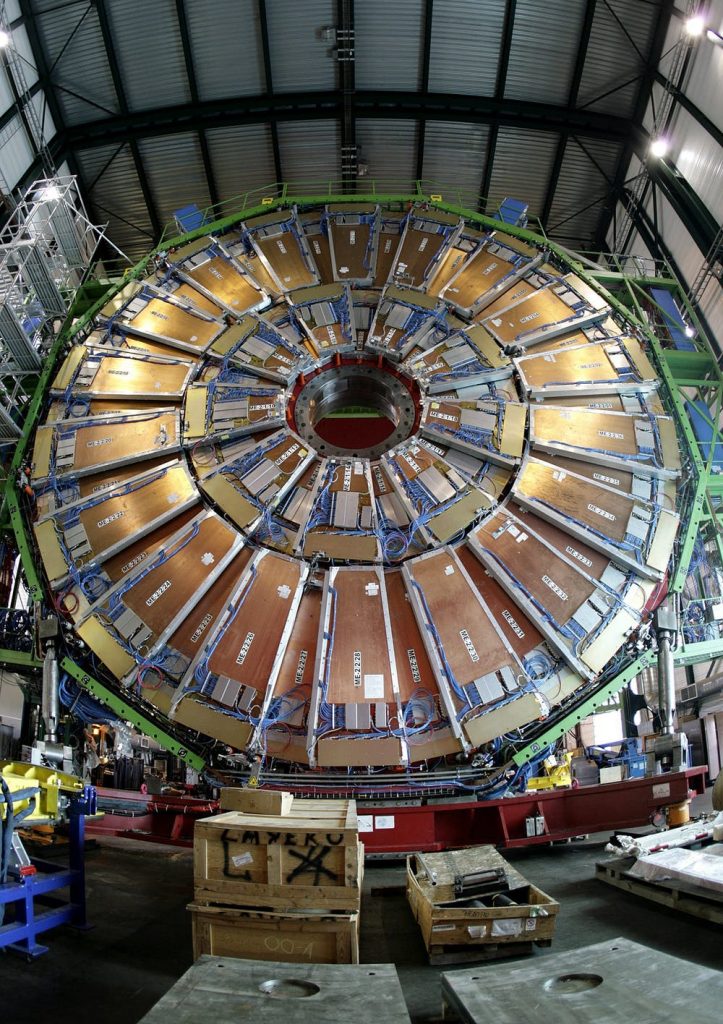
What would happen if I was inside the Hadron Collider?

Overview of the Large Hadron Collider The Large Hadron Collider (LHC), situated at CERN on the border between Switzerland and France, is the most powerful particle accelerator ever built. This monumental scientific instrument is designed to probe the fundamental constituents of matter and to explore the underlying principles governing the universe. The LHC’s vast underground […]

Read More →

Why are nuclear bombs even produced?

Definition of Nuclear Bomb Production Nuclear bomb production refers to the process by which nations develop and manufacture atomic weapons, devices capable of unleashing immense destructive power through nuclear reactions. These weapons embody a paradoxical nature, offering both a sense of security through deterrence and posing an existential threat due to their catastrophic potential. Understanding […]

Read More →

Quark-Gluon First! CERN’s Latest Claim Rewrites the Early Universe

Definition of Quark-Gluon Plasma Quark-gluon plasma (QGP) is an extraordinary state of matter believed to have existed just microseconds after the Big Bang. Unlike ordinary matter composed of protons and neutrons, QGP consists of free quarks and gluons-fundamental particles that are usually confined within hadrons. This plasma forms under extreme temperatures and densities, where quarks […]

Read More →

What is the next frontier in particle physics?

Definition of Particle Physics Particle physics is the branch of science dedicated to investigating the most elementary building blocks of matter and the fundamental forces that dictate their interactions. This field aims to unravel the subatomic structure of the universe, providing insights into the nature of reality at its smallest scales. Through rigorous experimentation and […]

Read More →

What is the ‘strong nuclear force’ in physics?

Definition of the Strong Nuclear Force The strong nuclear force, often referred to as the strong interaction, is a fundamental force responsible for binding protons and neutrons within an atomic nucleus. It plays a crucial role in maintaining the stability of matter by counteracting the repulsive electromagnetic forces between positively charged protons. This force is […]

Read More →

How does one become a ‘nuke’ (nuclear engineer)?

Definition of Nuclear Engineering Nuclear engineering is a specialized branch of engineering focused on harnessing nuclear processes for practical applications. This discipline encompasses the design, development, and maintenance of systems that utilize nuclear reactions, primarily in areas such as energy production, medical technologies, and radiation safety management. Often informally called “nuke” within the industry, nuclear […]

Read More →

What is the nucleus force explained?

Definition of the Nuclear Force The nuclear force, also known as the strong nuclear interaction or strong force, is a fundamental force responsible for holding the atomic nucleus together. It binds protons and neutrons-collectively termed nucleons-into a stable, compact structure despite the repulsive electromagnetic forces between positively charged protons. Role: It counteracts the electromagnetic repulsion […]

Read More →

Can a magnetic shield protect against cosmic radiation?

Understanding Cosmic Radiation Cosmic radiation refers to a continuous and omnipresent stream of high-energy particles that permeate the universe, especially prevalent in regions beyond Earth’s atmospheric shield. These particles primarily originate from astrophysical phenomena such as supernova explosions, black holes, and the solar wind emitted by our Sun. Composed mainly of protons and heavier atomic […]

Read More →

What are subatomic particles made out of?

Definition of Subatomic Particles Subatomic particles are the most basic units that constitute matter, forming the essential foundation of the physical universe. These particles, though often discussed in abstract terms, are the fundamental components that determine the properties and behavior of all known matter. Understanding what subatomic particles consist of requires an exploration into the […]

Read More →