
Short Answer
Definition of Dark Matter
Dark matter is a mysterious and invisible form of matter that constitutes a significant portion of the universe’s total mass. Unlike ordinary matter, which forms stars, planets, and living beings, dark matter does not emit, absorb, or reflect light, making it undetectable by conventional electromagnetic observations. Despite its invisibility, dark matter exerts a powerful gravitational influence, shaping the large-scale structure of the cosmos and playing a crucial role in its evolution.
Origins of Dark Matter in the Early Universe
Shortly after the Big Bang, the universe was an extremely hot and dense environment filled with a plasma of fundamental particles. This era, known as the quark epoch, was characterized by temperatures and energies so intense that atoms and molecules had not yet formed. It was within this primordial state that dark matter began to emerge, influenced by complex interactions among fundamental forces and particles, many aspects of which remain elusive to modern science.
Thermal Freeze-Out and Weakly Interacting Massive Particles (WIMPs)
A leading hypothesis proposes that dark matter consists of particles distinct from the baryonic matter that makes up stars and planets. These particles, called Weakly Interacting Massive Particles (WIMPs), are believed to have been produced during the early universe through a process termed thermal freeze-out. Initially, WIMPs were in thermal equilibrium with the hot plasma of photons, quarks, and leptons. As the universe expanded and cooled, the interaction rates between WIMPs and other particles decreased, causing them to decouple and cease frequent annihilation or creation.

This freeze-out mechanism naturally results in a residual abundance of dark matter particles, matching the proportions observed in the universe today. When the temperature dropped below a critical threshold, annihilation became inefficient, effectively “freezing” the number of dark matter particles and linking their abundance to the universe’s thermal history and expansion.
Alternative Dark Matter Candidates
Beyond WIMPs, other theoretical particles have been proposed as dark matter constituents:
- Axions:
Hypothetical particles arising from solutions to the strong CP problem in quantum chromodynamics. Axions may have formed through non-thermal processes such as the decay of topological defects in the early universe’s quantum fields. - Supersymmetric Particles:
Predicted by supersymmetry theories, these particles extend the Standard Model and could contribute to dark matter if stable and weakly interacting. - Sterile Neutrinos:
These neutrinos do not interact via the weak nuclear force like their active counterparts but could have been generated through oscillations, representing a form of dark matter independent of thermal equilibrium.
Role of Dark Matter in Cosmic Structure Formation
Dark matter’s gravitational influence was pivotal during the universe’s formative stages. Unlike ordinary matter, which interacts electromagnetically and couples with radiation, dark matter interacts primarily through gravity. This allowed it to begin clustering and forming gravitational wells before photons decoupled from baryons, an event imprinted in the cosmic microwave background radiation.
These early dark matter concentrations acted as gravitational anchors, drawing in normal matter and facilitating the formation of the first stars, galaxies, and galaxy clusters. The cosmic web’s intricate network of filaments, voids, and clusters owes much of its architecture to these primordial dark matter halos. Without dark matter’s scaffolding, the universe’s evolution toward its present complexity would have been severely hindered.
Scientific Evidence and Methods of Study
Researchers employ a variety of observational and experimental techniques to investigate dark matter’s nature and origins:
- Cosmic Microwave Background (CMB) Measurements:
Analysis of temperature fluctuations in the CMB provides insights into the density and distribution of dark matter in the early universe. - Gravitational Lensing:
The bending of light from distant objects by massive dark matter concentrations reveals its presence and distribution. - Galactic Rotation Curves:
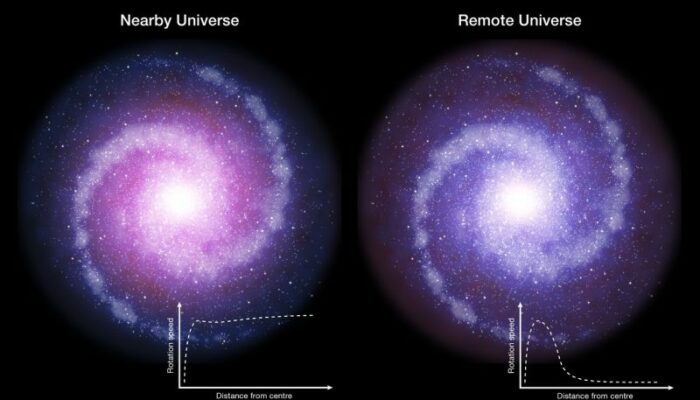
Observations of stars’ orbital speeds in galaxies indicate gravitational effects exceeding those attributable to visible matter alone. - Particle Physics Experiments:
Searches for dark matter particles through direct detection, collider experiments, and indirect signals aim to identify their properties and interactions.
Implications for Fundamental Physics and Cosmology
Understanding how dark matter formed shortly after the Big Bang has profound implications for both cosmology and particle physics. If dark matter particles originated from high-energy interactions in the early universe, their characteristics could reveal physics beyond the Standard Model, including new symmetries, hidden sectors, or extra spatial dimensions. This intersection of cosmology and particle physics represents a frontier where the smallest constituents influence the universe’s grandest structures.
Common Misconceptions About Dark Matter
Dark matter is simply ordinary matter that is invisible.
Dark matter is fundamentally different from baryonic matter and does not interact electromagnetically, making it undetectable by conventional means.
Dark matter emits or absorbs light but is too faint to see.
Dark matter does not emit, absorb, or reflect electromagnetic radiation, which is why it remains invisible to telescopes.
Dark matter is uniformly distributed throughout space.
Dark matter clusters gravitationally, forming halos and structures that influence galaxy formation and cosmic architecture.
Significance of Dark Matter in the Universe
Dark matter is indispensable for explaining the universe’s structure and evolution. Its gravitational effects govern the formation of galaxies and clusters, influence cosmic expansion, and provide clues about the universe’s initial conditions and ultimate fate. The study of dark matter not only enriches our understanding of the cosmos but also challenges and expands the boundaries of fundamental physics, inviting humanity to explore the unseen fabric that underpins reality.




Leave a Reply