How precise is QCD compared to QED?

Overview of Quantum Electrodynamics and Quantum Chromodynamics Quantum Electrodynamics (QED) and Quantum Chromodynamics (QCD) are fundamental components of the Standard Model of particle physics, each describing different fundamental forces that operate at the subatomic scale. QED focuses on the electromagnetic interactions between charged particles mediated by photons, while QCD explains the strong nuclear force that […]

Read More →

Can the strong nuclear force bind neutrons alone? And why?

Definition of the Strong Nuclear Force The strong nuclear force is one of the four fundamental forces in nature, playing a crucial role in holding the atomic nucleus together. It acts between nucleons-protons and neutrons-binding them tightly despite the repulsive electromagnetic forces between positively charged protons. This force is mediated by gluons at the quark […]

Read More →

What’s your favorite introductory quantum field theory book?

Understanding Quantum Field Theory Quantum Field Theory (QFT) stands as a cornerstone of modern theoretical physics, weaving together the principles of quantum mechanics and special relativity to describe the behavior of fundamental particles and fields. This intricate domain challenges learners with its abstract concepts and sophisticated mathematics, yet it also captivates with its profound insights […]

Read More →

In which particle of the atom is the spin found?

Understanding Spin in Atomic Particles Spin is a fundamental and intriguing property of subatomic particles that plays a crucial role in shaping our understanding of atomic behavior, chemical interactions, and the principles of quantum mechanics. This article focuses on the concept of spin as it relates to atomic constituents, especially electrons, and explores its profound […]

Read More →

What is quantum chromodynamics?

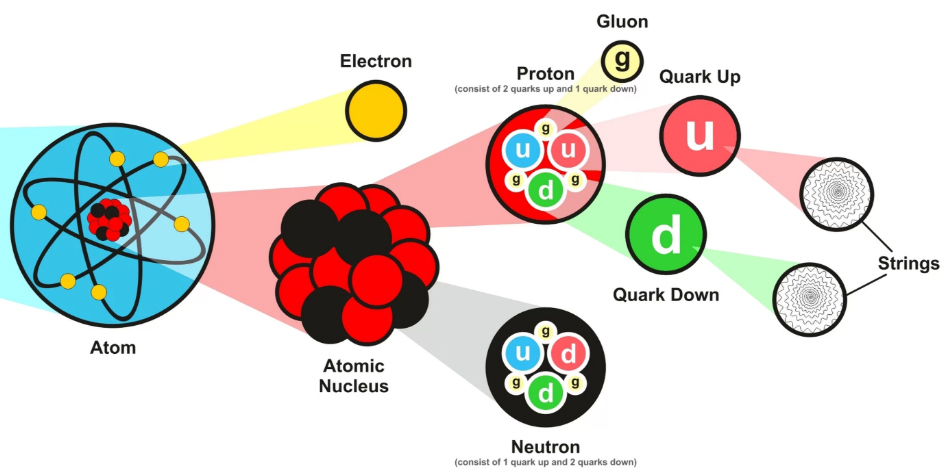
Definition of Quantum Chromodynamics Quantum Chromodynamics (QCD) is a fundamental theory in particle physics that explains the interactions between quarks and gluons, the elementary constituents of matter. It specifically addresses the strong nuclear force, one of the four fundamental forces in nature, which is responsible for binding protons and neutrons within atomic nuclei. QCD provides […]

Read More →

What is color charge in quantum mechanics?

Definition of Color Charge Color charge is a fundamental property in particle physics, specifically within the domain of quantum chromodynamics (QCD), which is the theory describing the strong interaction. It characterizes quarks and gluons-the elementary particles that compose protons, neutrons, and other hadrons-by assigning them a type of charge that governs their interactions. Despite its […]

Read More →

Can the standard model of particle physics explain gravity?

Overview of the Standard Model and Gravity The Standard Model of particle physics stands as one of the most comprehensive and successful frameworks in contemporary physics, describing a wide array of fundamental particles and their interactions through three of the four fundamental forces: electromagnetism, the weak nuclear force, and the strong nuclear force. Despite its […]

Read More →

Do animals ever get into the Large Hadron Collider?

Overview of the Large Hadron Collider The Large Hadron Collider (LHC), situated at CERN near Geneva, Switzerland, stands as the most powerful particle accelerator globally. This cutting-edge scientific instrument is engineered to investigate the fundamental building blocks of matter by propelling protons to velocities close to the speed of light and colliding them. The LHC […]

Read More →

What is a particle collider and how does it work?

Definition of Particle Colliders Particle colliders are highly advanced scientific instruments designed to accelerate charged particles to extremely high velocities and then bring them into collision. These collisions recreate conditions similar to those just after the Big Bang, allowing researchers to investigate the fundamental building blocks of matter and the forces that govern their interactions. […]

Read More →