Astrophysicist Thinks Big—And Wins Bigger: Innovation Beyond the Stars

Understanding the Ambition of Astrophysical Innovation Within the vast expanse of the universe, where stars shimmer with enigmatic beauty, lies a story of groundbreaking progress driven by astrophysicists who challenge the boundaries of conventional thought. The concept of “thinking big” in this context goes beyond simple aspiration; it signifies a transformative shift in humanity’s comprehension […]

Read More →

Black Hole Shrinks Braneworld: Dimensions Collapse in Theoretical Twist

Understanding Black Holes and Their Cosmic Significance Black holes have long fascinated scientists and thinkers alike due to their mysterious properties and profound impact on our comprehension of space and time. These extraordinary cosmic objects not only challenge conventional physics but also serve as a crucial platform for investigating advanced theoretical frameworks such as string […]

Read More →

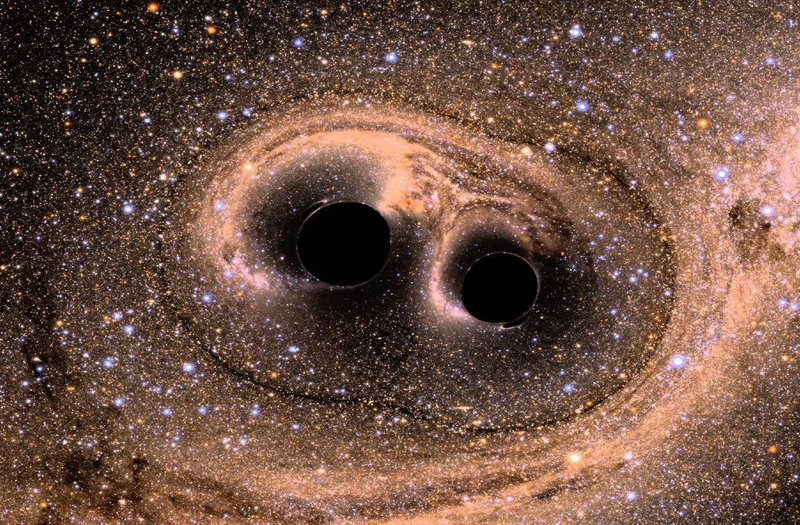
Twin Black Holes Spew Gravitational Waves: The Universe Hums in Harmony

Understanding Gravitational Waves and Black Hole Mergers The universe, with its vast and intricate structure, may be perceived as producing a cosmic melody through the dynamic interactions of celestial bodies. Among the most fascinating contributors to this cosmic symphony are twin black holes merging, an event that generates gravitational waves-ripples in the fabric of spacetime. […]

Read More →

Calculations Hint at Massive Quark Stars: Stranger Than Neutron Stars?

Definition of Quark Stars Quark stars are theoretical celestial objects composed predominantly of quark matter, representing an exotic state of matter beyond the familiar neutron stars. These stars are hypothesized to exist under conditions of extreme density and pressure, where the neutrons within a star’s core break down into their fundamental constituents-quarks. This concept challenges […]

Read More →

The Neutron Star Hunt Narrows: Cosmic Beasts Revealed

Definition of Neutron Stars Neutron stars are incredibly dense celestial objects formed as remnants of massive stars that have undergone supernova explosions. These compact stars consist predominantly of neutrons tightly packed into a sphere roughly 20 kilometers in diameter, yet they possess masses exceeding that of our Sun. Their extreme density and gravitational forces place […]

Read More →

Cannibal Star Ate Its Planet: Cosmic Appetite Confirmed

Definition of Cannibal Stars Cannibal stars are celestial objects that actively consume material from their surrounding environment, including planets and other nearby bodies. This phenomenon is not fictional but is rooted in astrophysical processes related to the star’s lifecycle, gravitational influence, and evolutionary stages. Essentially, a cannibal star is one that ingests parts of its […]

Read More →

Reflecting Symmetry: The Universe in Reverse

Definition of Reflecting Symmetry Reflecting symmetry, also known as bilateral symmetry, refers to a property where an object or system can be divided into two mirror-image halves along a central axis. Each half is a reflection of the other, creating a balanced and harmonious structure. This form of symmetry is prevalent in numerous domains, including […]

Read More →

Big Stars Have Weather Too: Storms Beyond the Solar System

Definition of Stellar Weather in Massive Stars Stellar weather refers to the dynamic and complex atmospheric phenomena occurring on massive stars, often called “big stars.” These phenomena include stellar winds, magnetic activity, flares, and eruptive events that shape the star’s immediate environment. Unlike terrestrial weather, which involves atmospheric conditions on planets, stellar weather encompasses processes […]

Read More →

Black Hole Analogue Acts Like a Laser: Light Gravity and Quantum Convergence

Understanding the Black Hole-Laser Analogy In recent scientific discourse, a captivating comparison has emerged between black holes and lasers, sparking innovative research at the crossroads of gravitational physics and quantum field theory. This analogy explores whether black holes can emulate the fundamental processes of light emission characteristic of lasers, thereby challenging and enriching our comprehension […]

Read More →

A Moon That Shines on Its Neighbours: The Curious Light of Celestial Siblings

Definition and Origin of the Moon The moon is Earth’s natural satellite, orbiting our planet and serving as a luminous presence in the night sky. Far from being a mere decorative feature, it symbolizes the complex gravitational interactions that govern celestial bodies within our solar system. Its light not only brightens Earth but also contributes […]

Read More →