

Short Answer
Understanding the Universe’s Composition
Envision the cosmos as an immense, intricate tapestry woven from both visible and invisible threads. The dazzling array of galaxies, stars, planets, and even ourselves represents only a small fraction of this vast expanse. The majority remains hidden in darkness-an elusive counterpart that cannot be directly observed but exerts a powerful gravitational influence. This unseen majority raises a fundamental question: why does most of the universe consist of something other than the matter we are familiar with?
Definition of Ordinary Matter, Dark Matter, and Dark Energy
The universe’s makeup reveals a striking duality at its core. Ordinary matter, which forms atoms and molecules, accounts for merely about 5% of the total cosmic content. The remainder is dominated by two mysterious components: dark matter and dark energy.
- Ordinary Matter:
Composed of protons, neutrons, and electrons, this matter interacts with electromagnetic forces and emits or absorbs light, making it detectable by telescopes. - Dark Matter:
Invisible to electromagnetic radiation, dark matter does not emit, absorb, or reflect light, yet its gravitational effects are evident in the motion of galaxies and the structure of the universe. - Dark Energy:
A pervasive, diffuse force responsible for the accelerated expansion of the universe, dark energy fills all of space and counteracts gravitational attraction on cosmic scales.
The Cosmic Imbalance: Matter vs. Antimatter
Following the Big Bang approximately 13.8 billion years ago, the universe was a hot, dense environment where particles and antiparticles should have formed in equal amounts. This symmetry, however, was broken, resulting in a universe dominated by matter with very little antimatter. This imbalance is crucial for our existence; without it, matter and antimatter would have annihilated each other completely, leaving behind only radiation and no stars, planets, or life.
CP Violation and the Matter-Antimatter Asymmetry
To explain this asymmetry, physicists propose mechanisms involving CP violation-a subtle difference in the behavior of particles and their antiparticles during the early moments after the Big Bang. These tiny deviations in fundamental symmetries allowed a slight excess of matter to survive, forming the basis of the visible universe. However, this explanation addresses only ordinary matter and does not clarify the nature of dark matter.
The Enigma of Dark Matter
Dark matter remains one of the most compelling mysteries in modern astrophysics. Although it does not interact with light, its gravitational influence shapes the rotation curves of galaxies and the formation of large-scale cosmic structures. Acting as a cosmic scaffold, dark matter holds galaxies together and influences their evolution.
Candidate Particles for Dark Matter
Scientists have proposed several hypothetical particles as dark matter candidates, including:
- Weakly Interacting Massive Particles (WIMPs):
Particles that interact via the weak nuclear force and gravity but rarely with electromagnetic forces. - Axions:
Extremely light particles predicted by certain extensions of the Standard Model, potentially abundant in the universe. - Sterile Neutrinos:
Hypothetical neutrinos that do not interact via the weak force, making them difficult to detect.
Detecting these particles requires highly sensitive experiments, often conducted deep underground or in space, to minimize background noise and capture rare interactions.
Dark Energy and the Accelerating Universe
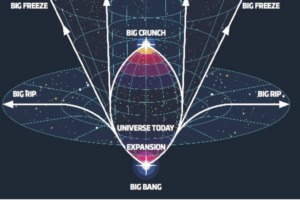
While dark matter acts as a gravitational glue, dark energy functions as a repulsive force driving the universe’s accelerated expansion. This phenomenon challenges previous cosmological models and suggests that the universe’s fate is governed by this mysterious energy permeating all of space.
The Cosmological Constant and Quantum Vacuum
Dark energy is often associated with the cosmological constant, a term introduced by Einstein to represent a constant energy density filling space. Its origin may lie in quantum vacuum fluctuations or the fundamental structure of spacetime, areas where conventional physics encounters profound mysteries.
Implications for Our Understanding of Reality
The dominance of dark matter and dark energy compels a reevaluation of what constitutes the fundamental fabric of reality. Ordinary matter, familiar and tangible, is merely a thin veneer atop a vast cosmic mosaic dominated by invisible and enigmatic components. This realization challenges anthropocentric views and highlights the limits of human perception and knowledge.
Scientific Efforts to Unveil the Dark Universe
Modern research employs a variety of sophisticated tools to probe the dark sector. Particle accelerators, underground detectors, and astronomical surveys collaborate to detect subtle signals that might reveal the nature of dark matter and dark energy. Each discovery brings us closer to understanding the unseen forces shaping the cosmos, though the complete picture remains elusive.
Why Most of the Universe Is Not Ordinary Matter
The predominance of non-ordinary matter stems from the universe’s earliest moments and the complex interplay of fundamental forces and particles beyond the Standard Model of physics. The visible universe is just the tip of an immense, hidden iceberg composed of dark matter and dark energy, which govern cosmic evolution and structure.
Conclusion: Embracing the Cosmic Mystery
The universe is a masterpiece of contrasts-illuminated by light yet dominated by darkness, structured by matter yet propelled by invisible energies. Understanding why most of the cosmos is not made of ordinary matter reveals not only the secrets of the universe but also the boundless curiosity and ingenuity of humanity, forever striving to uncover the unseen forces that shape existence.
FAQ
What is dark matter?
Dark matter is a type of matter that does not emit, absorb, or reflect light, making it invisible, but its presence is inferred from its gravitational effects on visible matter.
What role does dark energy play in the universe?
Dark energy is a mysterious force that drives the accelerated expansion of the universe, counteracting gravitational attraction on cosmic scales.
Why is there more matter than antimatter in the universe?
The asymmetry between matter and antimatter is believed to arise from CP violation, allowing a slight excess of matter to survive after the Big Bang.

Leave a Reply