
Short Answer
Definition of Magnetic Resonance Imaging (MRI)
Magnetic Resonance Imaging (MRI) is a sophisticated, non-invasive diagnostic technique that produces detailed images of the internal structures of the human body. Utilizing strong magnetic fields and radiofrequency waves, MRI enables clinicians to visualize anatomy and physiological processes without the need for surgical intervention. This technology has become indispensable in modern medicine, offering critical insights that aid in accurate diagnosis and effective treatment planning.
Fundamental Principles Behind MRI Technology
The operation of MRI is grounded in the magnetic properties of hydrogen atoms, which are abundant in the human body due to the high water content in tissues. When exposed to a powerful magnetic field, these hydrogen nuclei align in a specific direction. The application of radiofrequency pulses disturbs this alignment, causing the nuclei to emit signals as they return to their original state. These emitted signals are then captured and processed by advanced computational algorithms to create high-resolution images of the body’s internal structures.
Key Components of an MRI System
- Superconducting Magnet:
The core of the MRI machine, typically generating magnetic fields between 1.5 and 3.0 teslas, which is significantly stronger than Earth’s magnetic field. - Gradient Coils:
These coils spatially encode the signals by varying the magnetic field, allowing precise localization of tissues within the body. - Radiofrequency Coils:
Responsible for transmitting radiofrequency pulses and receiving the signals emitted by hydrogen nuclei. - Computer System:
Processes the raw data into detailed images, enabling visualization of anatomical and physiological information.
Patient Experience During an MRI Scan
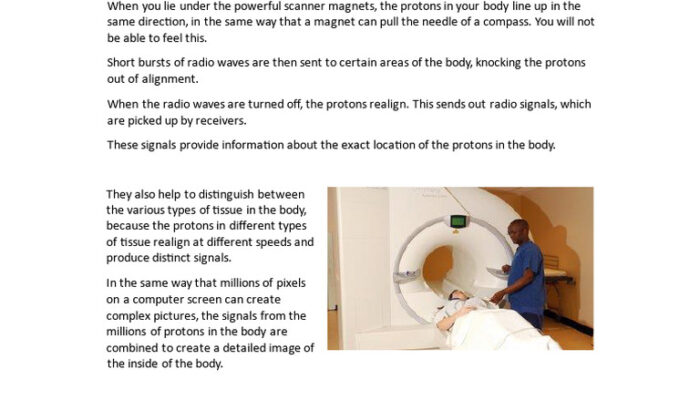
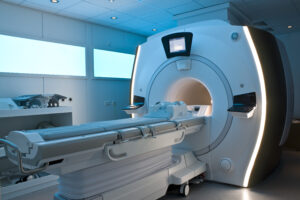
Before the scan, patients are typically asked to change into a hospital gown and remove any metallic objects to prevent interference with the magnetic field. The scanning environment often involves lying on a movable table that slides into a cylindrical magnet bore, which can cause discomfort or claustrophobia for some individuals. To alleviate this, open MRI designs have been developed. During the scan, patients hear loud knocking or thumping noises caused by the rapid switching of magnetic gradients. Many facilities provide music or other auditory distractions to improve patient comfort. It is essential for patients to inform medical staff about any implants, such as pacemakers or metal fragments, as these can pose safety risks.
Image Interpretation and Diagnostic Applications
After image acquisition, radiologists analyze the scans to detect abnormalities that may not be visible through other diagnostic methods. MRI is invaluable for identifying tumors, ligament injuries, vascular anomalies, and neurological conditions. Advanced MRI techniques, such as diffusion-weighted imaging and functional MRI (fMRI), extend the capabilities of traditional imaging by revealing dynamic physiological processes, including brain activity and blood flow changes, which are crucial for understanding diseases like Alzheimer’s, stroke, and psychiatric disorders.
Advanced MRI Techniques: Functional MRI (fMRI)
Functional MRI leverages the relationship between neural activity and cerebral blood flow. By detecting variations in blood oxygenation levels, fMRI maps brain function during cognitive tasks, offering insights into the neural basis of thought, emotion, and behavior. This technique bridges neuroscience and medical imaging, opening new avenues for both clinical diagnostics and research into brain function.
Ethical Considerations and Accessibility
While MRI technology represents a significant advancement in medical imaging, it also raises important ethical questions regarding equitable access. In many under-resourced regions, limited availability of MRI scanners restricts patient access to this critical diagnostic tool. Addressing these disparities is essential to ensure that the benefits of MRI technology are shared globally, promoting fairness and inclusivity in healthcare.
Significance of MRI in Modern Medicine
MRI exemplifies the integration of cutting-edge technology with biological science, providing unparalleled visualization of the human body. From patient preparation to image interpretation, each step reflects a dedication to precision and patient-centered care. As MRI technology continues to advance, it holds the promise of further transforming medical diagnostics and treatment, enhancing our understanding of complex diseases and improving patient outcomes worldwide.
FAQ
What is an MRI scan?
MRI is a non-invasive imaging technology that uses magnetic fields and radio waves to generate detailed images of the body's internal structures.
How does MRI work?
MRI aligns hydrogen nuclei in the body using a strong magnetic field, then disturbs and detects their signals with radiofrequency pulses to create images.
Are MRI scans safe for everyone?
Most people can safely undergo MRI scans, but those with certain metal implants or fragments should consult their doctor due to safety risks.
What can MRI detect?
MRI can identify tumors, ligament injuries, neurological disorders, vascular anomalies, and other internal abnormalities.
What is functional MRI (fMRI)?
fMRI maps brain activity by detecting changes in blood oxygenation, providing insights into brain function during cognitive tasks.




Leave a Reply