
Short Answer
Understanding Black Holes and Galaxies
Within the immense expanse of the universe, galaxies and black holes represent two of the most fascinating cosmic phenomena. Galaxies are vast conglomerates of stars, gas, dust, and dark matter, bound together by gravity, while black holes are regions of spacetime exhibiting gravitational forces so intense that nothing, not even light, can escape. A compelling question arises when considering their lifespans: do black holes outlive the galaxies that host them? Exploring this question requires a deep dive into the nature, evolution, and interaction of these celestial entities.
Definition and Characteristics
- Galaxies:
Massive systems composed of billions to trillions of stars, along with interstellar gas, dust, and dark matter, all gravitationally bound. They come in various shapes such as spiral, elliptical, and irregular, and are dynamic structures that evolve over billions of years. - Black Holes:
Extremely dense points in space formed from the gravitational collapse of massive stars or accumulation of matter at galactic centers. They possess gravitational fields so strong that escape velocity exceeds the speed of light, rendering them invisible except through their interactions with surrounding matter.
Galactic Evolution and Lifespan
Galaxies are not static; they undergo continuous transformation influenced by internal processes and external interactions. Their lifecycles are shaped by star formation rates, supernova explosions, and collisions or mergers with other galaxies. Over billions of years, galaxies may change morphology-for example, spiral galaxies can evolve into elliptical types. The depletion of gas, essential for star formation, gradually leads galaxies toward a state of reduced activity and eventual quiescence. Environmental factors within galaxy clusters also contribute to their evolution, sometimes triggering dramatic changes or even the dissolution of galactic structures.
Temporal Nature of Black Holes
Black holes exhibit a distinct temporal behavior compared to galaxies. Originating from stellar collapse or matter accumulation in galactic centers, supermassive black holes can grow by accreting gas and stars from their surroundings. Unlike galaxies, which age by exhausting their star-forming material, black holes may continue to increase in mass over time. Theoretical physics suggests that black holes can evaporate through Hawking radiation, but this process occurs over timescales vastly exceeding the current age of the universe, implying that black holes are effectively long-lived cosmic entities.
Interaction Between Black Holes and Their Host Galaxies
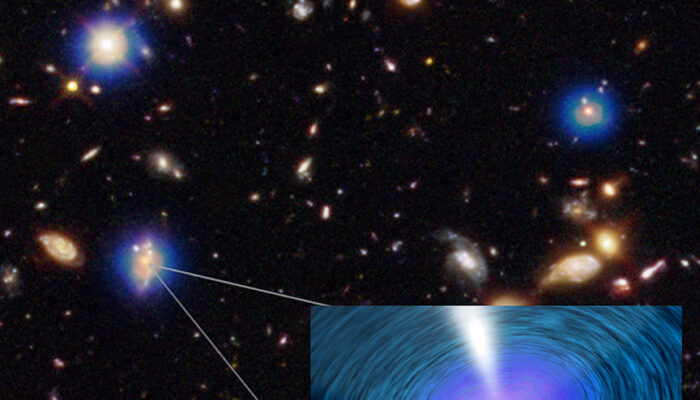
The relationship between black holes and galaxies is complex and interdependent. Observations reveal a correlation between the mass of supermassive black holes and the properties of their host galaxies, known as the black hole-galaxy mass relationship. Black holes influence galactic evolution through energetic feedback mechanisms, such as active galactic nuclei (AGN), which can heat or expel gas, thereby regulating or halting star formation. This feedback loop suggests that black holes not only coexist with galaxies but actively shape their developmental trajectories.
Longevity Comparison: Black Holes vs. Galaxies
While galaxies experience a lifecycle marked by birth, growth, transformation, and eventual decline, black holes may persist far beyond the lifespan of their host galaxies. As galaxies age and their star-forming gas diminishes, black holes can continue to accrete residual matter or intergalactic gas, maintaining or increasing their mass. This decoupling of evolutionary paths implies that black holes could remain active and influential even after their galaxies have faded or fragmented.
Ultimate Fate and Cosmic Significance
Speculative models propose that black holes might survive the ultimate disintegration of their galaxies, wandering alone through the cosmic void as relics of ancient epochs. Their persistence is further supported by the extraordinarily long timescales associated with Hawking radiation-driven evaporation, which far exceed the universe’s current age. Consequently, black holes may represent some of the longest-lasting structures in the cosmos, continuing to warp spacetime and bear witness to the universe’s history long after their galactic hosts have ceased to exist.
Why This Matters
Understanding whether black holes outlive galaxies reshapes our perspective on cosmic evolution and longevity. It highlights black holes as dynamic, enduring agents that influence galactic life cycles and may dominate the universe’s distant future. This insight is crucial for astrophysics, as it informs models of galaxy formation, black hole growth, and the ultimate fate of cosmic structures. Moreover, it challenges traditional views of black holes as mere endpoints, positioning them instead as persistent, evolving entities integral to the universe’s grand narrative.
Common Misconceptions
Black holes are simply cosmic vacuum cleaners that indiscriminately consume everything.
Black holes only accrete matter that crosses their event horizon; they do not actively suck in objects at a distance.
Galaxies are permanent, unchanging structures.
Galaxies evolve over billions of years, undergoing transformations in shape, size, and star formation activity.
Black holes evaporate quickly.
Hawking radiation causes black holes to evaporate over timescales far longer than the current age of the universe, making them effectively long-lived.
Real-World Examples
Observations of active galactic nuclei, such as those in quasars, demonstrate how supermassive black holes accrete matter and emit enormous energy, influencing their host galaxies. The Milky Way’s central black hole, Sagittarius A*, provides a nearby example of a supermassive black hole interacting with its galactic environment. Additionally, galaxy mergers observed in deep space illustrate how galactic structures evolve and how central black holes may grow through such cosmic events.
FAQ
Do black holes outlive galaxies?
Yes, black holes can continue to grow and exist long after their host galaxies have faded.
What factors influence the lifespan of galaxies?
Galaxies evolve through processes like star formation, gas depletion, and external interactions.
How do black holes affect their host galaxies?
Black holes influence galactic evolution through feedback mechanisms that can regulate star formation.


Leave a Reply