
Short Answer
Definition of Mass Measurement in the Metric System
Mass measurement is a critical component in both scientific research and practical applications across numerous disciplines, including chemistry, engineering, and everyday activities. Within the metric system, mass is quantified using a variety of instruments, each designed to suit specific accuracy requirements and operational contexts. These tools enable precise determination of mass, facilitating advancements in science and technology as well as routine tasks.
Types of Instruments for Measuring Mass
Analytical Balances
Analytical balances are precision instruments designed to measure mass with exceptional accuracy, often down to milligrams or micrograms. They operate using sensitive mechanisms, frequently involving electromagnetic forces to counterbalance the object’s weight. To maintain their high precision, environmental factors such as temperature, air currents, and vibrations must be carefully controlled. Due to their exactness, analytical balances are indispensable in laboratory environments, particularly in pharmaceutical development and biochemical experiments where precise mass measurements are vital.
Beam Balances
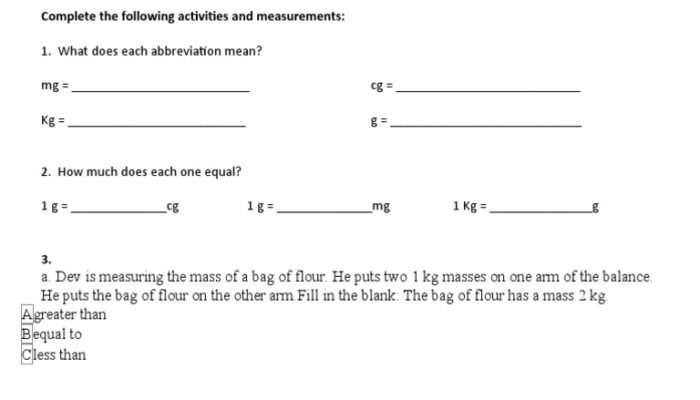
Beam balances function on the principle of lever arms and counterweights. The object to be measured is placed on one side of the beam, while calibrated weights are added to the opposite side until equilibrium is reached. Known for their durability and straightforward design, beam balances provide adequate accuracy for many uses, especially in educational settings and industrial applications. They are also valuable for comparative mass measurements, helping users develop a conceptual understanding of mass and weight.
Digital Scales
Digital scales have gained widespread popularity due to their ease of use and quick results. These devices utilize load cells, which convert applied force into electrical signals, allowing for immediate digital readouts. Their convenience makes them suitable for everyday tasks such as grocery shopping and classroom demonstrations. However, while digital scales generally offer reasonable accuracy, they may not match the precision of analytical balances, making it important for users to be aware of their limitations.
Spring Scales
Spring scales measure mass based on Hooke’s Law, which states that the force exerted by a spring is proportional to its extension or compression. When an object is suspended from the spring, the degree of elongation corresponds to the force exerted by the object’s weight, which can then be translated into mass. Although spring scales provide approximate measurements, their portability and simplicity make them ideal for educational purposes and situations where high precision is not essential.
Force Sensors and Load Cells
Force sensors and load cells represent advanced technologies for indirectly measuring mass through force detection. These instruments are integral to automation and process control in industries such as manufacturing and logistics. By integrating force sensors into complex systems, real-time mass data can be obtained, enhancing operational efficiency. Despite their higher cost compared to simpler devices, their ability to be embedded in automated workflows justifies their use in critical industrial applications.
Mass Spectrometers
Mass spectrometers are specialized instruments used primarily in scientific research to measure the mass of ions by separating them according to their mass-to-charge ratio. This technique is essential for identifying molecular structures, isotopes, and analyzing complex chemical mixtures. Mass spectrometry exemplifies the intersection of mass measurement with fields like chemistry and physics, playing a pivotal role in cutting-edge scientific investigations.
How Mass Measurement Instruments Operate
Each mass measurement device functions based on distinct physical principles:
- Analytical balances:
Utilize electromagnetic forces to achieve equilibrium with the object’s mass. - Beam balances:
Employ lever mechanics and calibrated weights to balance the object’s mass. - Digital scales:
Use load cells to convert force into electrical signals for digital display. - Spring scales:
Rely on the proportional extension of a spring under load (Hooke’s Law). - Force sensors/load cells:
Detect force applied and convert it into measurable electrical output. - Mass spectrometers:
Separate ions by mass-to-charge ratio using electromagnetic fields.
Mathematical Principles Behind Mass Measurement
Several fundamental formulas underpin the operation of mass measurement instruments:
- Hooke’s Law (Spring Scales):
( F = k times x )
Where ( F ) is the force exerted by the spring, ( k ) is the spring constant, and ( x ) is the displacement of the spring. - Force to Mass Conversion:
( m = frac{F}{g} )
Where ( m ) is mass, ( F ) is force measured by the sensor or scale, and ( g ) is the acceleration due to gravity (approximately 9.81 m/s²). - Mass Spectrometry:
Separation based on mass-to-charge ratio ( frac{m}{z} ), where ( m ) is ion mass and ( z ) is charge number.
Practical Applications of Mass Measurement Tools
Mass measurement instruments are utilized across a broad spectrum of real-world scenarios:
- Laboratory Research:
Analytical balances provide precise mass data for chemical formulations and pharmaceutical development. - Education:
Beam and spring scales help students grasp fundamental concepts of mass, force, and equilibrium. - Retail and Commerce:
Digital scales facilitate quick and convenient mass measurement for goods and produce. - Industrial Automation:
Force sensors and load cells enable real-time mass monitoring in manufacturing processes. - Scientific Exploration:
Mass spectrometers assist in molecular analysis, isotope identification, and astrophysical research.
Common Misunderstandings About Mass Measurement
- Misconception: Digital scales are always as accurate as analytical balances.
Correction: Digital scales offer convenience but generally have lower precision compared to analytical balances, which are designed for high-accuracy measurements. - Misconception: Spring scales measure mass directly.
Correction: Spring scales measure force, which is then converted to mass assuming constant gravitational acceleration. - Misconception: Beam balances provide exact mass readings.
Correction: Beam balances often provide comparative mass measurements and may not be as precise as electronic balances.
Significance of Mass Measurement in Science and Daily Life
Accurate mass measurement is foundational to numerous scientific disciplines and everyday activities. It underpins the principles of physics, chemistry, and engineering, enabling precise formulation, quality control, and experimentation. In daily life, reliable mass measurement ensures fairness in commerce and supports health and nutrition monitoring. As technology advances, understanding the capabilities and limitations of various mass measurement instruments becomes increasingly important, driving innovation and enhancing the accuracy of scientific and practical endeavors.
FAQ
What instrument is most commonly used for precise mass measurement in labs?
The analytical balance is most commonly used for precise mass measurement in laboratories due to its high sensitivity and accuracy.
Can digital scales be trusted for scientific measurements?
Digital scales offer reasonable accuracy for many applications but may lack the precision required for high-level scientific measurements.
How does a beam balance work?
A beam balance measures mass by balancing an unknown mass against known calibrated weights on opposite sides of a lever arm until equilibrium is reached.
Why are mass spectrometers important for scientific research?
Mass spectrometers allow scientists to analyze the mass of ions, which is crucial for identifying molecular structures, isotopes, and complex mixtures.


Leave a Reply