
Short Answer
Definition of Non-Linear Optics
Non-linear optics is a specialized branch of optics that studies the behavior of light when it interacts with materials in ways that deviate from the simple, proportional responses seen in linear optics. Unlike linear optics, where the response of a medium to an electromagnetic field is directly proportional to the light’s intensity, non-linear optics explores scenarios where this relationship becomes complex and non-proportional. This field reveals how intense light can alter the properties of the medium it travels through, leading to a variety of unique and technologically significant phenomena.
Fundamental Principles
At the core of non-linear optics is the concept that the optical properties of a material, such as its refractive index, can change in response to the intensity of the incident light. In linear optics, light behaves predictably, following well-established laws like refraction and reflection. However, in non-linear media, the interaction between light and matter becomes dynamic and interdependent, resulting in effects that cannot be explained by simple linear equations. This non-linear response is often described as a higher-order polarization of the medium induced by the electromagnetic field of the light.
Key Phenomena in Non-Linear Optics
Second-Harmonic Generation (SHG)
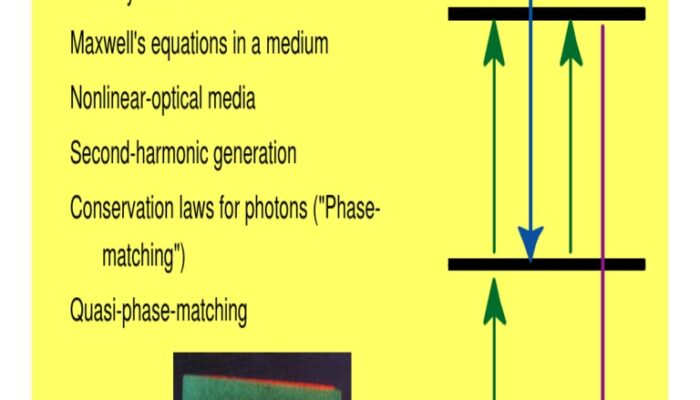
One of the hallmark effects in non-linear optics is second-harmonic generation, where photons of a fundamental frequency combine within a non-linear medium to produce new photons at twice the original frequency. This process is analogous to musical harmonics, where a fundamental tone generates overtones that enrich the sound. SHG is crucial in applications requiring coherent light sources at new wavelengths, such as in laser technology, medical diagnostics, and advanced telecommunications.
Self-Focusing and Filamentation
Self-focusing occurs when the intensity of light traveling through a non-linear medium induces a localized increase in the refractive index, causing the light beam to focus itself into a narrow, intense filament. This phenomenon is comparable to a river narrowing as it flows through a gorge. Self-focusing is essential in high-power laser applications, including precision material processing and the study of solitons-stable, solitary wave packets that maintain their shape over long distances.
Optical Solitons
Optical solitons are stable light pulses that arise from a balance between dispersion and non-linear effects in a medium. These waves can travel long distances without changing shape, much like a tightrope walker maintaining perfect balance. Solitons are vital in fiber-optic communications, enabling efficient and distortion-free transmission of data over vast distances.
Optical Kerr Effect
The optical Kerr effect describes the phenomenon where the refractive index of a material changes in response to the electric field of light, affecting the medium’s polarization. This effect is harnessed to develop ultra-fast optical switches and modulators that operate at the speed of light, facilitating real-time processing of large volumes of information in photonic devices.
Chaos in Non-Linear Optical Systems
Non-linear optical interactions can sometimes lead to chaotic behavior, where small variations in initial conditions cause unpredictable and complex outcomes, similar to weather systems. Understanding and controlling chaos in optical systems is not only a theoretical pursuit but also opens avenues for innovative technologies such as secure communication methods and advanced imaging techniques that exploit the inherent unpredictability of light.
Mathematical Framework
The behavior of non-linear optical phenomena is often described by expanding the polarization P of a medium as a power series in the electric field E of the light:
P = ε₀ (χ^(1) E + χ^(2) E² + χ^(3) E³ + …)
- ε₀: Permittivity of free space
- χ^(1): Linear susceptibility, representing the linear response
- χ^(2), χ^(3): Second- and third-order susceptibilities, responsible for non-linear effects such as SHG and the Kerr effect
- E: Electric field amplitude of the incident light
This expansion illustrates how higher-order terms become significant at high light intensities, leading to the rich variety of non-linear optical phenomena.
Applications in Technology and Science
Non-linear optics plays a pivotal role in numerous cutting-edge technologies:
- Laser Systems:
Generation of new wavelengths and ultra-short pulses for industrial, medical, and research purposes. - Telecommunications:
Optical switching and soliton-based data transmission enhance speed and capacity of fiber-optic networks. - Medical Imaging:
Techniques like multiphoton microscopy rely on non-linear optical effects for high-resolution, deep-tissue imaging. - Secure Communications:
Exploiting chaotic dynamics in optical systems to develop encryption methods resistant to interception.
Common Misunderstandings About Non-Linear Optics
- Misconception: Non-linear optics only occurs at extremely high light intensities.
Correction: While high intensities enhance non-linear effects, certain materials and configurations can exhibit non-linear behavior at relatively low power levels. - Misconception: Non-linear optics is purely theoretical and lacks practical applications.
Correction: Non-linear optics underpins many real-world technologies, from laser manufacturing to telecommunications and medical diagnostics.
Significance of Non-Linear Optics
The study of non-linear optics is fundamental to advancing our understanding of light-matter interactions beyond classical limits. It enables the development of innovative devices that manipulate light with extraordinary precision and speed, driving progress in fields such as photonics, information technology, and biomedical engineering. By exploring the complex dynamics of non-linear phenomena, scientists and engineers unlock new capabilities that continue to transform technology and expand the frontiers of scientific knowledge.
FAQ
What is non-linear optics?
Non-linear optics is the study of how light interacts with materials in ways where the response is not proportional to the light intensity, leading to new phenomena and applications.
What causes second-harmonic generation?
Second-harmonic generation occurs when photons combine in a non-linear medium to produce new photons at twice the original frequency.
What is self-focusing in non-linear optics?
Self-focusing happens when intense light changes the refractive index of a medium, causing the light beam to focus itself into a narrow filament.
How are optical solitons useful?
Optical solitons maintain their shape over long distances in fiber-optic communications, enabling stable and efficient data transmission.
What is the optical Kerr effect?
The optical Kerr effect is the change in refractive index of a material caused by the electric field of light, used for ultra-fast optical switching.





Leave a Reply