
Short Answer
Definition of the Voyager Missions
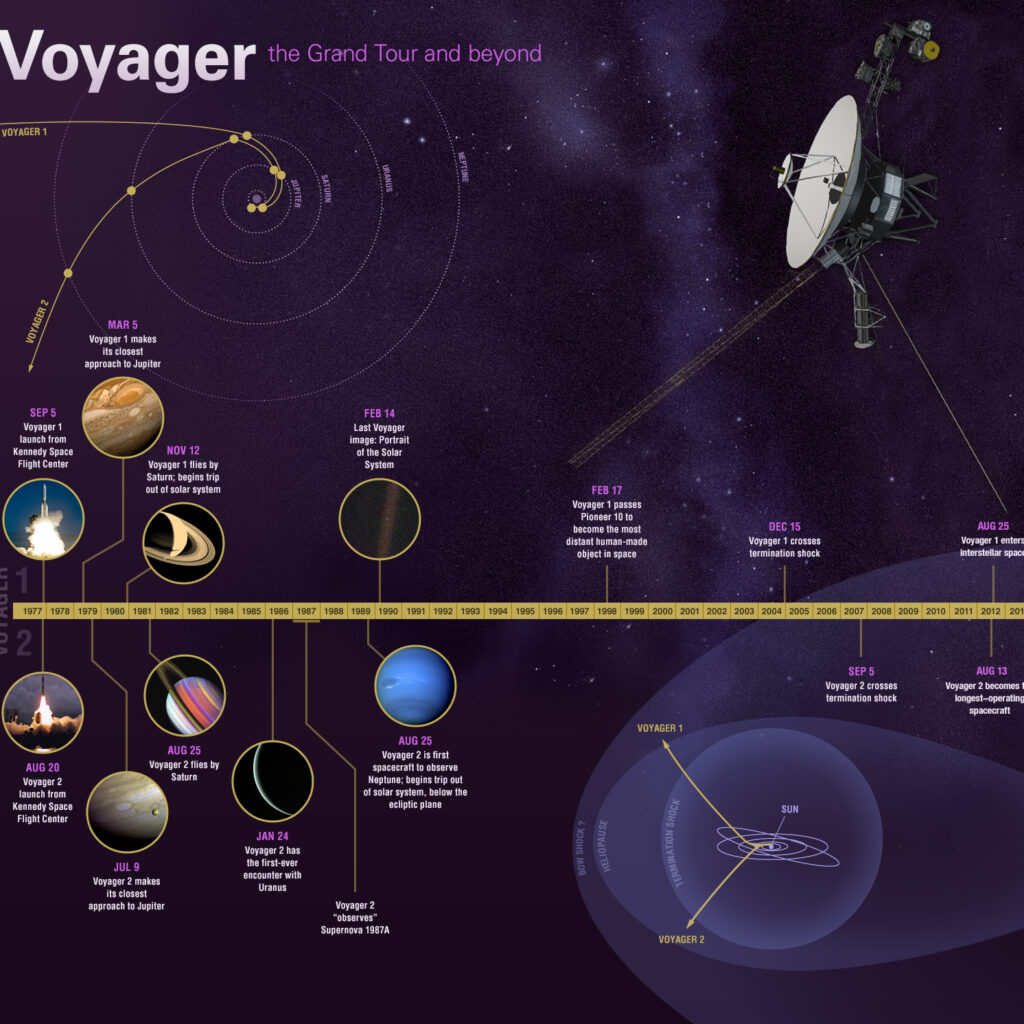
The Voyager missions consist of two robotic spacecraft, Voyager 1 and Voyager 2, launched in the late 1970s with the goal of exploring the outer planets and eventually venturing beyond the solar system. These probes represent some of humanity’s most ambitious efforts to extend our reach into interstellar space, carrying scientific instruments and cultural artifacts designed to communicate with potential extraterrestrial life.
Current Visibility of the Voyager Spacecraft
Many wonder if the Voyager probes can still be observed from Earth today. Unlike planets or stars, the Voyagers do not emit light nor reflect enough sunlight to be seen with the naked eye or typical telescopes. Their immense distance-over 14 billion miles for Voyager 1-renders them invisible to optical instruments. Instead, their presence is detected through radio signals received by specialized Earth-based antenna arrays, such as NASA’s Deep Space Network (DSN).
Voyager’s Position in Space
Both Voyager 1 and Voyager 2 have crossed the heliosphere, the vast bubble formed by the solar wind that envelops our solar system, entering interstellar space. This boundary marks humanity’s first direct encounter with the galactic environment surrounding our sun. The probes’ extraordinary distances mean that even light takes more than 20 hours to travel from Voyager 1 back to Earth, highlighting the vast scale of their journey.
Why Optical Detection Is Impossible
- Size and Reflectivity:
Each Voyager spacecraft is roughly the size of a compact car and does not generate its own light. The tiny amount of sunlight they reflect is negligible against the backdrop of space. - Distance:
Their extreme remoteness places them far beyond the reach of most telescopes, which are designed to observe bright celestial bodies like stars, galaxies, and nebulae.
Scientific Contributions of the Voyager Missions
The Voyager probes revolutionized planetary science by providing unprecedented data during their flybys of the outer planets. They revealed the turbulent atmosphere of Jupiter, the intricate ring system of Saturn, the unique axial tilt of Uranus, and the intense storms on Neptune. Beyond planetary exploration, their ongoing measurements from interstellar space offer critical insights into cosmic rays, magnetic fields, and the properties of the interstellar medium.
Engineering Marvels Behind Voyager’s Longevity
Powered by radioisotope thermoelectric generators, the Voyagers have operated continuously for over four decades. Although their energy supply is gradually diminishing, they still transmit faint radio signals detectable by Earth’s high-gain antennas. This enduring functionality is a testament to the ingenuity and resilience of their design, as well as the dedication of mission teams who maintain communication and track their trajectories.
Tracking and Monitoring the Voyagers
While invisible to optical instruments, the spacecraft’s positions, velocities, and trajectories are precisely monitored by NASA’s flight teams. This tracking enables ongoing scientific research and mission planning, ensuring that the probes continue to contribute valuable data from the frontier of interstellar space.
The Cultural and Symbolic Significance of the Voyagers
Beyond their scientific value, the Voyager missions carry profound symbolic meaning. Each probe carries a Golden Record containing sounds and images representing Earth’s diversity, intended as a message to any potential extraterrestrial civilizations. This human element transforms the spacecraft into cosmic ambassadors, embodying our curiosity, hope, and desire to connect with the universe.
Common Misconceptions About Voyager Visibility
The Voyager spacecraft can be seen with amateur telescopes.
Due to their small size and extreme distance, the Voyagers are not visible through amateur or most professional telescopes.
The probes emit visible light.
The Voyagers do not produce visible light; their detection relies solely on radio signal reception.
Why the Voyager Missions Remain Important
The Voyager missions exemplify humanity’s enduring quest to explore beyond known boundaries. They highlight the value of patience, perseverance, and long-term scientific endeavor in an era often focused on immediate results. Their silent journey into the cosmos invites reflection on our place in the universe and the legacy of exploration we aspire to leave. Although invisible to the naked eye, the Voyagers’ signals carry humanity’s story and a message of peace, inspiring generations to continue reaching for the stars.
FAQ
What are the Voyager missions?
The Voyager missions consist of Voyager 1 and Voyager 2, launched to explore the outer planets and currently traveling through interstellar space.
Why can't we see the Voyager spacecraft?
The Voyager probes do not emit light and are too far away to be detected by optical telescopes.



Leave a Reply