
Short Answer
Definition of Self-Assembling Transistors
Self-assembling transistors represent an innovative fusion of molecular biology and nanotechnology, utilizing the unique properties of DNA to create electronic components. Unlike traditional transistors made from silicon, these devices harness DNA’s natural ability to organize itself into precise nanoscale structures, offering a novel approach to building future computing systems.
- Self-assembly:
The process by which molecules autonomously organize into structured arrangements without external guidance. - Transistor:
A semiconductor device used to amplify or switch electronic signals and electrical power. - DNA as a medium:
DNA molecules serve as programmable scaffolds that guide the formation of transistor components at the molecular level.
Fundamental Properties of DNA Enabling Self-Assembly
DNA’s molecular structure is central to its role in self-assembling transistors. The double helix, composed of complementary nucleotide base pairs, allows for highly specific and programmable interactions. This specificity facilitates the precise arrangement of nanoscale components, making DNA an ideal template for constructing electronic devices.
- Programmability:
DNA sequences can be designed to fold and hybridize in predetermined ways. - Stability:
DNA maintains structural integrity under various physical conditions, essential for device reliability. - Molecular recognition:
Base pairing enables selective binding, guiding the assembly of complex nanostructures.
Limitations of Conventional Silicon Transistors
Traditional semiconductor devices primarily rely on silicon-based transistors, which face significant challenges as technology pushes toward smaller scales. The fabrication processes become increasingly complex and costly, and physical limitations arise when shrinking components below the nanometer scale.
- Size constraints:
Silicon transistors encounter quantum effects and heat dissipation issues at extremely small dimensions. - Manufacturing complexity:
Advanced lithography techniques required for miniaturization are expensive and technically demanding. - Performance limits:
There is a practical ceiling on speed and energy efficiency improvements using conventional materials.
Mechanism of DNA-Based Self-Assembling Transistors
DNA-based transistors operate on principles similar to traditional field-effect transistors (FETs), where an applied gate voltage modulates the flow of charge carriers. The DNA scaffold acts as a nanoscale framework, enabling precise placement of conductive elements that control electrical current with high efficiency and low power consumption.
Techniques for Constructing DNA-Driven Transistor Architectures
Several innovative methods have been developed to fabricate self-assembling transistors using DNA:
- DNA Origami:
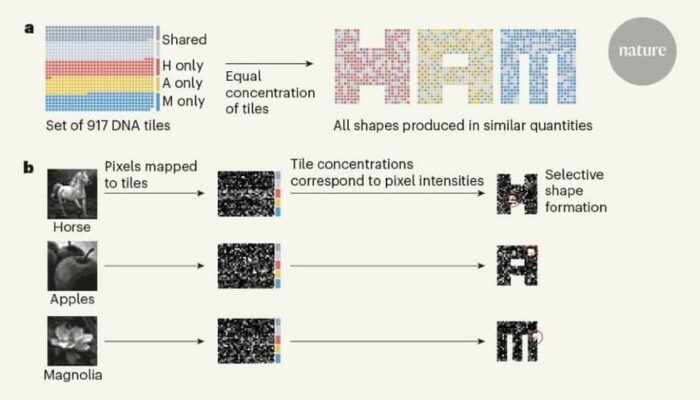
This technique involves folding long DNA strands into specific shapes that serve as templates for assembling conductive nanoparticles or organic semiconductors, enabling the creation of complex transistor circuits. - Hybrid Systems:
Combining DNA scaffolds with materials like carbon nanotubes enhances electronic properties such as charge transport, merging biological self-assembly with traditional conductive elements. - Templating Approaches:
DNA structures guide the deposition of metals or semiconductors, forming nanoscale transistor networks with high precision.
Mathematical and Physical Principles
The operation of DNA-based transistors can be described using the field-effect transistor model:
ID = μCox(W/L)(VGS – Vth)VDS
- ID: Drain current, the current flowing through the transistor.
- μ: Charge carrier mobility within the channel.
- Cox: Capacitance per unit area of the gate oxide.
- W/L: Width-to-length ratio of the transistor channel.
- VGS: Gate-to-source voltage controlling the channel conductivity.
- Vth: Threshold voltage required to turn the transistor on.
- VDS: Drain-to-source voltage driving the current.
In DNA-based transistors, the DNA scaffold influences parameters such as channel dimensions and carrier mobility by dictating the spatial arrangement of conductive materials.
Practical Applications and Emerging Uses
Self-assembling DNA transistors hold promise across various fields:
- Biocomputing:
Integration of biological molecules with electronic circuits could enable devices capable of complex, bio-inspired decision-making. - Data Storage:
Leveraging DNA’s natural information density, these transistors may revolutionize memory devices with ultra-compact and efficient data handling. - Medical Technology:
Miniaturized, biocompatible electronics could lead to advanced diagnostic tools and implantable devices. - Telecommunications and AI:
Enhanced processing capabilities at the nanoscale may improve communication systems and artificial intelligence hardware.
Challenges and Limitations
Despite their potential, DNA-based transistors face several obstacles before widespread adoption:
- Stability Issues:
DNA is prone to degradation under typical electronic operating conditions, necessitating protective encapsulation strategies. - Reproducibility:
Achieving consistent fabrication and performance across devices remains a significant hurdle. - Integration:
Seamlessly combining DNA-based components with existing semiconductor technologies requires further research and development.
Common Misconceptions About DNA-Based Electronics
DNA transistors can immediately replace silicon devices.
While promising, DNA-based transistors are still in early research stages and require overcoming stability and integration challenges before commercial viability.
DNA is only useful for biological functions.
Beyond genetics, DNA’s programmable structure makes it a versatile material for nanoscale engineering and electronics.
Significance and Future Outlook
The development of self-assembling transistors using DNA heralds a transformative shift in electronics, merging biological principles with advanced nanotechnology. This interdisciplinary approach could lead to devices that are smaller, more energy-efficient, and capable of functionalities beyond current silicon-based systems. As research progresses, the collaboration between molecular biology, materials science, and electrical engineering will be vital to unlocking the full potential of DNA-driven electronics, potentially revolutionizing computing, data storage, and bio-integrated technologies.
FAQ
What are self-assembling transistors?
Self-assembling transistors are electronic components that utilize DNA's unique properties to autonomously organize into nanoscale structures, offering a novel alternative to traditional silicon transistors.
What are the potential applications of DNA-based transistors?
Potential applications include biocomputing, data storage, medical technology, and advancements in telecommunications and AI.
What challenges do DNA-based transistors face?
Challenges include stability issues, reproducibility of fabrication, and integration with existing semiconductor technologies.



Leave a Reply