
Short Answer
Definition of Memristors
Memristors, a portmanteau of “memory” and “resistor,” are innovative two-terminal electronic components that uniquely combine memory storage and resistance functions. Unlike conventional resistors, memristors retain a memory of the electrical charge that has previously passed through them, enabling them to maintain a specific resistance state even when power is removed. This non-volatile characteristic distinguishes memristors from traditional transistors and capacitors, which require continuous power to preserve their states.
- Non-volatile memory:
Memristors store information by altering their resistance based on historical current flow, allowing data retention without power. - Resistance state:
The resistance level of a memristor corresponds directly to the cumulative charge that has traversed it, effectively encoding information. - Energy efficiency:
Due to their ability to maintain states without power, memristors offer significant reductions in energy consumption compared to traditional memory devices.
Operational Principles of Memristors
At the core of memristor functionality lies the relationship between electric charge and magnetic flux linkage, which governs their resistance changes. When current flows through a memristor, it modifies the internal state of the device, typically by moving ions or vacancies within the material, thereby adjusting its resistance. This change is retained even after the current ceases, enabling the device to “remember” its previous state.
This behavior can be understood as a dynamic resistor whose resistance depends on the integral of the current over time. The memristor’s resistance thus encodes the history of electrical activity, making it a fundamental building block for memory and logic applications that mimic synaptic behavior in biological systems.
Memristors in Neuromorphic Computing
One of the most transformative applications of memristors is in neuromorphic engineering, where computing systems are designed to emulate the neural structures and processes of the human brain. Traditional digital computers operate on binary logic and sequential processing, which contrasts sharply with the massively parallel and adaptive nature of biological neural networks.
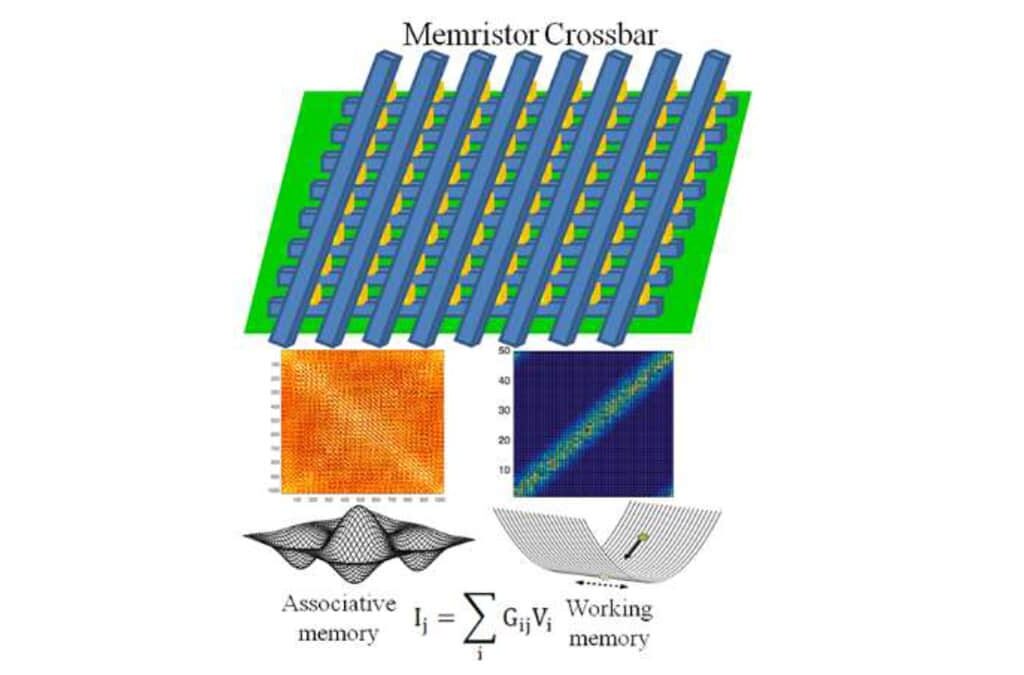
Memristors serve as artificial synapses in neuromorphic circuits, enabling devices to learn, adapt, and store information in a manner similar to neurons. Their ability to modulate resistance in response to electrical stimuli allows these systems to perform complex pattern recognition, learning, and memory tasks with remarkable energy efficiency and speed.
- Parallel processing:
Memristor networks can process multiple signals simultaneously, mirroring the brain’s distributed computation. - Asynchronous operation:
Unlike clock-driven digital systems, memristor-based neuromorphic devices operate asynchronously, enhancing efficiency. - Synaptic plasticity:
The adjustable resistance of memristors mimics synaptic weight changes, fundamental to learning and memory.
Applications in Artificial Intelligence
As artificial intelligence (AI) systems grow in complexity, the demand for hardware capable of efficient, high-speed data processing intensifies. Memristors offer promising solutions by enabling hardware implementations of neural networks that can learn and adapt in real time.
In deep learning, memristor arrays can replicate synaptic connections, facilitating faster training and inference compared to traditional silicon-based processors. This hardware acceleration reduces energy consumption and latency, making AI applications more scalable and practical for real-world deployment.
Memory-Centric Computing and the “Memory Wall”
Conventional computing architectures often face the “memory wall” challenge, where the speed gap between processors and memory access limits overall system performance. Memristors address this bottleneck by integrating memory and processing capabilities within a single device.
This convergence allows for faster data access and reduced latency, as information no longer needs to shuttle between separate memory and processing units. Such architectures promise enhanced computational throughput and energy efficiency, particularly beneficial for data-intensive applications.
Miniaturization and Integration in Emerging Technologies
Advancements in nanofabrication techniques have enabled the production of memristors at nanoscale dimensions, facilitating their incorporation into compact and versatile electronic devices. This miniaturization opens avenues for their use in the Internet of Things (IoT), wearable technology, and biomedical devices.
By embedding memristor networks into these platforms, it becomes possible to perform real-time data analysis and context-aware computing, driving innovation in smart environments and personalized healthcare.
Challenges in Memristor Development
Despite their promising potential, several obstacles remain before memristors can achieve widespread commercial adoption. The materials commonly used, such as transition metal oxides, require further refinement to enhance device stability, endurance, and reproducibility under diverse operating conditions.
Moreover, the lack of standardized fabrication processes and system integration protocols poses significant challenges for scaling memristor technology across the electronics industry. Addressing these issues is critical to unlocking the full capabilities of memristor-based computing systems.
Significance and Future Outlook
The introduction of memristors signifies a major leap forward in the evolution of computing technology. By emulating the functional characteristics of biological synapses, memristors pave the way for the development of intelligent, adaptive, and energy-efficient computing architectures that transcend the limitations of traditional digital systems.
As research progresses, memristors are expected to play a central role in shaping the future of brain-inspired computing, artificial intelligence, and memory-centric architectures. Their integration promises to blur the boundaries between neuroscience and technology, heralding a new era of computational innovation with profound implications for science, industry, and everyday life.
FAQ
What are memristors?
Memristors are electronic components that retain a memory of electrical charge and combine memory storage with resistance functions.
How do memristors function?
Memristors modify their resistance based on historical current flow, allowing them to 'remember' previous states.
What are the applications of memristors?
They are used in neuromorphic computing, artificial intelligence, and to address memory wall challenges in computing.




Leave a Reply