
Short Answer
Definition of General Relativity
General relativity, introduced by Albert Einstein in 1915, revolutionized the way we comprehend gravity and the structure of spacetime. Unlike classical Newtonian physics, which treats gravity as a force acting at a distance, general relativity describes gravity as the warping or curvature of spacetime caused by mass and energy. This theory fundamentally reshaped our understanding of how objects move and interact in the universe.
- Gravity as Geometry:
Gravity is not a force but the effect of curved spacetime geometry around massive bodies. - Geodesics:
Objects in free fall follow the straightest possible paths, called geodesics, within this curved spacetime.
Principles Underlying General Relativity
Einstein’s theory posits that mass and energy dictate the curvature of spacetime, which in turn governs the motion of objects. This concept replaces the Newtonian idea of gravitational force with a geometric interpretation, where the presence of mass distorts the fabric of the universe, influencing trajectories and the flow of time itself.
The Cassini Mission and Its Role in Testing General Relativity
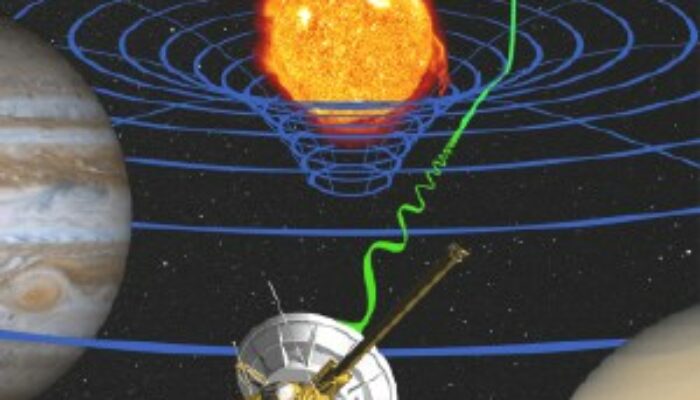
Launched in 1997, the Cassini spacecraft primarily aimed to explore Saturn and its moons. However, its journey also provided a unique experimental platform to test the predictions of general relativity. During a close solar flyby in 1999, Cassini passed within a few million kilometers of the Sun, allowing scientists to observe how the Sun’s gravity affected the spacecraft’s path and the propagation of signals near the Sun.
- Gravitational Deflection of Light:
One key prediction of general relativity is that light passing near a massive object like the Sun bends due to spacetime curvature, a phenomenon known as gravitational lensing. - Relativistic Effects on Trajectory:
The spacecraft’s trajectory and signal timing were measured with high precision to detect these subtle relativistic influences.
How the Cassini Test Validated Einstein’s Theory
The Cassini experiment involved precise measurements of the time delay and bending of radio signals as they passed close to the Sun. These observations matched the predictions made by general relativity with remarkable accuracy, confirming that the curvature of spacetime affects the path of light and the motion of objects as Einstein described. This empirical evidence reinforced the theory’s status as a cornerstone of modern physics.
Mathematical Framework of General Relativity
At the heart of general relativity lies the Einstein field equations, which relate the geometry of spacetime to the distribution of mass and energy:
Gμν + Λgμν = (8πG/c⁴) Tμν
- Gμν: Einstein tensor representing spacetime curvature.
- Λ: Cosmological constant, accounting for the energy density of empty space.
- gμν: Metric tensor describing spacetime geometry.
- Tμν: Stress-energy tensor representing matter and energy content.
- G: Gravitational constant.
- c: Speed of light.
These equations form the foundation for predicting how mass-energy influences spacetime and, consequently, the motion of objects and light.
Real-World Implications and Examples
The confirmation of general relativity through the Cassini mission has profound implications across astrophysics and cosmology:
- GPS Technology:
Satellite navigation systems rely on relativistic corrections to maintain accuracy, accounting for time dilation effects predicted by general relativity. - Black Hole Physics:
Understanding the behavior of light and matter near black holes depends on the principles of spacetime curvature. - Gravitational Lensing:
Observations of distant galaxies and dark matter distribution utilize the bending of light by massive objects, a direct consequence of general relativity.
Challenges and Limitations of General Relativity
Despite its successes, general relativity faces challenges when applied to certain extreme conditions and phenomena:
- Quantum Gravity:
The theory does not incorporate quantum mechanics, leaving the behavior of gravity at the smallest scales unresolved. - Dark Matter and Dark Energy:
These mysterious components of the universe are not fully explained by general relativity alone, prompting exploration of alternative or extended theories. - Higher-Order Effects:
Some astrophysical observations may require corrections beyond classical general relativity, motivating ongoing research.
Scientific Significance of the Cassini Test
The Cassini mission exemplifies the power of the scientific method, where theoretical predictions are rigorously tested through observation and experimentation. The successful validation of general relativity through this mission highlights the interplay between abstract mathematical models and tangible cosmic phenomena, reinforcing the theory’s foundational role in physics.
Broader Cosmological Considerations
The insights gained from the Cassini test invite deeper reflection on the dynamic nature of spacetime and the universe:
- Dynamic Spacetime:
Rather than a static backdrop, spacetime is an evolving entity shaped by the distribution and movement of mass and energy. - Interconnectedness of Mass and Geometry:
The mutual influence between matter and spacetime geometry underpins the large-scale structure and evolution of the cosmos.
The Future of Relativistic Physics
As technology advances, new observational tools such as gravitational wave detectors and next-generation telescopes will continue to test and refine our understanding of gravity. The ongoing quest to reconcile general relativity with quantum mechanics and to explain dark matter and dark energy ensures that the study of gravity remains a vibrant and evolving field.
Interdisciplinary Collaboration in Gravitational Research
The exploration of gravity and spacetime is inherently multidisciplinary, drawing from astrophysics, mathematics, philosophy, and beyond. This collaborative approach fosters a richer comprehension of the universe and drives the formulation of new questions that propel scientific discovery forward.
Conclusion: The Enduring Legacy of General Relativity
The Cassini mission’s confirmation of general relativity stands as a testament to human curiosity and the power of scientific inquiry. Einstein’s theory continues to inspire and challenge researchers, encouraging ongoing exploration into the fundamental laws governing the cosmos. The dialogue between theory and observation remains central to physics, urging us to expand the horizons of knowledge and to embrace the mysteries that lie beyond our current understanding.
FAQ
What is general relativity?
General relativity is a theory by Einstein that describes gravity as the curvature of spacetime caused by mass and energy.
How did the Cassini mission test general relativity?
The Cassini mission tested general relativity by measuring the bending of radio signals and the trajectory of the spacecraft during a flyby near the Sun.
What were the results of the Cassini test?
The results confirmed the predictions of general relativity with remarkable accuracy, validating the theory.




Leave a Reply