
Short Answer
Understanding the Concept of a Flat Universe
The shape and structure of the universe have captivated both scientists and the general public for centuries, raising profound questions about its geometry and ultimate destiny. Central to these inquiries is the question: Is the universe flat on a large scale? This topic lies at the intersection of cosmology, physics, and astronomy, where the universe’s shape influences theories about its origin, evolution, and eventual fate.
Definition of Cosmic Curvature
In cosmology, the term “flatness” refers to the curvature of space on a cosmic scale, a concept grounded in Einstein’s theory of general relativity and differential geometry. The universe’s geometry can be categorized into three primary types:
- Closed Universe (Positive Curvature):
This model resembles the surface of a sphere, where parallel lines eventually converge. Such a universe is finite in volume but without boundaries. - Open Universe (Negative Curvature):
Characterized by a saddle-shaped geometry, parallel lines diverge indefinitely, and the universe extends infinitely. - Flat Universe (Zero Curvature):
Analogous to an infinite plane, parallel lines remain parallel forever, indicating no curvature.
Implications of Different Geometries on Cosmic Evolution
The geometry of the universe is not merely a spatial descriptor; it profoundly affects its long-term behavior:
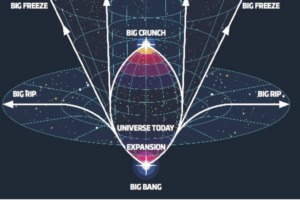
- Closed Universe: Expansion may halt and reverse, culminating in a “Big Crunch.”
- Open Universe: Expansion continues indefinitely, leading to a cold, dark, and ever-expanding cosmos.
- Flat Universe: Expansion persists forever but slows down, approaching a steady rate asymptotically.
How Scientists Measure the Universe’s Curvature
Determining the universe’s shape relies on precise astronomical observations, particularly of the cosmic microwave background (CMB) radiation. The CMB is the residual thermal radiation from about 380,000 years after the Big Bang, permeating all space. Tiny temperature and polarization fluctuations within the CMB encode information about the universe’s spatial curvature. Advanced satellite missions and observatories have mapped these anisotropies with exceptional precision, enabling cosmologists to estimate curvature parameters accurately.
Current Observational Evidence for Flatness
Most contemporary measurements indicate that the universe is extremely close to flat on large scales. However, this conclusion is nuanced by factors such as cosmic variance and measurement uncertainties. While data suggest near-zero curvature within very tight error margins, slight deviations from perfect flatness cannot be entirely ruled out. Observations from galaxy distributions, baryon acoustic oscillations, and supernova brightness further support the flat universe model.
The Role of Inflation in Explaining Flatness
The flatness problem, which questions why the universe appears so flat, inspired the development of inflationary theory. Inflation proposes a brief period of rapid exponential expansion in the early universe, which would have stretched any initial curvature to near flatness. This process also explains the universe’s remarkable uniformity and the origin of small fluctuations that seeded galaxy formation, integrating flatness into the broader framework of cosmic evolution.
Critical Density and Its Connection to Curvature
The universe’s curvature is intimately linked to its total matter and energy content. The critical density is the precise energy density at which the universe is flat. When the combined density of matter, radiation, dark matter, and dark energy equals this critical value, the geometry of space is flat. Observations show that the universe’s total energy density is very close to this critical threshold, highlighting a delicate cosmic balance. Dark energy, which drives accelerated expansion, also influences the dynamics of curvature.
Philosophical and Observational Challenges of a Flat Universe
A truly flat universe implies infinite spatial extent without edges or boundaries, a concept that challenges human intuition and visualization. Observationally, we are limited to the observable universe, a finite region bounded by the cosmic horizon. This means that while local measurements support flatness, the global shape and topology of the entire universe remain uncertain and subject to ongoing theoretical investigation.
Future Directions in Studying Cosmic Geometry
Advances in cosmological techniques promise to refine our understanding of the universe’s shape. Upcoming missions aim to achieve higher resolution measurements of the CMB, conduct extensive surveys of large-scale structures, and detect gravitational wave backgrounds. Theoretical progress in fields like quantum gravity and string theory may also provide deeper insights into why the universe exhibits its observed curvature, potentially linking cosmic geometry with fundamental physics.
Why Understanding the Universe’s Flatness Is Crucial
The evidence supporting a flat universe is a cornerstone of the standard cosmological model. This flatness is not just a geometric curiosity; it shapes our understanding of dark energy, cosmic inflation, and the universe’s ultimate fate. Grasping the universe’s curvature helps scientists predict its long-term evolution and informs the search for a unified theory of physics.
Summary and Reflection
Exploring whether the universe is flat reveals a complex interplay between observational data, theoretical models, and profound existential questions. While current evidence strongly favors a flat cosmos, subtle uncertainties and open questions remain at the forefront of scientific research. This ongoing inquiry not only advances our knowledge but also inspires wonder at the vastness and intricacy of the universe. As observational capabilities and theoretical frameworks evolve, our comprehension of cosmic geometry will deepen, potentially unveiling a richer and more intricate cosmic tapestry beyond the elegant simplicity of flatness.
FAQ
What does it mean for the universe to be flat?
A flat universe means that its geometry is such that parallel lines remain parallel, indicating zero curvature on a large scale.
How do scientists measure the universe's curvature?
Scientists measure curvature through observations of the cosmic microwave background and other cosmic structures.
What implications does a flat universe have?
A flat universe influences theories about cosmic expansion, dark energy, and the universe's ultimate fate.

Leave a Reply