
Short Answer
Definition of Faster-Than-Light Particles
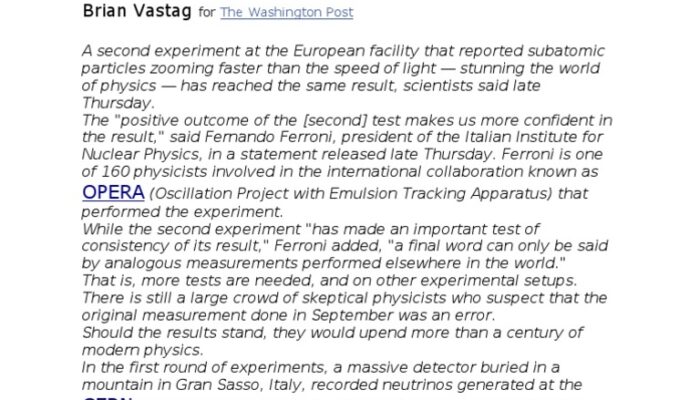
Faster-than-light (FTL) particles refer to hypothetical or experimentally suggested entities that travel at speeds exceeding the speed of light in a vacuum, approximately 299,792 kilometers per second. According to Einstein’s special relativity, this speed represents an absolute cosmic speed limit, beyond which no matter or information can travel. The concept of particles surpassing this threshold challenges fundamental principles of physics and has been a subject of intense debate and investigation.
- Speed of Light:
The maximum speed at which all energy, matter, and information in the universe can travel, as established by special relativity. - Superluminal Particles:
Entities that hypothetically move faster than light, including theoretical constructs like tachyons. - Tachyons:
Hypothetical particles that inherently travel faster than light and possess unusual properties such as imaginary mass.
Foundations in Physics: Special Relativity and Its Implications
Einstein’s special relativity forms the cornerstone of modern physics by asserting that the speed of light in a vacuum is constant and insurmountable. This principle governs our understanding of space, time, and causality, implying that surpassing this speed would require a fundamental revision of physical laws. The theory predicts that as an object approaches light speed, its relativistic mass increases, demanding infinite energy to reach or exceed light speed, thus rendering superluminal travel impossible under conventional physics.
Experimental Investigations and Observations
Scientific experiments have occasionally hinted at the possibility of particles traveling faster than light, though such claims are met with rigorous scrutiny. Notably, neutrino experiments have at times reported measurements suggesting superluminal velocities. However, these findings often face challenges related to experimental errors, instrumental inaccuracies, or misinterpretations. The scientific method demands reproducibility and peer validation before accepting any results that contradict established theories.
Astrophysical phenomena also provide a natural laboratory for testing the limits of light speed. Observations of gamma-ray bursts, cosmic rays, and other high-energy cosmic events sometimes produce data that appear to challenge the speed limit. These extreme environments help scientists probe the universality of physical laws, though current consensus maintains the speed of light as the ultimate boundary.
Theoretical Perspectives on Superluminal Entities
Beyond experimental data, theoretical physics explores frameworks that could accommodate faster-than-light particles without violating causality or relativity outright. Tachyons, for example, emerge from certain solutions to relativistic equations but remain undetected in practice. Their existence would imply paradoxical effects, such as backward time travel, challenging the conventional cause-and-effect relationship.
Other speculative theories propose mechanisms like extra spatial dimensions, quantum entanglement, or modifications to spacetime topology that might permit superluminal communication or travel. Concepts such as wormholes and warp drives fall within this realm, suggesting hypothetical shortcuts or distortions in spacetime that could enable effective faster-than-light transit without breaching relativistic constraints.
Scientific Community’s Approach and Methodology
The response to claims of faster-than-light particles is characterized by a balance of skepticism and open inquiry. Researchers prioritize exhaustive verification, considering alternative explanations grounded in known physics, such as measurement delays or unaccounted-for interactions. This cautious approach ensures that extraordinary claims undergo thorough validation before prompting revisions to foundational theories.
Philosophical and Ethical Considerations
The possibility of superluminal particles raises profound questions about the nature of reality, causality, and the structure of the universe. If such particles exist, they could revolutionize communication technologies, enable interstellar travel, and alter our understanding of time and space. These implications invite interdisciplinary dialogue spanning physics, philosophy, engineering, and futurism, exploring how such discoveries might reshape human knowledge and society.
Educational Resources and Public Engagement
Educational materials on faster-than-light particles aim to clarify complex concepts such as the nature of light, particle physics, and relativity for diverse audiences. These resources often include animations, simulations, and interactive tools to facilitate comprehension. From high school learners to advanced scholars, accessible explanations and forums encourage curiosity and collaborative learning about these challenging topics.
Real-World Examples and Applications
While no confirmed faster-than-light particles have been observed, ongoing research in neutrino physics and astrophysics continues to test the boundaries of light-speed travel. Experimental setups in particle accelerators and cosmic observations provide practical contexts for investigating superluminal phenomena. Theoretical models also inspire technological concepts like warp drives, which, if realized, could transform space exploration.
Common Misconceptions About Faster-Than-Light Travel
Faster-than-light travel is already proven by some experiments.
While some experiments have suggested superluminal speeds, these results have not been conclusively validated and often stem from measurement errors or misinterpretations.
Tachyons are confirmed particles that travel faster than light.
Tachyons remain theoretical constructs without empirical evidence supporting their existence.
Faster-than-light travel would allow time travel without paradoxes.
Superluminal travel introduces causality paradoxes that challenge our current understanding of time and require new physics to resolve.
Why Understanding Faster-Than-Light Particles Is Crucial
Exploring the possibility of particles exceeding the speed of light is vital for advancing physics, as it tests the limits of established theories and may uncover new physical laws. Such research drives innovation in technology, deepens our grasp of the universe’s structure, and fuels philosophical inquiry into the nature of reality. The pursuit of understanding superluminal phenomena exemplifies humanity’s enduring quest to push the frontiers of knowledge and explore the cosmos beyond current limitations.
FAQ
What are faster-than-light particles?
Faster-than-light particles are hypothetical particles that are theorized to travel faster than the speed of light, challenging established physics.
Are tachyons real?
Tachyons remain theoretical and have not been observed or confirmed by experiments.
What implications do faster-than-light particles have?
Their existence could revolutionize our understanding of physics, causality, and even enable concepts like time travel.

Leave a Reply