
Short Answer
Understanding the Nature of Space
The cosmos has long captivated the curiosity of scientists, philosophers, and visionaries, inspiring profound questions about the fundamental essence of space. Is space simply an empty void, or does it possess a tangible structure composed of particles? To explore this, one must delve into the complex relationship between space, matter, and the underlying framework that constitutes the universe. This article examines various perspectives, combining observational data, theoretical models, and scientific evidence to shed light on this enduring enigma.
Defining Space and Its Constituents
Traditionally, space has been viewed as an infinite, empty continuum-a backdrop against which matter exists and events unfold. However, this classical interpretation is challenged by modern physics, which suggests that space may have a more intricate composition.
- Classical View:
Space is an unbounded void without substance, serving merely as a stage for physical phenomena. - Contemporary Perspective:
Space may contain dynamic elements such as quantum fluctuations and dark components, implying it is not truly empty.
The Quantum Vacuum: Space as a Sea of Particles
Quantum field theory revolutionizes our understanding by revealing that what appears as empty space is actually a vibrant arena filled with transient virtual particles. These particles spontaneously emerge and vanish due to inherent quantum uncertainties, indicating that even the emptiest regions of space are alive with activity. This phenomenon, known as the quantum vacuum, blurs the line between emptiness and substance.
Dark Matter and Dark Energy: Invisible Architects of the Universe
Beyond the quantum vacuum, two mysterious components dominate the cosmic landscape:
- Dark Matter:
Accounting for roughly 27% of the universe’s mass-energy content, dark matter does not interact with electromagnetic radiation, making it invisible. Its presence is inferred from gravitational effects on visible matter, suggesting it plays a crucial role in shaping cosmic structures. - Dark Energy:
Constituting about 68% of the universe, dark energy is hypothesized to drive the accelerated expansion of space. While not directly linked to particles, its influence profoundly affects the evolution and geometry of the cosmos.
Space-Time and Gravity: Insights from General Relativity
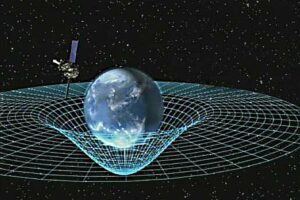
Albert Einstein’s theory of general relativity redefines space as a dynamic entity intertwined with time, collectively forming space-time. Massive objects distort this fabric, producing gravitational effects that govern the motion of planets, stars, and galaxies. This curvature implies that space is not a passive void but an active participant influenced by mass and energy.
Gravitational Waves: Ripples in the Fabric of Space-Time
Gravitational waves, detected from cataclysmic events like black hole mergers, are oscillations propagating through space-time itself. Their discovery confirms that space is subject to energetic disturbances, further dispelling the notion of a static emptiness and highlighting the dynamic nature of the cosmos.
Fundamental Particles and the Quest for Unification
The Standard Model of particle physics categorizes the fundamental constituents of matter-quarks, leptons, and gauge bosons-yet it does not incorporate gravity. Bridging this gap requires theories that unify quantum mechanics with general relativity.
String Theory and the Fabric of Reality
String theory proposes that the universe’s fundamental elements are not zero-dimensional points but one-dimensional strings vibrating at specific frequencies. This framework suggests that space and particles are deeply interconnected, with additional spatial dimensions beyond the familiar three, offering a novel perspective on the nature of existence.
Energy-Matter Equivalence
Einstein’s equation E=mc² reveals the intrinsic link between energy and matter, indicating that particles are manifestations of energy. This principle invites speculation on whether space itself might emerge from various energetic states, further complicating the understanding of its composition.
Integrating Concepts: A Complex Cosmic Tapestry
Collectively, these insights paint a sophisticated picture of space as more than a mere void. Instead, space is a dynamic interplay of forces, particles, energy, and geometry. It is a realm where visible matter coexists with invisible phenomena, and where the boundaries between emptiness and substance are fluid and nuanced.
Why Understanding Space Matters
Grasping the true nature of space is vital for advancing physics, cosmology, and technology. It informs our comprehension of the universe’s origin, structure, and fate, and drives innovations in fields such as quantum computing, astrophysics, and gravitational research. Moreover, it challenges humanity’s philosophical perspectives on existence and reality.
Common Misconceptions About Space
Space is completely empty.
Quantum fluctuations and dark components ensure that space is never truly void.
Particles only exist within space, not as part of space.
Theories like string theory suggest particles and space are fundamentally intertwined.
Gravity is a force acting at a distance.
General relativity shows gravity arises from the curvature of space-time itself.
Conclusion
The inquiry into whether space is composed of particles opens a window into the profound complexities of the universe. From quantum vacuums and dark matter to gravitational waves and string vibrations, space emerges as a dynamic, multifaceted entity. Ongoing research continues to unravel these mysteries, promising deeper insights into the fabric of reality and the essence of existence.
FAQ
Is space completely empty?
No, space is not completely empty; it contains quantum fluctuations and particles that spontaneously appear and vanish.
What role does dark matter play in space?
Dark matter, which is invisible and does not emit light, influences the structure and movement of galaxies through its gravitational effects.
How does general relativity describe space?
General relativity views space as intertwined with time in a dynamic fabric called space-time that is curved by mass and energy.
What does string theory suggest about the nature of space and particles?
String theory proposes that fundamental particles are one-dimensional strings and that space itself includes additional dimensions beyond the familiar three.
Leave a Reply