
Short Answer
Understanding Dark Matter
Dark matter is a mysterious and invisible form of matter that constitutes a significant portion of the universe’s total mass-energy content. Unlike ordinary matter, it does not emit, absorb, or reflect electromagnetic radiation, making it undetectable by traditional telescopes. Its existence is inferred primarily through its gravitational influence on visible matter, radiation, and the large-scale structure of the cosmos. This elusive nature compels scientists to rely on indirect methods to study and detect dark matter.
Cosmic Rays: Nature’s High-Energy Messengers
Cosmic rays are high-energy particles, mostly protons and atomic nuclei, that travel through space at nearly the speed of light. They originate from powerful astrophysical phenomena such as supernova explosions, active galactic nuclei, and other energetic cosmic events. Constantly bombarding Earth’s atmosphere, cosmic rays serve as natural probes into the universe’s most extreme environments. Embedded within this flux of particles may be subtle clues pointing to the presence and properties of dark matter.
How Cosmic Rays Aid in Dark Matter Detection
Scientists utilize cosmic rays as indirect evidence to uncover dark matter by searching for unusual signals that cannot be explained by known astrophysical sources. When dark matter particles annihilate or decay, they are theorized to produce secondary particles, including gamma rays, positrons, and antiprotons. These products can create detectable excesses or anomalies in cosmic ray measurements, providing potential signatures of dark matter interactions.
Gamma Rays as Dark Matter Indicators
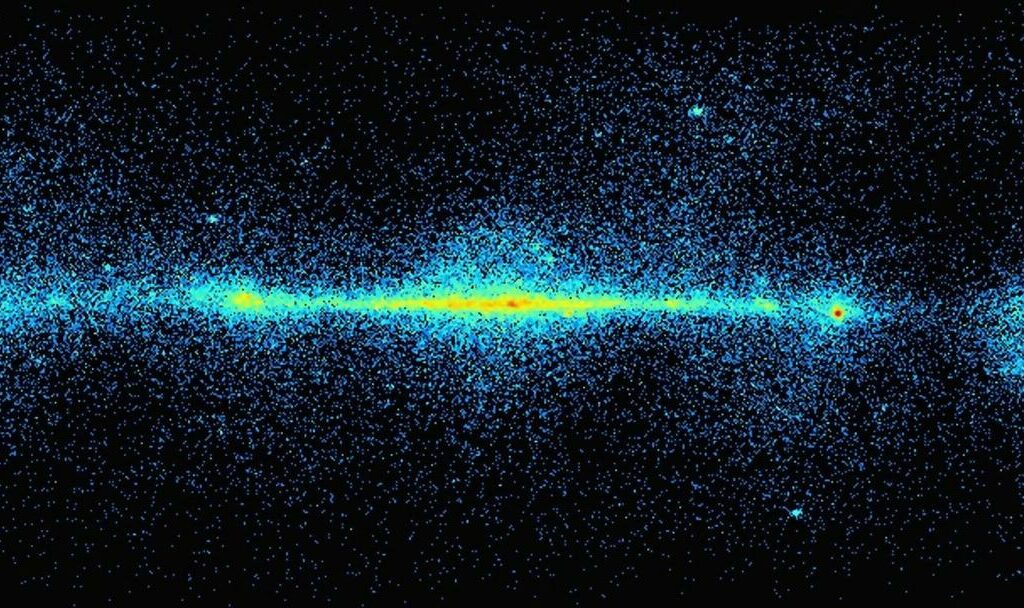
Gamma rays are the most energetic form of electromagnetic radiation and can travel vast cosmic distances without being deflected by magnetic fields. Dark matter annihilation or decay is expected to generate gamma rays, which may appear as localized surpluses above the typical astrophysical background. Observations of gamma-ray emissions from regions with dense dark matter concentrations-such as the center of the Milky Way or dwarf spheroidal galaxies-offer promising avenues for identifying dark matter signals.
Charged Particles: Positrons and Antiprotons
In addition to gamma rays, dark matter interactions might produce an excess of antimatter particles like positrons and antiprotons. Detecting these charged particles requires sophisticated instruments capable of distinguishing them from the background cosmic ray flux. Experiments such as the Alpha Magnetic Spectrometer (AMS) aboard the International Space Station analyze these particles with high precision, searching for deviations from expected astrophysical production rates that could hint at dark matter processes.
Technological Tools for Cosmic Ray and Dark Matter Research
Modern astrophysics employs advanced detection systems to capture and analyze cosmic rays and gamma rays. Space-based observatories like the Fermi Gamma-ray Space Telescope continuously monitor the sky, measuring the energy and origin of incoming gamma rays to construct detailed maps of cosmic phenomena. Ground-based and orbital cosmic ray detectors complement these observations by tracking charged particles, enabling comprehensive studies of potential dark matter signatures.
Challenges in Interpreting Cosmic Ray Data
Extracting dark matter signals from cosmic ray data is a complex task due to the numerous astrophysical processes that can mimic or obscure these signatures. The interstellar medium, with its magnetic fields and energetic environments, affects the propagation and composition of cosmic rays, complicating the identification of primary sources. Researchers use sophisticated computational models to simulate cosmic ray transport and interactions, aiming to isolate potential dark matter contributions by subtracting known astrophysical backgrounds.
Multi-Messenger Astronomy: A Holistic Approach
To strengthen the search for dark matter, scientists integrate data from multiple cosmic messengers, including cosmic rays, gamma rays, neutrinos, and gravitational waves. This multi-messenger strategy enhances the reliability of potential dark matter detections by cross-verifying signals across different observational channels. Such interdisciplinary efforts represent the cutting edge of astrophysical research, offering a more complete understanding of the universe’s hidden components.
Significance of Detecting Dark Matter via Cosmic Rays
Unveiling dark matter through cosmic ray observations is crucial for advancing our comprehension of the universe’s fundamental structure and evolution. Dark matter shapes the formation of galaxies and influences the dynamics of cosmic systems. Understanding its nature could revolutionize physics, shedding light on phenomena beyond the Standard Model and potentially revealing new particles or forces. This pursuit exemplifies the synergy between human curiosity and technological innovation in exploring the cosmos.
Future Prospects and Innovations
Upcoming missions and technological advancements promise to enhance the sensitivity and resolution of cosmic ray and gamma-ray detectors. Innovations such as improved detection materials, machine learning algorithms for data analysis, and next-generation space telescopes will refine the ability to distinguish dark matter signals from astrophysical noise. These developments will accelerate progress in the quest to decode the universe’s most enigmatic substance.
Common Misconceptions About Cosmic Rays and Dark Matter
Dark matter can be directly observed with telescopes.
Dark matter does not emit or absorb light, making it invisible to conventional telescopes; its presence is inferred through gravitational effects and indirect detection methods.
All cosmic rays originate from dark matter interactions.
Most cosmic rays come from astrophysical sources like supernovae; only specific anomalies in cosmic ray data might indicate dark matter processes.
Detecting gamma rays alone conclusively proves dark matter existence.
Gamma-ray excesses can have multiple astrophysical explanations; corroborating evidence from multiple messengers is necessary for confirmation.
FAQ
What are cosmic rays?
Cosmic rays are high-energy particles, mostly protons and atomic nuclei, that travel through space and can provide clues about dark matter.
How do scientists detect dark matter?
Scientists detect dark matter by looking for indirect signals from cosmic rays, such as excess gamma rays or antimatter particles.
What is dark matter?
Dark matter is a form of matter that does not emit or reflect light, making it invisible and detectable only through its gravitational effects.


Leave a Reply