

Short Answer
Definition of Gravitational Lensing
Gravitational lensing is a phenomenon predicted by Einstein’s general theory of relativity, where the presence of massive objects causes a curvature in spacetime, bending the path of light traveling near them. This effect acts similarly to an optical lens, but on a cosmic scale, distorting and magnifying the images of distant celestial bodies. It serves as a crucial tool for detecting and studying matter that does not emit or absorb light, such as dark matter.
- Massive Objects:
Objects like galaxy clusters or dense concentrations of matter warp the fabric of spacetime, influencing the trajectory of passing light rays. - Light Deflection:
The bending of light results in magnified, distorted, or multiple images of background galaxies, revealing the gravitational influence of otherwise invisible matter.
Mechanism Behind Light Bending
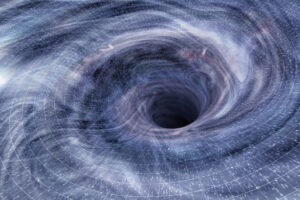
According to general relativity, mass and energy curve spacetime, and light follows the shortest path within this curved geometry. When light from a distant source passes near a massive foreground object, its path deviates from a straight line, creating observable distortions. This bending is not caused by the light itself but by the gravitational field of the intervening mass, which acts as a natural lens.
Mathematical Framework of Gravitational Lensing
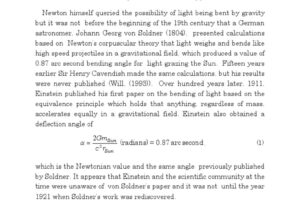
The bending angle of light, α, near a mass M can be approximated by the formula:
α = (frac{4GM}{c^2 b})
- G: Gravitational constant
- M: Mass of the lensing object
- c: Speed of light
- b: Impact parameter (closest approach distance of the light to the mass)
This equation quantifies how much the light path bends due to the gravitational influence of the mass, enabling astronomers to infer the mass distribution of the lensing object.
Applications in Detecting Dark Matter
Dark matter, which neither emits nor absorbs electromagnetic radiation, remains invisible to traditional telescopes. Gravitational lensing provides an indirect yet powerful method to detect and map dark matter by analyzing how it distorts the light from distant galaxies. The observed lensing patterns allow scientists to reconstruct the mass distribution within galaxy clusters, revealing the presence and quantity of dark matter.
- Mass Mapping:
By studying the distortions and multiple images created by lensing, researchers create detailed maps of dark matter’s distribution. - Indirect Evidence:
Although dark matter cannot be observed directly, its gravitational effects on light serve as compelling proof of its existence.
Insights into the Nature of Dark Matter
Variations in gravitational lensing patterns can provide clues about the properties of dark matter. For example, differences in how dark matter clumps or spreads may indicate whether it is composed of slow-moving “cold” particles or faster “warm” particles. This makes gravitational lensing a valuable cosmic laboratory for testing theories about the fundamental characteristics of dark matter beyond direct detection methods.
Challenges in Interpreting Lensing Data
Analyzing gravitational lensing observations involves overcoming several complexities. Foreground structures, such as stars and gas, also affect light paths and must be carefully separated from the lensing signal caused by dark matter. Additionally, instrumental noise, resolution limits, and the immense distances involved introduce uncertainties. Continuous improvements in modeling and observational techniques are essential to refine our understanding of the lensing effects and the underlying mass distributions.
Broader Cosmological Implications
Beyond revealing dark matter, gravitational lensing plays a pivotal role in studying dark energy-the mysterious force accelerating the universe’s expansion. By mapping how matter clusters and evolves over time, lensing surveys provide critical data to constrain cosmological models and predict the universe’s ultimate fate. Thus, the bending of light not only uncovers hidden matter but also illuminates the large-scale dynamics shaping cosmic history.
Real-World Examples of Gravitational Lensing
Observations from advanced telescopes like the Hubble Space Telescope and powerful ground-based observatories have captured spectacular images of gravitational lensing phenomena. These include:
- Einstein Rings:
Circular rings formed when a background galaxy is perfectly aligned behind a massive foreground object, causing its light to bend symmetrically. - Arcs and Multiple Images:
Distorted arcs and duplicated images of distant galaxies created by uneven mass distributions in galaxy clusters.
Common Misconceptions About Light Bending and Dark Matter
Light bending is caused by the light itself.
The bending occurs due to the curvature of spacetime caused by mass, not by the light’s own properties.
Dark matter can be detected directly through electromagnetic radiation.
Dark matter does not emit, absorb, or reflect light, making gravitational lensing one of the few ways to infer its presence.
Significance of Gravitational Lensing in Modern Science
Gravitational lensing is a cornerstone of contemporary astrophysics and cosmology. It enables the study of invisible matter, tests fundamental physics, and enhances our comprehension of the universe’s structure and evolution. By decoding the subtle distortions in light’s path, scientists gain unprecedented access to the hidden components shaping galaxies, clusters, and the cosmos at large, making it an indispensable tool in unraveling the universe’s deepest mysteries.
FAQ
What is gravitational lensing?
Gravitational lensing is a phenomenon where massive objects warp spacetime, bending the path of light from distant sources.
How does gravitational lensing help in detecting dark matter?
It allows scientists to infer the presence of dark matter by analyzing how it distorts light from background galaxies.

Leave a Reply