
Short Answer
Definition of Black Holes as Invisible Stars
Black holes are often perceived as mysterious voids in space-celestial objects that absorb all light and matter, rendering them invisible to direct observation. Conceptualizing black holes as “invisible stars” offers a fresh perspective, portraying them not merely as empty spaces but as powerful cosmic entities with significant roles in the universe. This metaphor highlights their unique nature as stellar remnants that, unlike traditional stars, emit no light yet exert immense gravitational influence.
Stellar Evolution and the Birth of Black Holes
The life cycle of massive stars frequently ends in a dramatic supernova explosion, which can leave behind either a neutron star or a black hole. In this context, black holes represent an advanced stage of stellar evolution-collapsed cores that have transcended the luminous phase of a star. Unlike the radiant glow of active stars fueled by nuclear fusion, black holes are the dense, dark aftermath of stellar death, embodying an extreme state of matter and spacetime curvature.
The Stellar Phoenix Analogy
Much like a phoenix rising transformed, black holes emerge from the remnants of stars but enter a realm dominated by gravity rather than light. They collapse inward to a singularity, a point of infinite density where conventional physics breaks down, surrounded by an event horizon that marks the boundary beyond which nothing can escape.
Structural Characteristics of Black Holes
At the core of a black hole lies the singularity, an infinitely dense point where mass is concentrated. Encasing this is the event horizon, a boundary that functions as a one-way surface-anything crossing it cannot return. Unlike a star’s luminous surface, the event horizon is completely dark, making black holes stellar objects defined by their gravitational invisibility rather than radiance.
- Singularity:
The infinitely dense core where known physical laws cease to apply. - Event Horizon:
The invisible boundary beyond which escape is impossible, analogous to a star’s surface but devoid of light.
How Black Holes Reveal Their Presence
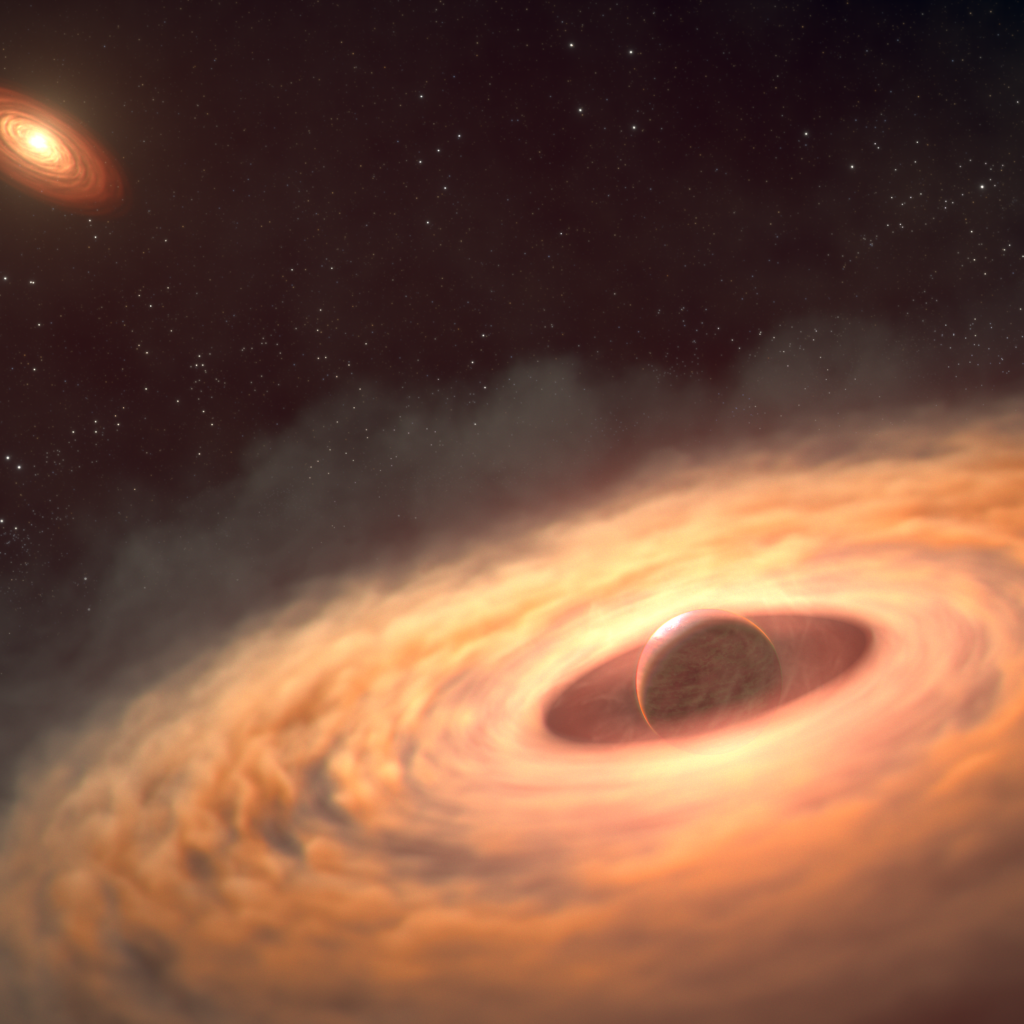
Although black holes themselves emit no light, their existence is betrayed by the energetic phenomena surrounding them. Accretion disks-swirling rings of gas and dust heated to extreme temperatures-glow brightly as material spirals inward, providing indirect evidence of the black hole’s gravitational pull. These luminous halos serve as cosmic signposts, illuminating the otherwise hidden black holes.
Gravitational Effects and Observational Techniques
Black holes are detected through their influence on nearby stars and gas clouds, gravitational lensing that bends light around them, and gravitational waves produced by black hole mergers. These indirect methods underscore the paradox of black holes: they are invisible by nature but reveal themselves through their profound impact on the surrounding universe.
Role of Black Holes in Cosmic Evolution
Far from being mere consumers of matter, black holes play a pivotal role in shaping galaxies. Supermassive black holes at galactic centers regulate star formation and influence the dynamics of interstellar material, acting as gravitational conductors in the cosmic symphony. Their presence orchestrates the balance between creation and destruction on a galactic scale.
Common Misconceptions About Black Holes
Black holes suck in everything like cosmic vacuum cleaners.
Black holes exert gravitational pull like any massive object; objects must cross the event horizon to be irretrievably captured.
Black holes are completely empty voids.
Black holes contain a singularity with immense mass compressed into an infinitely small point, not empty space.
Why Viewing Black Holes as Invisible Stars Matters
Understanding black holes as invisible stars enriches our cosmological perspective by valuing the unseen forces that shape the universe. This viewpoint challenges traditional notions of visibility and existence, emphasizing that cosmic significance is not solely tied to light emission. Black holes exemplify how power and presence can manifest through gravitational influence rather than illumination, deepening our appreciation of the universe’s complexity.
Conclusion: The Cosmic Significance of Invisible Stars
Black holes are dynamic, influential entities that defy simple categorization as mere absences. Their gravitational dominion and interaction with surrounding matter tell compelling stories of cosmic evolution and structure. Recognizing black holes as invisible stars invites us to embrace a broader understanding of celestial phenomena-one where brilliance is not always visible, and where shadows play a vital role in the grand cosmic narrative.
FAQ
What are black holes?
Black holes are regions in space where the gravitational pull is so strong that nothing, not even light, can escape from them.
How do we know black holes exist?
We detect black holes by observing their gravitational effects on nearby stars and gas clouds, as well as through phenomena like gravitational waves.
Why are black holes referred to as invisible stars?
This term emphasizes their significant gravitational influence while highlighting that they do not emit light like traditional stars.

Leave a Reply