
Short Answer
Definition of X-rays and Gamma Rays
X-rays and gamma rays are both forms of electromagnetic radiation, sharing similar wave-like properties but differing significantly in their origins and energy levels. These differences influence their behavior, interaction with matter, and applications in science and medicine.
- X-rays:
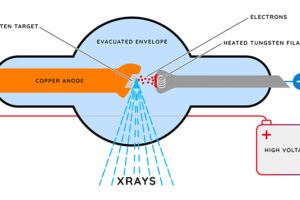
Generated primarily by electronic transitions within atoms or by the rapid deceleration of high-energy electrons, X-rays typically have energies measured in kilo-electronvolts (keV). - Gamma rays:
Produced from nuclear processes such as radioactive decay, gamma rays possess higher energies, often in the mega-electronvolt (MeV) range, granting them greater penetrating power.
Energy Characteristics and Penetration Abilities
The energy disparity between X-rays and gamma rays is a fundamental factor that dictates their interaction with materials. Gamma rays, with their elevated energy levels, can penetrate denser substances more effectively than X-rays, which are comparatively lower in energy and less penetrating.
- Energy Levels:
Gamma rays generally exceed X-rays in energy, making them more capable of traversing thick or dense shielding materials. - Penetration:
The higher energy of gamma rays allows them to pass through materials that would typically attenuate or block X-rays.
Principles of Radiation Attenuation
Attenuation describes the process by which the intensity of radiation diminishes as it passes through a medium. This reduction depends on several factors, including the radiation’s energy, the shielding material’s composition, and its thickness.
- Attenuation Coefficient:
A material-specific value that quantifies how effectively it can reduce radiation intensity. - Material Density and Atomic Number:
Denser materials with higher atomic numbers, such as lead, are more effective at attenuating high-energy radiation like gamma rays. - Thickness:
Increasing the thickness of shielding material enhances its ability to absorb or scatter radiation.
Effectiveness of X-rays as a Shield Against Gamma Rays
Despite their shared electromagnetic nature, X-rays cannot serve as an effective barrier to gamma rays. The lower energy and penetration capacity of X-rays render them incapable of attenuating the more energetic gamma radiation.
- Energy Insufficiency:
X-rays lack the necessary energy to absorb or scatter gamma rays significantly. - Shielding Materials:
Proper gamma-ray shielding requires dense materials like lead or concrete, not other forms of radiation such as X-rays. - Practical Implications:
Attempting to use X-rays as a shield against gamma rays is ineffective and potentially hazardous.
Mechanisms of Radiation Interaction with Matter
Both X-rays and gamma rays interact with matter through several processes, including photoelectric absorption, Compton scattering, and pair production. The probability and effectiveness of these interactions depend heavily on the radiation’s energy and the properties of the material encountered.
- Photoelectric Absorption:
Dominant at lower energies, this process involves the complete absorption of photons by atoms. - Compton Scattering:
Involves the partial transfer of energy from photons to electrons, prevalent at intermediate energies. - Pair Production:
Occurs at very high energies, where photons convert into an electron-positron pair near a nucleus.
Applications and Safety Considerations in Medicine and Industry
Understanding the distinct properties of X-rays and gamma rays is critical in fields such as radiation therapy, nuclear medicine, and industrial radiography. Proper shielding and safety protocols depend on recognizing the specific type of radiation involved.
- Radiation Therapy:
Precise knowledge of radiation interactions ensures effective treatment while minimizing damage to healthy tissues. - Protective Measures:
Healthcare workers and patients require shielding materials tailored to the radiation type to ensure safety. - Industrial Use:
Nuclear power plants and imaging facilities employ dense shielding to protect against gamma radiation exposure.
Common Misconceptions About Radiation Shielding
X-rays can block gamma rays.
Due to their lower energy, X-rays cannot effectively shield against the more penetrating gamma rays.
All electromagnetic radiation behaves identically in matter.
Different radiation types interact with materials in distinct ways depending on their energy and origin.
Significance of Understanding Radiation Interactions
Grasping the differences between X-rays and gamma rays and their interactions with matter is vital for advancing safety standards, improving medical treatments, and developing innovative shielding technologies. This knowledge underpins the design of effective protective measures and enhances our ability to harness radiation safely in various scientific and industrial applications.
FAQ
Can X-rays shield against gamma rays?
No, X-rays cannot shield gamma rays because gamma rays have much higher energy and penetrating power.
What materials effectively block gamma rays?
Dense materials like lead or concrete are required to shield against gamma radiation.
How are X-rays and gamma rays different?
X-rays come from electronic transitions or electron deceleration, while gamma rays originate from nuclear decay.
Why can't X-rays block gamma rays?
Because X-rays have lower energy and insufficient penetration ability compared to gamma rays.




Leave a Reply