
Short Answer
Definition of Quantum Technology
Quantum technology represents a cutting-edge field at the intersection of physics and engineering, rooted in the principles of quantum mechanics-the fundamental framework describing the behavior of matter and energy at atomic and subatomic scales. This technology aims to exploit the unique and often counterintuitive properties of quantum systems to develop innovative applications that could transform various aspects of modern life.
- Quantum Mechanics:
The branch of physics that explains phenomena at microscopic scales, including superposition, entanglement, and quantum coherence. - Quantum Technology:
The practical use of quantum mechanical effects to create devices and systems with capabilities beyond classical limits.
Core Areas of Quantum Technology
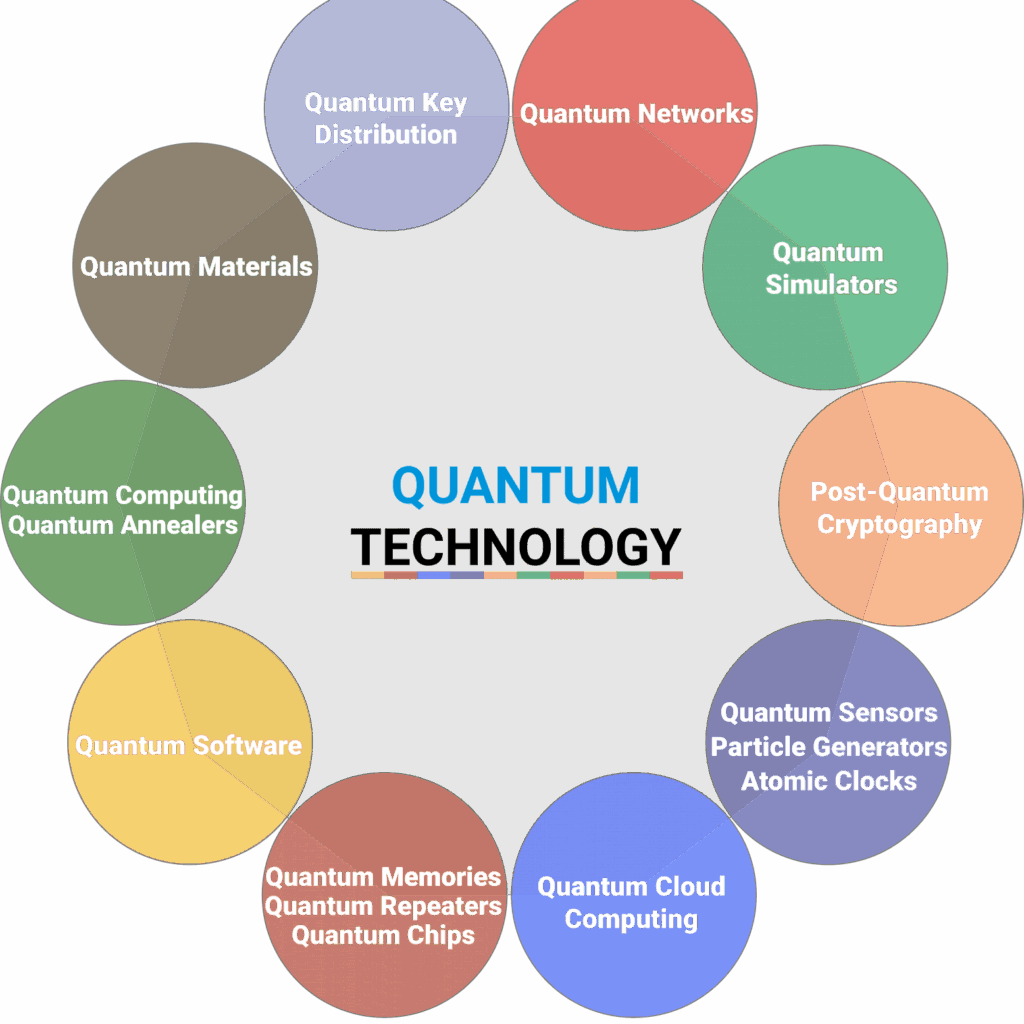
Quantum technology can be broadly categorized into three main sectors, each harnessing distinct quantum phenomena to achieve groundbreaking advancements:
- Quantum Computing: Enhancing computational power through qubits and quantum algorithms.
- Quantum Communication: Establishing ultra-secure information transfer channels using quantum states.
- Quantum Sensing: Achieving unprecedented measurement precision by exploiting quantum sensitivity.
Quantum Computing: Expanding Computational Horizons
Quantum computing is at the forefront of quantum technology, promising to revolutionize data processing by leveraging the principles of superposition and entanglement. Unlike classical bits, which represent information as either 0 or 1, quantum bits (qubits) can exist in multiple states simultaneously, enabling parallel computation on a massive scale.
Entanglement further enhances computational power by linking qubits in such a way that the state of one instantly influences another, regardless of distance. This property underpins quantum algorithms capable of tackling complex problems, such as integer factorization and quantum system simulations, which are currently infeasible for classical computers.
Despite its promise, quantum computing faces significant hurdles, including maintaining qubit coherence and minimizing error rates. Developing fault-tolerant quantum architectures remains a critical challenge to realizing practical, scalable quantum computers.
Quantum Computing Challenges
- Qubit Stability:
Qubits are highly susceptible to environmental noise, which can cause decoherence and loss of information. - Error Correction:
Implementing reliable error correction methods is essential to preserve computational accuracy over time. - Scalability:
Building systems with a large number of qubits while maintaining coherence is a major engineering challenge.
Quantum Communication: Revolutionizing Secure Data Transmission
Quantum communication exploits the principles of quantum mechanics to create communication channels that are fundamentally secure against eavesdropping. The cornerstone of this field is Quantum Key Distribution (QKD), which encodes information in quantum states that cannot be measured or copied without detection.
This intrinsic security arises because any attempt to intercept or measure the quantum information disturbs the system, alerting the communicating parties to potential breaches. Beyond secure messaging, quantum communication technologies are being developed for global networks, including satellite-based QKD systems that enable secure communication over vast distances.
However, widespread implementation faces obstacles such as the need for robust infrastructure, integration with existing communication networks, and the establishment of international standards. Additionally, the geopolitical implications of unequal access to quantum communication technologies require careful consideration.
Key Considerations in Quantum Communication
- Infrastructure Requirements:
Building quantum networks demands specialized hardware and protocols compatible with classical systems. - Standardization:
Developing universal standards is crucial for interoperability and security assurance. - Ethical and Geopolitical Issues:
Ensuring equitable access and preventing technological monopolies are important societal challenges.
Quantum Sensing: Enhancing Measurement Precision
Quantum sensing leverages the extraordinary sensitivity of quantum states to detect and measure physical quantities with accuracy surpassing classical limits. By utilizing phenomena such as squeezed states and entanglement, quantum sensors can reduce noise and improve signal detection in various applications.
These sensors have transformative potential in fields like medical diagnostics, environmental monitoring, and fundamental physics research, including gravitational wave detection and magnetic field mapping. However, challenges remain in miniaturizing these devices and scaling their production for widespread use.
Applications and Challenges of Quantum Sensing
- Medical Imaging:
Quantum sensors can provide higher resolution and sensitivity, enabling earlier disease detection. - Environmental Monitoring:
Enhanced detection of subtle changes in magnetic and gravitational fields aids in climate and geological studies. - Scalability and Accessibility:
Developing cost-effective, compact sensors is essential for broad adoption across industries.
Common Misconceptions About Quantum Technology
Quantum computers will instantly replace classical computers.
Quantum computers are specialized devices suited for particular problems and will complement rather than replace classical systems.
Quantum communication guarantees absolute security.
While quantum communication offers unprecedented security, practical implementations must still address technical vulnerabilities and integration challenges.
Quantum sensors are too complex for real-world use.
Advances in engineering are making quantum sensors increasingly practical and accessible for diverse applications.
Significance of Quantum Technology
The advent of quantum technology heralds a new era in science and technology, with the potential to revolutionize computation, communication, and measurement. Its impact spans from accelerating drug discovery and optimizing logistics to securing global communications and enhancing environmental monitoring.
Moreover, the ethical, societal, and economic implications of quantum technology necessitate thoughtful governance and inclusive policies to ensure that its benefits are distributed fairly and risks are mitigated. As research progresses, fostering public understanding and interdisciplinary collaboration will be vital to responsibly harnessing the power of quantum phenomena for the advancement of humanity.
FAQ
What is quantum technology?
Quantum technology is the practical application of quantum mechanics principles to develop devices and systems with capabilities beyond classical limits.
What are the main areas of quantum technology?
The main areas are quantum computing, quantum communication, and quantum sensing.
What challenges does quantum computing face?
Key challenges include qubit stability, error correction, and scalability.
Is quantum communication absolutely secure?
Quantum communication provides unprecedented security but still faces technical vulnerabilities and integration challenges.
Are quantum sensors practical for real-world applications?
Advances in engineering are making quantum sensors increasingly practical and accessible.






Leave a Reply