
Short Answer
Definition of Neutrinos
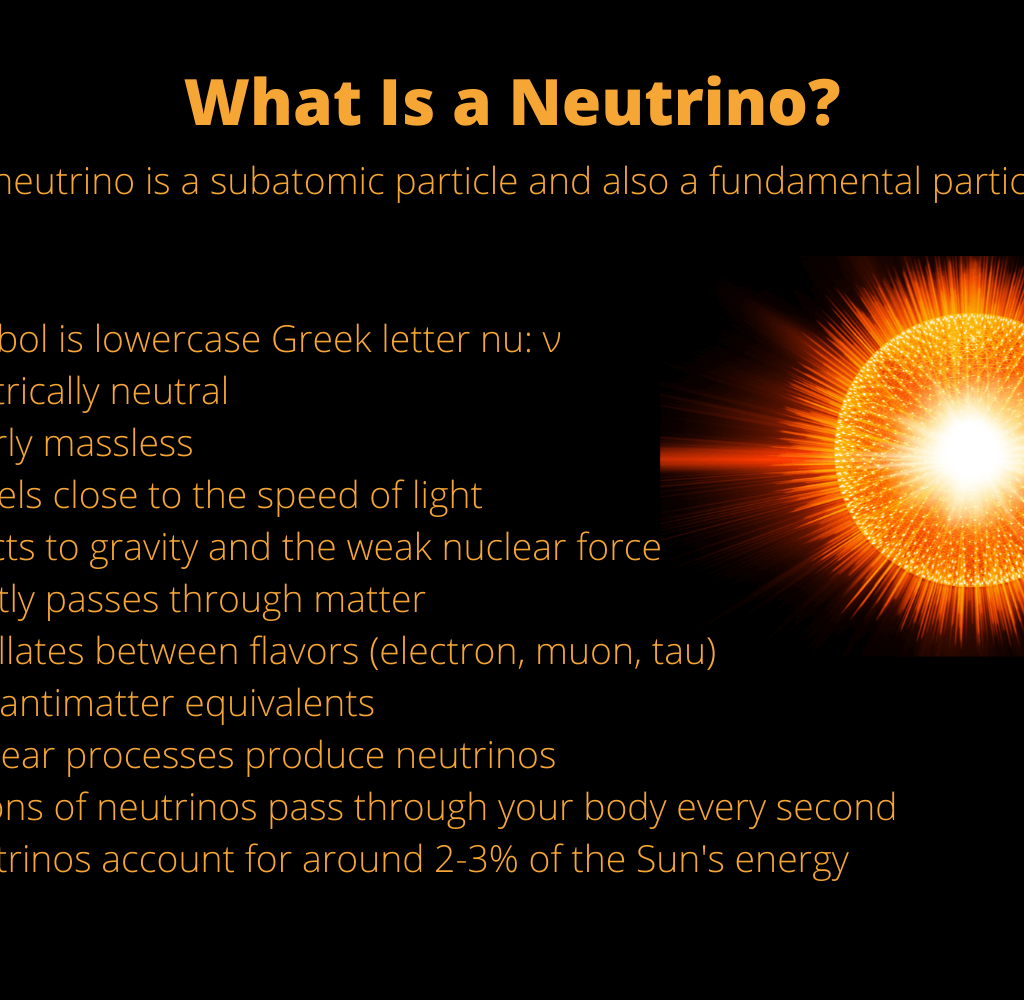
Neutrinos are fundamental subatomic particles characterized by their extremely elusive nature. They belong to the family of fermions and are electrically neutral with an almost negligible mass. These particles interact solely through the weak nuclear force, which makes their detection exceptionally challenging. Neutrinos exist in three varieties, known as flavors: electron neutrinos, muon neutrinos, and tau neutrinos, each linked to a corresponding charged lepton.
- Electron Neutrino:
Associated with the electron, it is the most commonly studied neutrino flavor. - Muon Neutrino:
Connected to the muon, a heavier cousin of the electron. - Tau Neutrino:
Related to the tau particle, the heaviest lepton.
Neutrino Oscillation and Quantum Behavior
One of the most intriguing phenomena involving neutrinos is their ability to change from one flavor to another, a process termed neutrino oscillation. This quantum mechanical effect reveals that neutrinos have mass and that their flavor states are superpositions of different mass states. Neutrino oscillation has profound implications for particle physics, challenging earlier assumptions and expanding our understanding of the subatomic world.
Abundance and Detection Challenges
Neutrinos are incredibly abundant in the universe; trillions pass through every human body each second, primarily originating from nuclear reactions within the sun. Despite this vast number, their weak interaction with matter allows them to pass through enormous amounts of material, such as light-years of lead, without being absorbed or deflected. This property makes neutrinos invaluable for probing astrophysical phenomena but also necessitates the construction of enormous and sensitive detectors to observe them.
Facilities like Japan’s Super-Kamiokande utilize massive volumes of ultra-pure water to detect the faint flashes of light produced when neutrinos interact with atomic nuclei. These experiments have been instrumental in confirming neutrino oscillations and measuring their properties.
Are Neutrinos Fundamental Particles?
Within the framework of the Standard Model of particle physics, neutrinos are classified as elementary particles, meaning they are not known to be composed of smaller constituents. This categorization places them alongside quarks and charged leptons as the basic building blocks of matter. However, the question remains open whether neutrinos are truly fundamental or if they possess an internal structure yet to be discovered.
Speculations on Sub-Neutrino Particles
The concept of particles smaller than neutrinos ventures into speculative territory. Theoretical models propose entities called “preons” as potential subcomponents of quarks and leptons, including neutrinos. Although preons have not been experimentally observed, their hypothesis reflects ongoing efforts to unify the fundamental forces and particles into a cohesive theory.
Other advanced frameworks, such as string theory, suggest that what we perceive as particles are actually tiny vibrating strings existing in multiple dimensions beyond our observable universe. These ideas, while still theoretical, push the boundaries of modern physics and inspire new avenues of research.
Neutrino Mass and Its Implications
Contrary to earlier beliefs that neutrinos were massless, experiments have demonstrated that neutrinos possess a minuscule but nonzero mass. This discovery has significant consequences for particle physics, indicating that the Standard Model requires modification or extension. The mechanism by which neutrinos acquire mass remains an active area of investigation, with potential links to the Higgs field and beyond.
Understanding neutrino mass is also crucial for cosmology, as neutrinos may contribute to the dark matter content of the universe and influence the evolution of cosmic structures.
Neutrinos in Astrophysics and Cosmology
Neutrinos play a vital role in various astrophysical processes. They are key participants in stellar formation, supernova explosions, and the synthesis of heavy elements following the Big Bang. Their weak interactions allow them to escape dense environments, providing unique insights into phenomena that are otherwise difficult to observe.
By studying neutrinos, scientists gain valuable information about the fundamental forces shaping the cosmos and the lifecycle of stars.
Exploring Beyond the Known: Dimensions and Theoretical Frontiers
The possibility that neutrinos are not the smallest constituents of matter invites speculation about additional layers of reality. Theoretical constructs like string theory propose extra spatial dimensions and describe particles as one-dimensional strings whose vibrational patterns determine their properties. Although experimental confirmation remains elusive, these ideas challenge conventional physics and open new perspectives on the universe’s fundamental nature.
Conclusion: The Significance of Neutrino Research
The study of neutrinos embodies a profound quest to unravel the universe’s deepest mysteries. While currently regarded as elementary particles, neutrinos continue to surprise scientists with their unique properties and behaviors. Ongoing research into their mass, oscillations, and potential substructures promises to enhance our understanding of both particle physics and cosmology.
As experimental techniques advance and theoretical models evolve, neutrinos may unlock answers to questions about the fabric of reality, the origin of mass, and the composition of the cosmos, heralding a new era of scientific discovery.
FAQ
What are neutrinos?
Neutrinos are fundamental subatomic particles that are electrically neutral and have a very small mass. They interact primarily through the weak nuclear force.
How do neutrinos behave?
Neutrinos can oscillate between three different flavors: electron, muon, and tau neutrinos.
Why are neutrinos important in physics?
Neutrinos provide insight into fundamental particle interactions and are crucial for understanding the universe’s composition, including dark matter.
Are there particles smaller than neutrinos?
While neutrinos are currently classified as elementary particles, theories such as preons have been proposed as potential subcomponents of neutrinos.






Leave a Reply