
Short Answer
Definition of Quantum Information
Quantum information is a rapidly developing interdisciplinary field that merges the principles of quantum mechanics with information theory. It investigates the distinctive informational properties that arise from the unique behaviors of quantum states. This domain forms the foundational framework for quantum computing, playing a pivotal role in the advancement of new computational models and technologies. To fully grasp quantum information, one must delve into its core concepts and their significance within quantum computing.
Fundamental Concepts in Quantum Information
The Quantum Bit (Qubit)
At the heart of quantum information theory lies the qubit, the quantum analogue of the classical bit. Unlike classical bits, which are restricted to binary states of either 0 or 1, qubits can exist in a superposition-a combination of both states simultaneously, weighted by complex probability amplitudes. This property enables quantum computers to evaluate multiple possibilities at once, potentially delivering exponential speedups for certain computational tasks. The state of a qubit is often visualized using the Bloch sphere, a three-dimensional geometric representation that captures all possible qubit states.
Quantum Entanglement
Entanglement is a hallmark phenomenon in quantum information science, where two or more qubits become linked such that the state of one instantly influences the state of the other, regardless of the distance separating them. This non-classical correlation is a resource that enables quantum computers to perform operations beyond the reach of classical systems. Entanglement also underpins applications like quantum cryptography, providing unparalleled security by ensuring that any interception attempts disturb the entangled state and alert the communicating parties.
Quantum Gates and Circuits
Quantum gates serve as the fundamental building blocks for manipulating qubits, analogous to classical logic gates but operating through unitary transformations. These gates enable the construction of quantum circuits that perform complex computations. Examples include the Hadamard gate, which generates superposition states, and the Controlled-NOT (CNOT) gate, which creates entanglement by flipping a target qubit conditional on the state of a control qubit. A key distinction from classical gates is that quantum gates are inherently reversible, preserving information throughout the computation process.
Mechanisms of Quantum Information Processing
Quantum information processing leverages the principles of superposition, entanglement, and unitary evolution to perform computations. By encoding information in qubits and manipulating them through quantum gates, quantum computers can explore a vast computational space simultaneously. This parallelism allows certain algorithms to solve problems more efficiently than classical algorithms, fundamentally altering the landscape of computational complexity.
Mathematical Framework of Quantum Information
The mathematical description of quantum information relies on linear algebra and complex vector spaces. A qubit state |ψ⟩ can be expressed as:
|ψ⟩ = α|0⟩ + β|1⟩
- α, β: Complex probability amplitudes satisfying |α|² + |β|² = 1, representing the likelihood of measuring the qubit in state |0⟩ or |1⟩ respectively.
- |0⟩, |1⟩: Basis states analogous to classical bit values 0 and 1.
Quantum gates are represented by unitary matrices U, which transform qubit states as |ψ’⟩ = U|ψ⟩, preserving the norm of the state vector. Entanglement is mathematically characterized by states that cannot be factored into tensor products of individual qubit states.
Practical Applications of Quantum Information
Quantum Algorithms
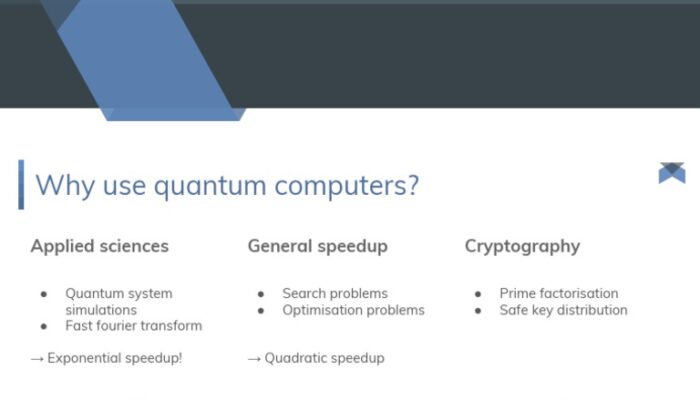
Quantum algorithms exploit quantum information properties to outperform classical counterparts in specific tasks. For instance, Shor’s algorithm efficiently factors large integers, threatening the security of classical cryptographic systems. Grover’s algorithm accelerates unstructured database searches quadratically, offering improvements in optimization and data retrieval.
Quantum Cryptography and Communication
Quantum information principles enable secure communication methods such as Quantum Key Distribution (QKD), which guarantees security based on the laws of physics rather than computational assumptions. Quantum teleportation allows the transfer of qubit states between distant locations using entanglement and classical communication, facilitating novel communication protocols without physically moving the quantum particles themselves.
Industry Impact and Future Prospects
Quantum information is driving transformative changes across various sectors, including finance, pharmaceuticals, and logistics. Quantum algorithms are being developed to tackle complex optimization problems, while quantum simulations promise breakthroughs in material science and drug discovery by accurately modeling quantum systems beyond classical capabilities.
Challenges in Quantum Information Processing
One of the primary obstacles in realizing practical quantum computing is decoherence-the loss of quantum coherence due to interactions between qubits and their environment. Decoherence disrupts superposition and entanglement, leading to computational errors. To mitigate this, quantum error correction techniques, such as the surface code, encode logical qubits into entangled networks of physical qubits, enhancing fault tolerance and preserving quantum information integrity.
Philosophical and Theoretical Implications
Quantum information theory not only advances technology but also provokes profound philosophical questions about the nature of information, reality, and measurement. Concepts like non-locality challenge classical notions of causality and objectivity, fueling ongoing debates about the interpretation of quantum mechanics. This field invites interdisciplinary inquiry, bridging physics, computer science, and philosophy to deepen our understanding of the universe.
Common Misconceptions About Quantum Information
Qubits are just faster classical bits.
Qubits exploit superposition and entanglement, enabling fundamentally different and more powerful computational processes than classical bits.
Quantum teleportation transports matter instantaneously.
Quantum teleportation transfers the state of a qubit, not physical particles, and requires classical communication, thus respecting causality.
Quantum computers can solve all problems instantly.
Quantum computers offer speedups for specific problems but are not universally faster for every computational task.
Significance of Quantum Information
The study of quantum information is crucial for the future of computing, communication, and security. By harnessing quantum phenomena, it promises to revolutionize how information is processed and transmitted, enabling capabilities unattainable by classical means. Beyond practical applications, it reshapes foundational concepts in science and philosophy, potentially redefining our understanding of knowledge, reality, and the physical world.
FAQ
What is a qubit?
A qubit is the fundamental unit of quantum information, capable of representing both 0 and 1 simultaneously due to superposition.
What is quantum entanglement?
Quantum entanglement is a phenomenon where qubits become interconnected, such that the state of one qubit instantly influences the state of another.
What are quantum gates?
Quantum gates are the building blocks of quantum circuits, manipulating qubits through unitary transformations.
What is quantum cryptography?
Quantum cryptography uses principles of quantum mechanics to create secure communication methods, such as Quantum Key Distribution.






Leave a Reply