
Short Answer
Definition of the Higgs Boson
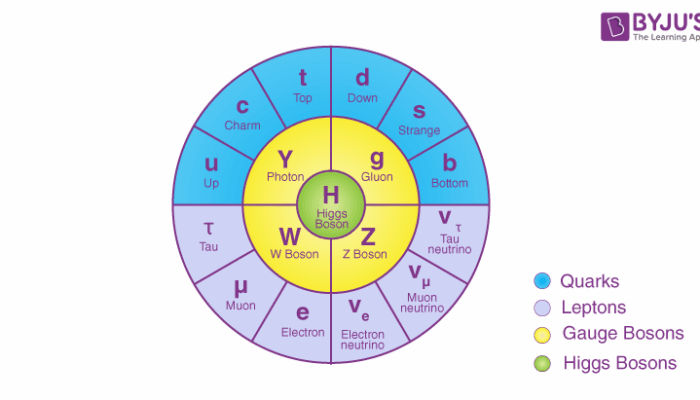
The Higgs boson, frequently referred to as the “God particle,” is a fundamental particle within the framework of the Standard Model of particle physics. This model describes the elementary particles and the fundamental forces that govern their interactions. The Higgs boson is intrinsically linked to the Higgs field, a universal field that permeates all space and time, playing a critical role in the origin of mass for elementary particles.
The Higgs Field and Mass Generation
The Higgs field can be envisioned as an omnipresent medium, somewhat like a cosmic syrup, through which particles move. As particles interact with this field, they gain mass, a process analogous to a swimmer experiencing resistance while moving through water. The degree of interaction varies among particles, determining their respective masses. This mechanism is essential for the formation of matter and the stability of the universe.
Theoretical Foundations and Historical Context
The concept of the Higgs mechanism was first introduced in the 1960s by physicist Peter Higgs and his colleagues. Their work revealed that without the Higgs field, particles would remain massless, fundamentally altering the structure of the universe. Without mass, atoms could not form complex structures, and the large-scale organization of stars and galaxies would be impossible. The eventual discovery of the Higgs boson in 2012 provided experimental confirmation of this theory, solidifying the Higgs field’s role in particle physics.
Discovery at the Large Hadron Collider
The Higgs boson was detected at the Large Hadron Collider (LHC) in Switzerland, a particle accelerator designed to collide protons at velocities approaching the speed of light. These collisions recreate conditions similar to those just after the Big Bang, allowing scientists to observe phenomena from the early universe. The detection of the Higgs boson offered a glimpse into the primordial transition of the Higgs field from a high-energy state to the stable state observed today.
Significance Beyond the Standard Model
Understanding the Higgs boson extends far beyond confirming the Standard Model. It provides insights into the fundamental properties of the universe and the forces that shape it. For example, the measured mass of the Higgs boson has implications for the stability of the universe’s vacuum state. A heavier or lighter Higgs could suggest different cosmic outcomes, including potential instability that might affect the universe’s long-term fate.
Implications for Advanced Theories and Cosmology
The study of the Higgs boson also opens avenues for exploring advanced theoretical frameworks such as supersymmetry, which posits that every known particle has a heavier “superpartner.” This theory could help explain dark matter and unify the fundamental forces under a comprehensive “theory of everything.” Observations of the Higgs boson’s behavior at high energies may reveal phenomena that challenge or extend the current Standard Model, prompting a reevaluation of particle physics.
Ongoing Research and Future Prospects
Research into the Higgs boson continues to evolve, with new data potentially leading to groundbreaking theories and discoveries. The particle’s elusive nature symbolizes the ongoing human quest for knowledge, where each breakthrough uncovers further mysteries. The interplay between experimental findings and theoretical innovation keeps the study of the Higgs boson at the forefront of scientific exploration.
Philosophical and Cultural Impact
Beyond its scientific importance, the Higgs boson resonates with philosophical inquiries about existence and the nature of reality. It exemplifies humanity’s relentless curiosity and the desire to understand the universe at its most fundamental level. The pursuit of knowledge about the Higgs boson bridges science and philosophy, enriching cultural narratives and inspiring deeper reflection on our place in the cosmos.
Public Engagement and Educational Influence
The fascination with the Higgs boson has also played a significant role in promoting public interest in science, education, and research funding. By effectively communicating complex scientific ideas, the story of the Higgs boson captivates imaginations and motivates future generations to pursue careers in science and technology, thereby contributing to the ongoing advancement of human knowledge.
Conclusion: The Higgs Boson’s Enduring Legacy
In summary, the Higgs boson is far more than a mere particle; it represents a profound convergence of scientific discovery, philosophical inquiry, and cosmic understanding. Its study is vital for unraveling the origins of mass, the stability of the universe, and the potential for new physics beyond current models. As investigations progress, the Higgs boson will continue to challenge and inspire our comprehension of reality, securing its place as a cornerstone of modern physics and a symbol of humanity’s intellectual ambition.
FAQ
What is the Higgs boson?
The Higgs boson is a fundamental particle associated with the Higgs field, which gives mass to other elementary particles.
Why is the Higgs boson important?
It is crucial for understanding mass generation in the universe and validates the Standard Model of particle physics.






Leave a Reply